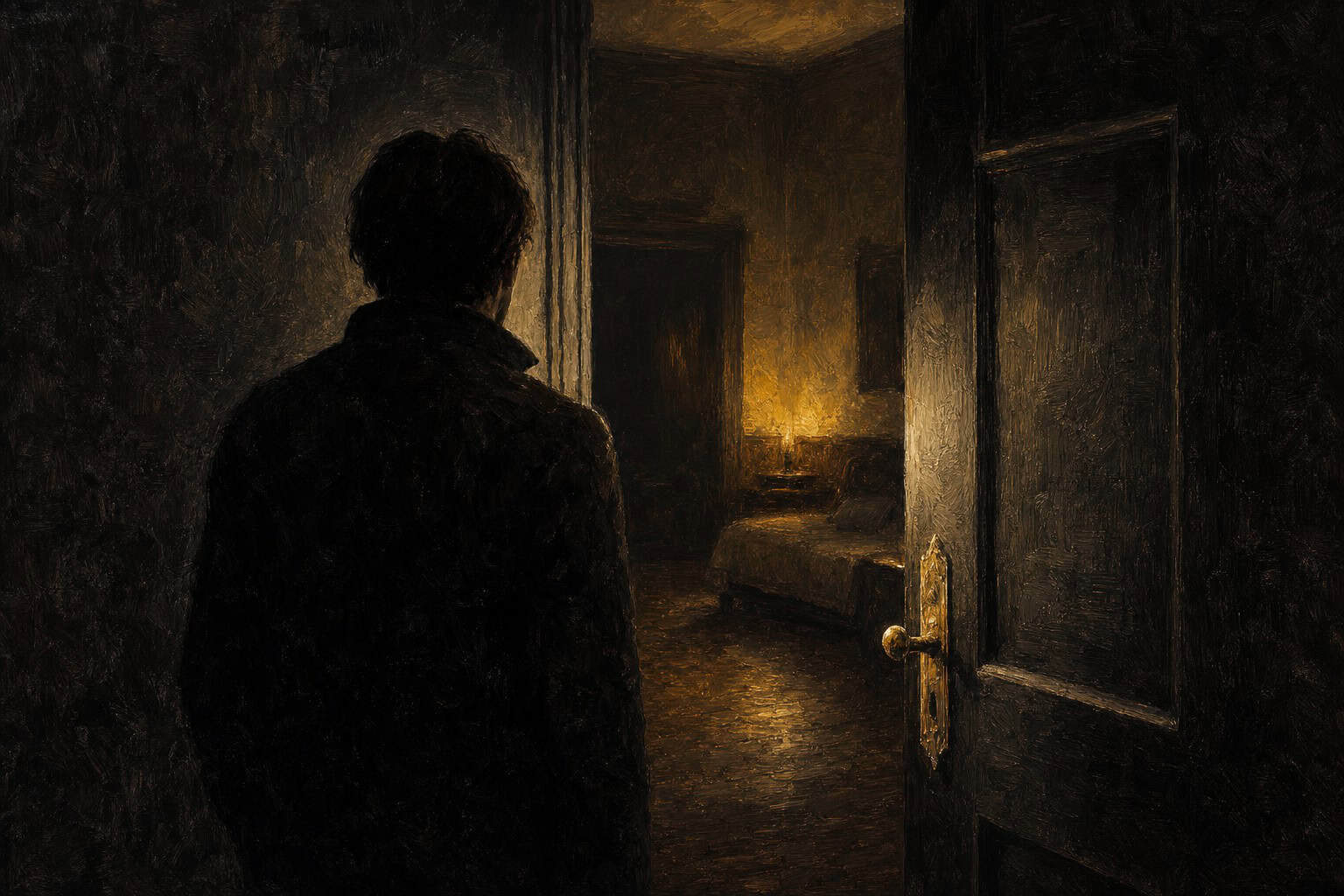
The body remembers betrayal in its muscles, holding itself one step behind where trust might begin.
You know this crouch before you name it—the way your shoulders pull slightly back when entering a room, how your eyes sweep the space for exits before faces, the subtle shift of weight that keeps you ready to pivot. Your body has learned what your mind still struggles to articulate: that safety is not given but continuously proven, measured in the narrow angles between what others show and what they conceal.
The Watching Post
Press your eye to the keyhole—that cold metal rim against your orbital bone, the restricted view that paradoxically feels safer than the open door. Or lean against the railing, its chill seeping through your shirt as you observe the party from above, counting the space others leave between themselves and you. The glowing screen becomes another such aperture, a luminous frame through which you can watch without being fully seen, where your written words receive responses your visible body has learned not to expect.
These are your watching posts, the familiar surfaces where your body returns to maintain its angle of defense. Not hiding exactly, but positioning—always positioning—so that when the impact comes (and the body knows it will come), you’ll see it approaching through your chosen narrow gap rather than taking it full in the face.
The Testing Blade
“What’s wrong?” you ask, but not from care alone. The question cuts precise as a scalpel, designed to reveal what shifts beneath their surface. You’ve established baselines—memorized their usual tone, their comfortable distance, the particular tilt of their head when relaxed. Now you deploy these sharp inquiries to grind down facades, to measure depth before trust.
All the while during the safe and mundane interactions, we are taking mental notes, collecting data points and breadcrumbs.
Your intellect becomes a clever guard, analyzing micro-expressions and word choices that pass through your instinctual awareness. A woman’s prolonged eye contact and grin from across the room—not a guess but a low-risk invitation you’ve learned to decode. The slight stiffening when you hold someone’s gaze a moment longer than social comfort allows, long enough for them to register your intent but not long enough to be aggressive. Each interaction becomes forensic, your mind that counts and measures and withholds, transforming even casual conversation into intelligence gathering.
The Rehearsed Distance
Your smile is polite, brittle—a thin sheet of glass over eyes perpetually counting the space others leave. From behind the walls guarding your spirit, you project invitation through carefully woven signals: the precise angle of a glance, the calculated openness of posture, words chosen not for truth but for effect.
Your body has learned what your mind still struggles to articulate: that safety is not given but continuously proven.
Physical intimacy becomes choreographed performance. Your body follows rehearsed habits of touch while your inner life withdraws, untouched and alone. Bodies distributed across calculated distances, managed through invisible formulas—multiple connections held like pieces on a board, ensuring no single departure can destroy. You’ve built a Codex to manage risk, a human system erected where trust failed, keeping public suspicion low while maintaining your angle of defense.
The split grows familiar: body performing its careful dance while soul remains sealed, offering only calculated fragments while the real self hovers inches behind the skin.
The Withheld Interior
Behind your forensic observation and rehearsed scripts, private mathematics run continuous calculations. Inner worlds tucked away where no sharp question can reach them, where no careful touch can disturb their volatile core. You tell yourself you cannot trust, should not trust—that loving Jeannètte led to this desolation, that the deep scar on your heart would poison any new relationship with bitter skepticism.
Silence becomes armor, thicker with each interaction that confirms your familiar story. You recognize this oppressive void—the presence in the room leeching warmth, hope, and peace, leaving you feeling intimidated, defeated. Your adversary appears sometimes as an ominous shadow in the dark, but always that distant coldness announces their presence, and you’ve learned to read these signals in others too, to spot the black eyes of common soldiers, the red eyes of warriors, the green eyes of heralds in the spiritual warfare you wage behind mundane encounters.
The Hardened Waiting
Your muscles never fully release. Even in sleep, some part remains braced for the impact that circles but never quite lands. This is not paranoia but embodied memory—your body remembering betrayals your mind tries to forget, holding itself in continuous strain.
Faith, full-hearted and half-sure, would be needed to step into the void of the unknown, to deal with the resulting consequences. But your body has learned a different catechism: “You shall have no other gods to rival me,” yet He never prevents the will and desire to the contrary. The divine presence becomes another silent witness that fully sees yet does not spare from suffering, shaping both your vigilance and a hard mercy toward others.
Relationships built on mutual existential fear, not faith, express themselves as an exaggerated codependent attachment between those involved.
You recognize this truth even as you perpetuate it, knowing your very systems of testing, distance, and control have become chains built from fear rather than peace.
The Familiar Crouch
The stance hardens into permanent architecture. One step behind others, close enough to move with them but far enough to keep your inner world protected. Sharp questions deployed like blades to test surfaces before any trust. Bodies and intimacies rationed through calculated distances. Every gesture of openness first passing through the testing machinery of a mind that counts, measures, withholds.
You can either risk being alone, surrounded within your own familiar existence in safety, or risk being wrong in your deductions and exposed. Both death and love either open up new possibilities to believe in something different or remind you to play it safe. The ocean crashes upon the shore—it never gives up—and you either collaborate with it or resist it.
But resistance has become your native tongue, your body’s first language. Even moments that could soften into connection become confirmations of the familiar story: that others will customize their temptations just for you, that legion circles on all sides, that even the sharpest blade has limits.
She did not flinch when you showed her the jagged impulse beneath your careful surface. She listened. Then, with quiet insight that slipped past your defenses, she took that raw edge and reframed it. For a moment, the crouch loosened, the watching post abandoned, the blade lowered.
But morning finds you at the keyhole again, eye pressed to cold metal, muscles braced for impacts that circle but never quite land, transforming even her moment of grace into another data point in your careful mathematics of distance—because this is what the body knows, what the body remembers, what the body cannot yet release: that safety must be continuously proven rather than simply received.