How space itself becomes sentient, harboring presences that precede and exceed our arrival
The Room That Remembers
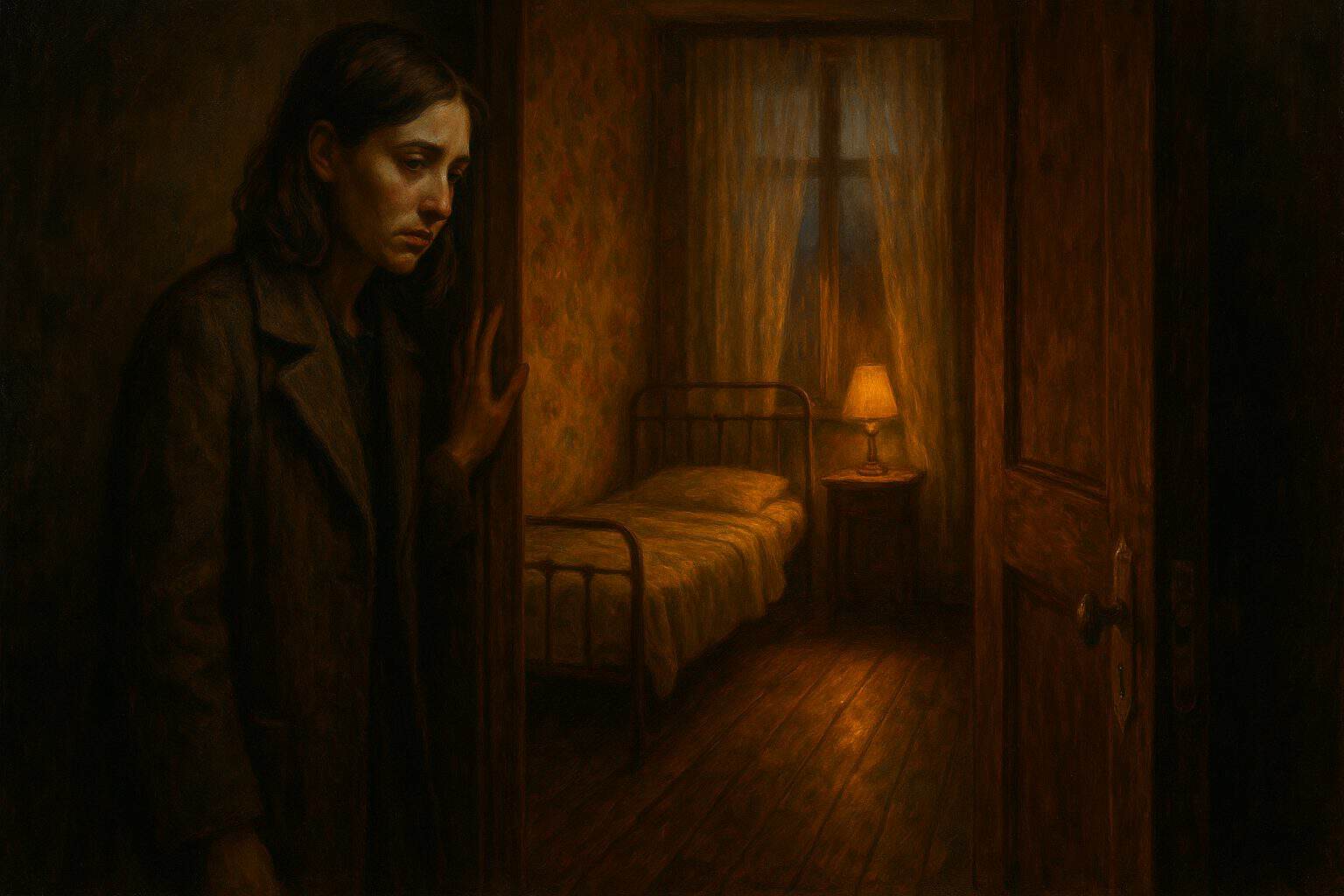
A friend describes returning to her childhood bedroom after years away. Nothing has been moved—the same faded wallpaper, the same narrow bed pushed against the wall, the same view of the neighbor’s fence through gauze curtains. Yet everything vibrates differently. The room knows she is no longer the girl who once lived here. It holds her absence like an accusation, or perhaps a question. She finds herself standing in the doorway, unable to fully enter, as if the space itself requires some password she has forgotten.
This is not mere nostalgia. The room genuinely resists her adult presence, maintains its loyalty to a child who no longer exists. Bachelard would recognize this immediately: spaces develop their own memory, their own fidelity to particular modes of inhabitation. They become tuned to specific frequencies of being, and when we return transformed, we encounter not emptiness but a kind of spatial judgment—the room measuring who we were against who we have become.
The Gradual Dissolving
Consider how two strangers approach each other at a gathering. Adoré captures this precisely: “the space separating them gradually shrinks with each step, transforming public space into social space, social space into personal space.” But notice—it is not simply that the distance decreases. The very quality of space undergoes metamorphosis.
What was initially mere extension—measurable, neutral, indifferent—begins to thicken with possibility. The air between two people who have just noticed each other carries different properties than the air between strangers who remain unaware. This is not metaphor but phenomenological fact: space itself becomes charged, magnetized, structured by mutual attention.
Watch how conversation creates its own invisible architecture. Two people talking at a party gradually construct walls of attention around themselves, walls that others instinctively respect. The space immediately surrounding their dialogue becomes denser, more resistant to intrusion. Others must raise their voices slightly to penetrate it, must excuse themselves more formally to interrupt. The conversing pair has transformed a portion of public space into something quasi-private through nothing more than sustained mutual address.
The Apartment’s Testimony
“Nate’s apartment: a first-floor unit with torn blinds… the unmistakable staleness of male inertia. The place smelled of cigarettes, beer, and testosterone.” Here Adoré reveals how spaces become soaked in the Stimmung of their inhabitants, how rooms absorb and then emanate the moods of those who dwell within them.
But this absorption is selective, discriminating. Spaces develop affinities for certain emotional registers while rejecting others. A room that has housed prolonged depression becomes almost allergic to sudden joy—watch how quickly laughter dies in such spaces, how even bright conversation takes on muted tones. The walls themselves seem to enforce an emotional grammar, permitting only those feelings that consonant with their accumulated history.
This is why certain rooms feel immediately welcoming while others repel us before we can even identify why. We are not simply projecting; we are encountering space that has been seasoned by particular forms of human presence, space that has learned to expect and therefore to invoke specific modes of being.
Sacred Space and Divine Silence
“I learned that His silence is multifaceted. Sometimes it is hard grace that forces us to seek; other times it is sacred space He provides.”
The chapel, the meditation room, the grove set aside for prayer—these spaces practice a peculiar form of hospitality. They do not fill themselves with presence but rather cultivate a quality of emptiness that makes presence possible. They are spaces that have learned to hold silence without making it oppressive, to maintain vacancy without becoming void.
Notice how differently silence behaves in a sacred space versus an abandoned building. Both may be equally quiet in terms of measurable decibels, yet the sacred space’s silence feels full, expectant, almost personified, while the abandoned building’s silence feels hollow, indifferent, dead. The sacred space has been trained through repeated use to hold a particular kind of attentiveness, to maintain readiness for encounter.
This is what Jager means when he speaks of vertical versus horizontal dimensions of lived space. The sacred space opens upward even when its ceiling is low; it creates height through the quality of its invitation. It makes room not just for bodies but for what exceeds bodies, for what cannot be contained in horizontal extension alone.
The Stalker in Empty Rooms
Adoré writes of “an oppressive void, a ‘presence in the room’ leeching warmth, hope, and peace from the individual, leaving them feeling intimidated, defeated.” This is space turned predatory, space that has somehow developed hostile intent.
We all know rooms like this—spaces that feel occupied even when empty, that seem to watch us with invisible eyes. The phenomenon is particularly acute in spaces that have witnessed trauma or sustained cruelty. It is as if the space itself has been wounded, has developed a kind of spatial PTSD that causes it to flinch at human approach or to emanate threat as a defensive measure.
But notice: this is not the same as a “bad vibe” or an “creepy feeling.” The haunted room presents itself with phenomenological specificity. There is often a particular corner that seems denser than the others, a specific zone where the temperature drops, a consistent direction from which the watching seems to emanate. The malevolence has structure, geography, almost personality.
The Architecture of Intimacy
“After interpreting and confirming signals from the blade, we delve into intimacy and we talk about guarded, secret, shameful, guilty, and ‘inappropriate’ things.” Here Adoré reveals how intimate space must be actively constructed, how it requires a kind of mutual labor to establish zones where the unspeakable can be spoken.
This construction is always fragile, always provisional. Watch two lovers in a restaurant, how they lean toward each other to create a pocket of private space within the public sphere. Their lowered voices, their angled bodies, their focused gazes all work to establish a temporary room within the larger room, a space where different laws apply, where normal social prohibitions are suspended.
Yet this intimate space remains vulnerable to collapse. A waiter’s approach, a loud laugh from another table, even a shift in lighting can cause it to suddenly evaporate, leaving the couple exposed, embarrassed, as if caught in some transgression. They must then rebuild, reconstruct the walls of their provisional privacy through renewed attention, through the patient work of mutual focusing.
The Split Chamber
“She can be intimate with her body with one man, and be intimate with her mind and heart with another.” This describes not just divided affection but divided space—the creation of separate chambers within the self, each attuned to different others, each operating according to different laws of approach and withdrawal.
Consider how we unconsciously map our relationships onto space. This friend belongs to coffee shops and afternoon light; that one to bars and evening shadow. This lover knows our bedroom; that one knows our mind. We create elaborate geographies of intimacy, careful to keep certain territories distinct, knowing that to allow them to overlap would be to risk a kind of spatial contamination.
“We began in the public space together… and the more time we spend together… the closer we are to the intimate destination of my design.”
But sometimes these carefully maintained boundaries dissolve. “The space between us dissolved…exploring beyond the boundaries we had previously held.” In such moments, we discover that the walls we thought were solid were merely habitual, that space is far more fluid than we imagined, capable of sudden reconfigurations that leave us disoriented, exhilarated, terrified.
The Community of Minds
“The BBS fostered a diverse community… creating an intellectually and socially stimulating environment ripe for the exchange of new ideas.” Here is space without physical extension, yet space nonetheless—virtual rooms where minds meet without bodies, where presence is established through text alone.
These digital spaces develop their own forms of haunting. Old forums retain the ghosts of departed members, their archived posts creating a kind of permanent presence-in-absence. Chat rooms remember conversations that occurred years ago, the logs creating temporal palimpsests where past and present overlay. Even after the servers are shut down, participants carry internal maps of these non-physical spaces, can still navigate them in memory, still feel the particular quality of presence each fostered.
The Loneliness of Adam
“Adam’s loneliness was pure, without evil, and that it was something woven into the human soul by God.” This primordial loneliness is not simply the absence of others but a positive space, a clearing that makes otherness possible. It is the first room, the original architecture of human consciousness—a space that knows itself to be incomplete, that experiences its own boundaries as question rather than definition.
This Adamic space persists in us. In our deepest solitude, we encounter not just the absence of others but the presence of a fundamental openness, a structural incompletion that no amount of company can fully address. It is the space that makes us capable of relationship precisely because it can never be entirely filled, the permanent guest room in consciousness that ensures we remain perpetually hospitable to otherness.
The Adversarial Presence
“Your adversary will sometimes appear as an ominous shadow in the dark… but a distant coldness will always announce their presence.” This coldness is not metaphorical—it is a genuine alteration in the thermal properties of lived space. The approach of enmity changes the temperature of rooms, makes the air harder to breathe, causes space itself to become viscous, resistant.
Watch how a room changes when someone enters who wishes you ill. Even before you consciously recognize them, even before your mind processes their presence, your body knows. The space between you and them becomes charged with different electricity than the space between you and others. It is as if invisible force fields emanate from both of you, creating zones of repulsion, corridors of danger, geometries of threat that everyone in the room unconsciously navigates.
The Room We Carry
Perhaps most mysteriously, we each carry internal spaces that operate according to their own laws. The room of memory where dead loved ones still move and speak. The room of fantasy where impossible encounters occur. The room of prayer where we are simultaneously most alone and least alone. These internal architectures are no less real for being invisible, no less spatial for being immaterial.
Sometimes external and internal spaces align in uncanny ways. We enter a physical room that perfectly matches some internal chamber we didn’t know we carried. We recognize it without having seen it before, know exactly where the shadows will fall, how the light will move across the floor as the day progresses. It is as if we have been rehearsing for this room our entire lives, carrying its blueprint in some deep recess of bodily memory.
The Poetics of Threshold
All space, finally, is threshold space—zones of potential crossing, membranes between states of being. Even the most solid-seeming room is actually a collection of doorways: between public and private, between self and other, between past and present, between the human and what exceeds the human.
This is why spaces can become haunted: they remember all the crossings that have occurred within them, all the transformations they have witnessed. They become archives of transition, museums of metamorphosis. And when we enter them, we enter not just a configuration of walls and air but a history of passages, a accumulated wisdom about what it means to move from one state of being to another.
The haunted room, then, is simply the room that has become too full of crossings, too rich with accumulated presence. It is space that has absorbed more than it can hold, that leaks the excess as uncanny presence, as the sense of being watched, as the feeling that we are never quite alone even in our solitude. It reminds us that all space is ultimately sacred space—set apart, charged with more than we can fully comprehend, harboring mysteries that exceed our capacity to rationalize or explain.
In the end, we are all guests in spaces that precede and will outlast us, temporary inhabitants of rooms that remember every previous dweller, that will remember us too when we are gone. The poetics of the haunted room is finally the poetics of our own transience, our own status as passing presences in spaces that endure, accumulating meaning like sediment, growing denser with significance with each crossing, each encounter, each transformation they witness and enable.