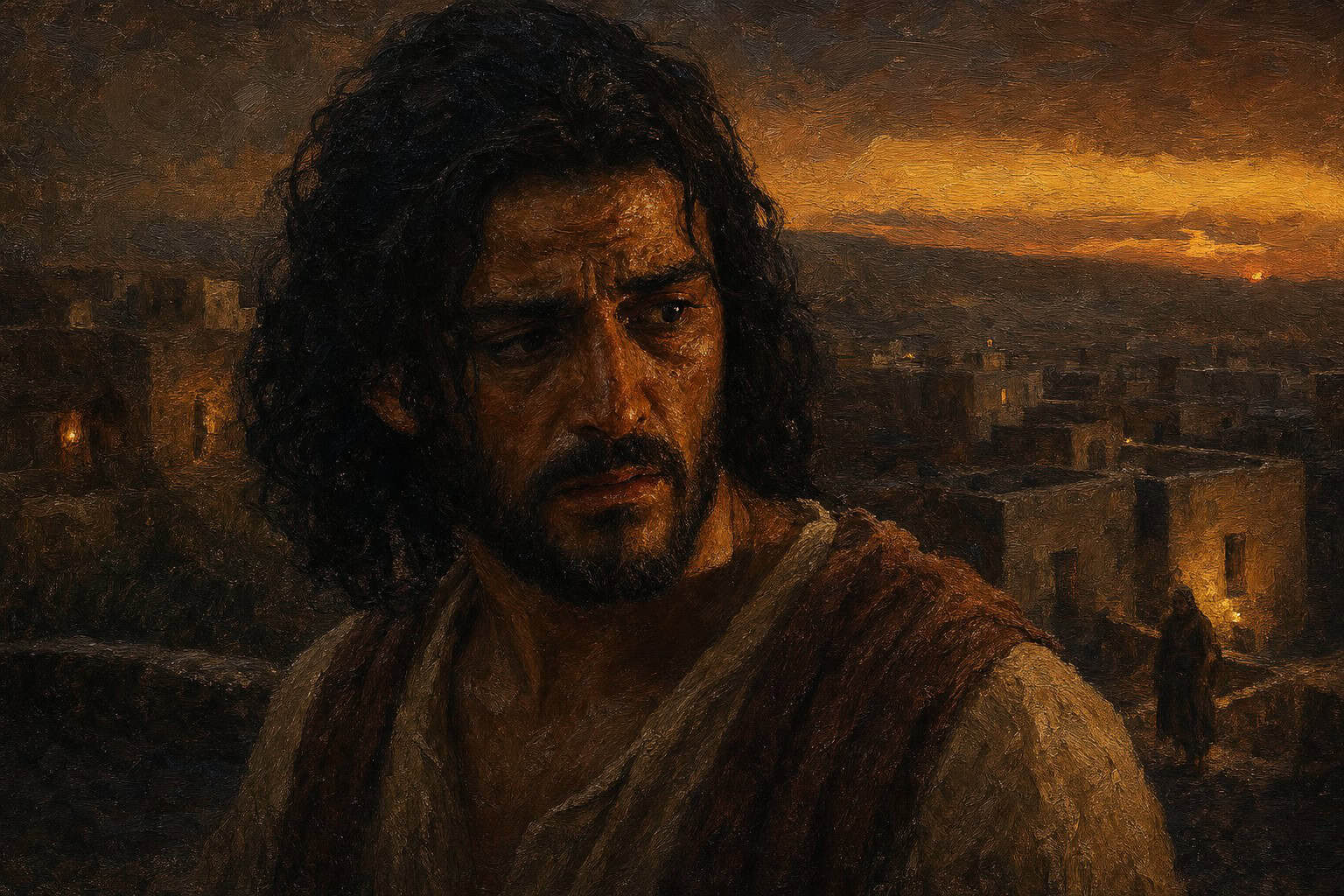
Looking for the truth about surrender? Read how one man’s fight to give up control became the real war beneath his desire and grief.
A King’s Idle Walk Above the Water
You typed the word surrender into the search bar because your hands are tired of closing. Maybe you have knelt a hundred mornings and tried to hand something over to God, and every time your fingers curl back around it before you stand. In Chapter 4 of Confessions to the Empty Chair, Anthony Adoré stands inside that same clenched fist, and he does not pretend to have opened it. He is turning over an old evening in his mind: a king out for a slow walk along a high roof, the light going soft, and far below him a woman bathing in the last of it. Nothing forced that king to look. No hand pushed him toward the ruin that followed. The whole disaster began with a single glance that could have slid past and did not, and Adoré holds that glance up to the light like a coin because he sees his own face stamped into the metal. He knows the exact temperature of the lingering eye. He knows how a man builds a small private theater behind his eyes, where soft flesh becomes a stage, where a woman’s imagined submission and his own imagined potency play out in a script he wrote and directs. That is the ground this scene plants under your feet. It is a man half-asking whether his own desires even belong to him, or whether something older and colder whispered them into his blood. He remembers wondering if God once shut certain doors early in his life, blocking worse falls before he could take them, and he feels a strange resentment about it, a boyish grief over pleasures he never got the chance to lose. Here surrender does not float down as peace. It arrives as a wrestling match he cannot win and cannot walk away from. The memory is quiet, almost ordinary, just a man walking and a man looking, and yet everything violent in the human heart is already coiled inside that stillness. You feel the heat of the imagined body, the swell of the ego, the hunger that swears it will fill a man and only scoops him hollow. And slowly you understand that the question you carried in here is larger than you guessed. Surrender is not simply quitting a bad habit. It is a fight over what your eyes are permitted to worship. Adoré meets you at the exact place where the reaching outruns the thing reached for, where the wanting swells bigger than any woman could ever be, and he will not shrink the fight to make you comfortable. He knows the ache by its real name, and he refuses to lie about how far the road runs.
The First Altar Raised in the Dark
The tension in this chapter tightens because Adoré refuses to let surrender stay a soft greeting-card word. He digs beneath the skin of desire and finds worship crouched underneath it. The old story draws a hard line for him: the sin was never merely the body. It was the heart turning, quietly, toward a rival altar. He watches the king’s eyes lead first to a scheme, then to a man’s death, and he watches the king’s famous son later raise temples with his own hands to please the foreign women he loved, until the Lord grows angry, not over the sheer number of bodies but over a face turned away. That distinction is the whole engine of the chapter. Heaven is not counting women. Heaven is grieving a divided heart. Adoré presses this against himself with a severity that will make you wince, because he knows his own imagination has raised altars no one else could ever see. This is where your search collides with its real answer. If you are fighting visual temptation and sensing your battle runs deeper than purity, this is why. What you let your eyes feast upon becomes the thing you serve. The lustful image is not the end of the matter. It is the first stone of a wider falling-away, the opening move in a slow drift of the heart away from its one true home. Beneath all this, Adoré is living something even harder to bear. His faith has become a country of abandonment. He begs to be pulled out and receives instead a long, slow, bleeding walk. God does not lift him above the fight. God pins him inside it. He senses his companion beside him only as an absence, a warmth that ought to be there and simply is not, a space at his side shaped exactly like a presence that has stepped away. The frustrating hand that once blocked his worst falls now feels less like mercy and more like a draft notice. He is conscripted every single morning into a war he never enlisted for, and surrender starts to look less like laying down his weapons and more like agreeing, one more day, to keep standing in the line. Shame threads through all of it, the specific shame of being seen and found wanting, the animal wish to cover yourself and vanish from your own gaze. He sees his own hunger with unbearable clarity and hates that it is so visible, that anyone looking could read it on him. Yet he keeps writing. He keeps naming the altars one by one. And the dread building in your chest is the terrible suspicion that surrender will cost him not the pleasure but the throne, the quiet rule he keeps over his own starving heart, the last thing on earth any man wants to hand across.
The Cold Look That Turns a Man to Stone
The turn comes when the fight stops being about God and becomes about another person’s freedom, and Adoré discovers he cannot bend it with any tool he owns. He has been trying to win a woman’s love the way a lawyer wins a difficult case, stacking his years of devotion, the sheer length of his faithfulness, his airtight and impeccable reasons, as though love were a verdict that evidence could compel. He calculates. He builds his argument until it should force a yes out of her. And it does nothing at all. Her freedom does not answer to logic, because a living will cannot be reasoned into loving you, no matter how flawless the case. This is the moment his entire strategy caves in. He meets a cold, indifferent gaze, and under that look something inside him hardens and stops. All his heat and hope, his living passion, is stripped of its motion and left standing like a figure carved from stone. He becomes an object in her eyes, a thing observed once and then set aside, and the humiliation of it goes all the way down. He had imagined her as a single unified soul, one true face he might finally reach. Now that face splinters into many faces, a bewildering crowd of roles, and the whole person he thought he loved dissolves into someone he never actually knew. The polished image he built of her breaks like a mask dropped on flagstone. And right here the surrender he has hunted his whole life finally shows him its real price. He cannot surrender to God while his fists are still locked around this. He cannot release the war in his heart while clutching a person he tried to conquer by force. The two hungers, he begins to see, were always one hunger, the same reach for something to worship, the same eyes feeding the same imagination, the same altar built in the same darkness.
Surrender is not the moment you stop fighting God; it is the moment you stop worshiping what your eyes have already chosen.
That is the blade that runs the length of the whole chapter. He learns, in the cruelest possible way, that you cannot coerce a soul into loving you and you cannot argue your way into being kept. The knowing arrives in his body before his mind will admit a word of it. His flesh registers the finality of the death between them, a cold settling weight low in the gut, while his thoughts are still busy constructing their defenses. He knows it in the stomach first. Only much later does the reasoning mind catch up, fall quiet, and stop building. This is the true face of the surrender he searched for. It is not the peace he wanted. It is the death of the calculating self that believed devotion could purchase a heart, and the raw terror of standing empty-handed before both the woman he could not keep and the God he could not compel.
Surrender is not the moment you stop fighting God; it is the moment you stop worshiping what your eyes have already chosen.
The Rage That Glues a Cracking Man Together
What follows is the fallout, and it is not clean or tidy. When a man is turned to stone by rejection and stripped of his standing, the self begins to come apart at the seams, and something rises up from inside to hold the pieces in place. In Adoré’s case that something is anger, a dark and defensive rage that works exactly like glue smeared across the cracks. He describes it plainly enough that you will recognize your own reflex in it: the comforting heat that keeps you from dissolving completely, the wrath that feels almost like strength because at least it belongs to you. This anger is not righteous and he never once pretends it is. It is a shadow rising in him, a protective paste that keeps the fractured pieces from scattering across the floor. Yet he watches himself lean his whole weight on it with a grim, unsparing honesty. He knows it is a crutch. He knows it is a poison he keeps drinking because it makes him feel alive. The power of this chapter lives precisely in that refusal to glance away from his own worst instinct. Meanwhile his inner world splits open into separate voices. His grief grows so loud that his mind divides into distinct speakers who argue and console and accuse one another, because the closeness he was denied out in the world has to be manufactured somewhere within. He sets an empty chair down inside his own soul and talks toward it, playing every role himself, staging the intimacy that life has stripped from him. This is where the erasure creeps in, the slow disappearance of a man who was not enough to be kept, thinning out under a gaze that no longer registers him at all. He feels himself going translucent, becoming a ghost haunting his own story, and the anger is partly a raw shout against that fading, a way to insist through gritted teeth that he is still here, still solid, still real. The walk of grief has become a dark pilgrimage. He is on a road going nowhere he ever wanted to go, and the companion he aches for is felt only as an absence shaped like a body beside him. But even here, down in the wreckage, something is being taught to him against his will. The false surrender, the one that was really control wearing a humble coat, is being burned off him. What remains is a man who can no longer pretend his devotion was ever pure, who can no longer wield his years or his logic as a weapon, who has run clean out of things to bargain with. That emptiness is almost unbearable to look at. It is also, though he cannot see it yet from where he stands, the first honest ground his feet have touched in the whole book.
Empty Hands With Nothing Left to Trade
By the end of this movement, Adoré is not repaired and not comforted, and that is exactly why you can trust his voice. He has stopped begging to be lifted off the battlefield. He is starting to grasp that survival was never going to come from his own strength, his clever arguments, or the anger that held his pieces together for a stretch. It comes, if it comes at all, from being carried down a road he would never have chosen for himself. The surrender you searched for turns out to be this: not a peaceful handing-over but a slow unclenching, one finger at a time, of everything he thought made him worthy of being loved. He learns that the deepest war was never against a woman, and never even against desire itself. It was against his own hunger to sit on the throne of his own life, to be the one who decides what gets worshiped. The king’s eyes led to murder. The king’s son’s hands led to idols. And Adoré’s whole heart, he finally admits out loud, has been quietly building altars in the dark to things that could never carry the weight of a soul. The chapter hands you no technique for letting go at last. It gives you something harder and far truer: a man who tried every trick, drained every argument, drank the poison of his own rage, split his mind into voices just to keep breathing, and still came up empty-handed before the God he could not compel and the person he could not keep. If you arrived here worn out from trying to surrender, you will find no cheap relief in these pages. You will find a companion instead. You will find someone who knows the exact ache of reaching for a wholeness you can name and cannot yet hold, and who will not lie about how long that road stretches. Confessions to the Empty Chair does not promise the fight ends tomorrow. It promises that the emptiness at the floor of your surrender is not the end of you. It is the place where the calculating, worshiping, grasping self finally runs clean out of moves, and something older and quieter can begin to speak in the hush that follows. Read the chapter and you will understand your own clenched hands better than you did an hour ago. You will see why letting go feels like dying, and why it may be the only way anything living in you gets to breathe. The last altar to fall is always the one your own hands built.