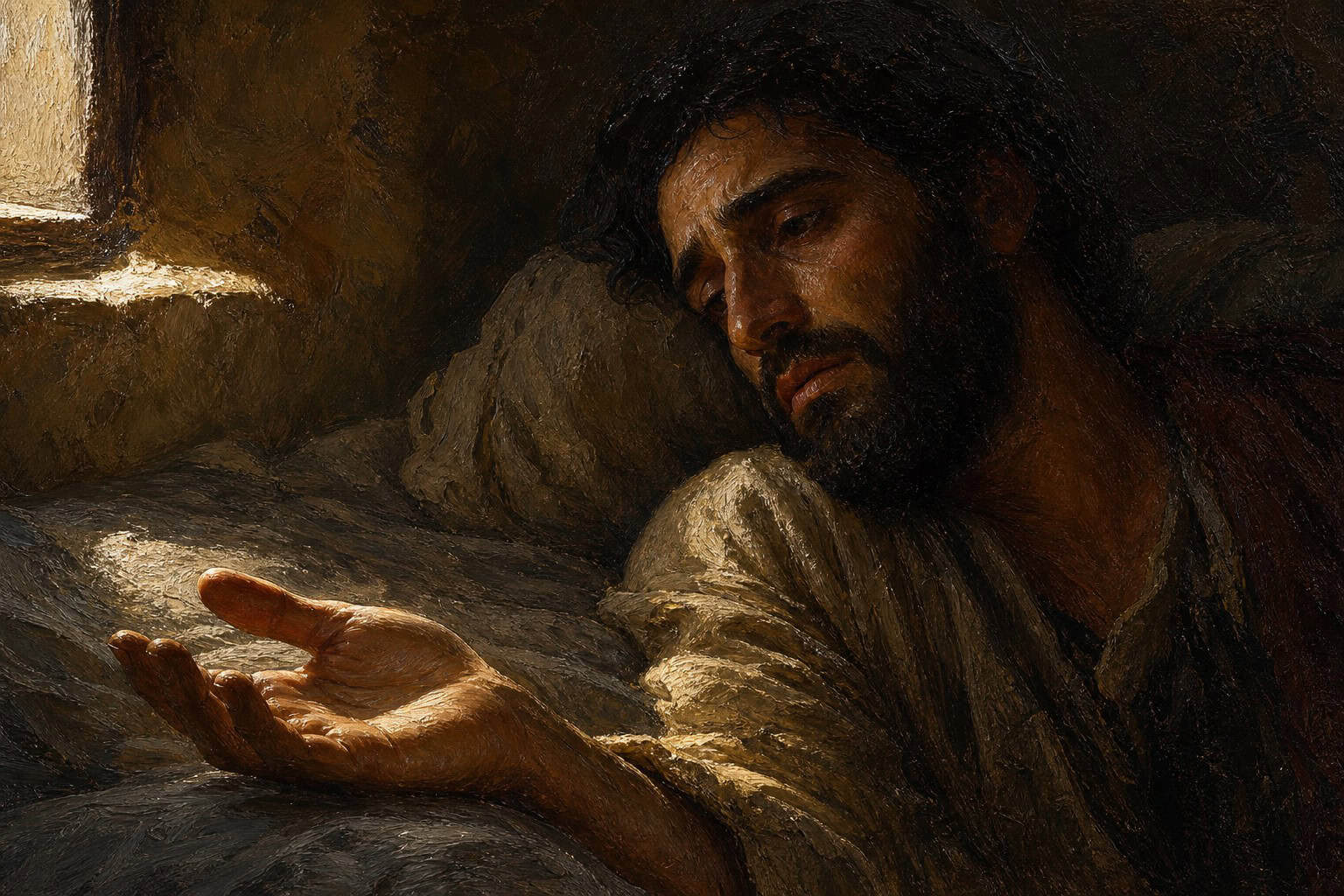
You receive what you surrender—why the thing you clutch hardest slips through your fingers, and how loss teaches what love could not.
The Closed Hand at Two in the Morning
You wake at two in the morning with your fists already shut. Somewhere in sleep your hands closed around something you were afraid to lose, and now you lie there in the dark clenching air, your knuckles pale, your nails printing small crescents into your own palms. This is how it begins for most of us—not with a grand refusal, but with the small, animal grip that tightens in the night while the rest of the house sleeps. You want to hold the person you love. You want to hold the version of yourself you were when they still wanted you, the face you wore in old photographs, the ease you cannot get back into your shoulders now. You want to hold the future you had already furnished in your head: the shared bed, the children’s names half-chosen, the ordinary Tuesdays you were certain were coming, the way you would grow old at the same table. And so you grip. Your jaw tightens until your back teeth ache. Your chest goes hard as a fist inside a fist. You believe, without ever once saying it out loud, that if you clench hard enough, nothing can be taken from you, that vigilance itself is a kind of keeping. But notice, in the gray dark, what the closed hand actually cannot do. It cannot receive. It cannot be filled. It cannot even feel the warmth of another hand laid gently over it, because it is too busy defending the small dark hollow it thinks it is protecting. You have spent whole years like this—guarding a love, a plan, a picture of yourself—and calling that guarding devotion. You told yourself the tightness in your body was proof of how much you cared. You told yourself the sleeplessness, the watching, the counting, meant you loved harder than they ever did. But a strength that cannot open is not strength; it is a cramp. It is a muscle locked so long it has forgotten how to release. And the cruel joke of it, the one you feel in your teeth when you finally admit it, is this: the harder you gripped, the faster it drained away. Sand does that. Water does that in a cupped palm. Love does that, and does it worst of all. The thing you clutched most fiercely is precisely the thing that slid out between your fingers while you slept, grain by grain, without a sound. You wake with empty fists and cannot quite remember what you thought you were keeping. Your hands ache from the holding, a real physical soreness. And into that ache, before any comfort arrives, comes the first honest question of your grief: what did you ever actually keep by grasping? Name one thing. You lie there and you cannot. The answer will not come, and its refusal is the beginning of your education.
The Ledger You Never Meant to Open
By morning the accounting starts, and you did not ask for it. It arrives uninvited, the way a bill slides under the door—an itemized list of everything you did and everything you left undone, written in a hand you recognize as your own. You lie in the wreckage of what you trusted, sheets tangled, light coming gray and flat through the blinds, and suddenly the mind that never once, in all its comfort, thought to examine its own foundations is forced to read the whole ledger aloud. Here is the striking thing about a broken heart: it is a harsh teacher, but it teaches what nothing gentler ever could. When your life was intact you never tested the beams that held the roof up. You assumed the floor beneath your feet. You assumed you were loved, that your plans were solid, that your version of the story was the true and only one. Comfort makes lazy readers of us all. It is only in the collapse—when the trusted thing gives way and you drop through it—that you are made to face the contradictions you built your ordinary days upon. So the ledger opens, page by unwanted page. You see, with a clarity that scalds, how much of your loving was really needing, how much of your holding was really fear of the empty room. You see how you called your grip devotion and your control a kind of care. You see the small moments you refused to look at directly, the warnings you translated into flattery, the plain signs you painted over because you preferred the picture you had already made. The accounting does not flatter you. It shows you your own part—not to grind you into the floor, though it feels exactly like grinding, but because you were never going to look at any of this while things stayed pleasant. Only through the wreckage do you find out what was always false. This is the terrible mercy of ruin: it will not let you keep your illusions, not one of them. Every story you told to protect yourself gets dragged into the light and weighed and found short. You wanted to be the one who was wronged, cleanly, purely, the innocent party—and the ledger will grant you your genuine wounds, yes, it does not deny them, but it sets beside them your own withholdings, your own coldness, the doors you shut hard and then called self-respect. To read this honestly is nearly unbearable, and you will want to slam the book closed and go back to sleep. But something in you already knows that a wound left unexamined only rots quietly behind a wall, and that the very wall you built to keep the pain out is the wall that now keeps you from seeing anything at all. You cannot look past what you built. So you keep reading, line by line, in the cold morning, learning the true price of everything you once believed you owned free and clear.
The Millstone You Mistook for a Medal
Then comes the turn, and it turns on you. You discover that somewhere in the long aftermath you began to wear your rejection like a medal—no, heavier and stranger than a medal, like a millstone you knotted around your own neck with your own two hands and then forgot you tied. At some point you stopped merely suffering the loss and started becoming it. Being unwanted hardened into an identity, set like plaster. You catch yourself introducing it, silently, before you introduce anything else about who you are: I am the one who was not chosen, the one found insufficient. You turn the dismissal over and over in the dark like a stone gone smooth from too much handling, and you begin, God help you, to draw a low and secret pride from how much of its weight you can carry. Look how I endure, you tell yourself. Look how faithfully I bear this thing. You mistake your capacity for pain for strength. But here is the sentence that breaks the spell, the one you will underline and come back to when the light is bad. What you grip to keep is already leaving; what you open your hands and give is the only thing that stays with you. The millstone was never proof of your depth or your loyalty. It was the last and most cunning form of your grasping—clutching the wound itself because at least the wound was yours, at least it would never leave you the way the person did. You held onto being insufficient because being insufficient still felt like being something rather than nothing. And so you fed it. You rehearsed the injury before sleep like a prayer said backward. You built the walls higher and higher and told yourself the height was safety, when really it was only a smaller and smaller cell with better and better locks, and you the sole prisoner and the sole warden. This is the revelation waiting at the very bottom of the fall: the strength you were so proud of was cowardice wearing a strong man’s coat. True strength would be to set down what was never yours to carry in the first place—to loosen the fingers, open the hand, and let the dead future finally, fully be dead. To grieve it, yes, completely, the way you would grieve real children who had died, phantoms in the ashes of a life you imagined and were simply not given. But grieving is not the same act as clutching. You can mourn what is gone without strapping it to your back as armor. You can release the story that says you are nothing but the sum of who did not want you. The millstone comes off the same way it went on, by your own hands, and the sheer terror of that freedom is exactly why you have resisted it for so long.
What you grip to keep is already leaving; what you open your hands and give is the only thing that stays with you.
Emptied Hands and the Short Road Home
What follows the turn is not relief but a strange, sober quiet. Your hands are open now, and they are empty, and the emptiness does not feel like a victory won—it feels like standing at the edge of your own smallness and seeing, for the first time clearly, how short the road actually is. Because underneath every grief of this kind lives a truth we work very hard, every day, to forget: you are going to die. The love you clutched, the plans you defended, the self you labored to preserve—all of it was always finite, always on loan, always sliding toward its ending whether or not a single person ever left you. The breakup only made visible, early and violently, what mortality makes true of every single thing you touch. You will lose all of it eventually, all of it. The people you hold, you hold for a while and then not at all. And this is the one thing no one can do for you, no one can carry in your place—the letting go, the ending, the standing alone at the last limit of your own life, where no companion follows. When you truly take hold of the fact that your days are counted, the whole frantic economy of grasping starts to look almost absurd. Why clench so hard around what cannot be kept by anyone? Why raise walls to defend a future that the grave was always going to collect anyway? In the emptied hands there is grief, real grief, but there is also, unexpectedly, a clarity that cuts through everything false. You start to hold things differently—not with the closed fist of an owner, but with the open palm of a guest who knows he is only passing through this house, not holding the deed to it. And in this new poverty something arrives that all the grasping had made impossible. Presence. You had believed that in your devastation God had gone entirely silent, that heaven had emptied itself out and left you alone in the cold while it sheltered, warm and untroubled, the very people who wounded you. That silence was real; let no one cheapen it or explain it away. But sitting there with your open, aching, empty hands, you begin to notice you were not, after all, entirely alone in the dark. There was a companionship inside the tears themselves—not a rescue that hauls you up into daylight, not a hand yanking you out of the pit, but Someone quietly there in the pit beside you, sitting on the same cold floor, walking with you inside your very failure and your very sin, present in each fresh collapse of the heart. The nearness was the gift, not the removal of the pain. And you understand, dimly at first, that you could only receive that nearness at all because your hands had finally come open. A closed fist can hold no one’s company, not even His.
What the Open Palm Was Always For
So here is where it settles, in the plainest terms your bruised heart can still bear to hear. You receive what you surrender. Not as a slogan stitched onto a pillow—you have no patience left for slogans, they curdle in your mouth—but as a hard law you had to be broken against before you could believe a word of it. The love you tried to keep by gripping, you lost by gripping. The self you tried to preserve by walling it off, you shrank and starved behind the wall until there was almost nothing left to save. The pain you clutched as your identity became the very thing that kept you from ever being wanted again, because a person walking around with a millstone cannot embrace anyone; both hands are full of stone. Everything you refused to release, you lost anyway, and lost worse for the refusing, the loss compounded by the clinging. And everything real that ever did come to you—every unearned mercy, every hour of genuine peace, every companionship that somehow survived the dark—arrived only into hands that had come open. This is not fair, and it is not tidy, and it does not make the loss ache any less. What was slaughtered stays slaughtered; the future that was cut down does not grow back from the stump. You are allowed to grieve it as long as you must, years if it takes years. But grieving with an open hand is a wholly different life than clutching with a closed one. In the open hand there is room for what has not yet come. In the open hand there is room, even, for God to lay His quiet company against your palm in the middle of the night. You spent years convinced that holding on was faithfulness and letting go was betrayal, and it was exactly the reverse the whole time: the letting go was the only fidelity, and the holding on was a slow theft you committed against your own soul, night after night. If you want to sit inside this reckoning honestly—the plain accounting of what you did and failed to do, the strange finding of nearness in the very dark you were sure was empty, the hard grace that refuses to resolve your suffering with easy comfort and chooses instead to walk beside it—then go and sit with Confessions to the Empty Chair. It does not promise you the pain will lift on schedule. It promises only that you will not be alone in it. And it will not lie to you about the true cost of the closed fist. Tonight, though, before any book at all, try one small thing. Unclench. Lay your fists open on the sheet in the dark and let them rest. Feel the ache drain slowly out of your fingers. Notice that nothing you were keeping was ever really in there. And notice, in that sudden strange lightness, how much your open hands can finally hold.