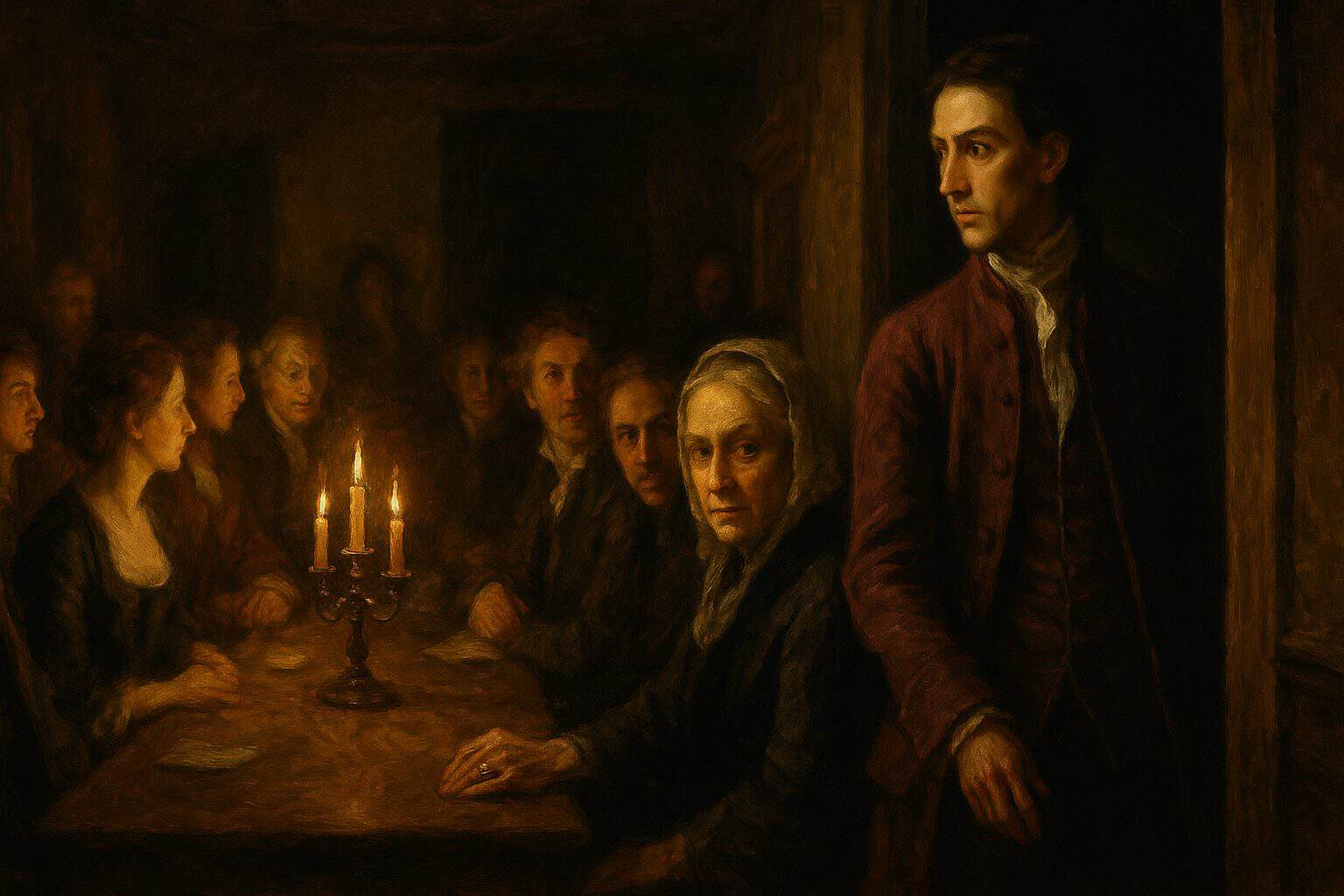
Where the invisible strings that move us reveal themselves through their very pulling
The phenomenon begins in the simplest of exchanges. You enter a room where conversation already flows, and before any word passes your lips, you have been read. Not analyzed, not evaluated—read, the way light reads a surface or water reads the shape of its container. In that instant, as Anthony Adoré discovered in his own moments of social arrival, “I was being read, not writing. I was being chosen, not choosing.” The mechanics of influence operate before consciousness catches up, in that primordial space where bodies orient themselves to other bodies, where hierarchies assert themselves through gesture rather than declaration.
The Grammar of the Unspoken
Watch how it happens. A slight shift in posture when certain people enter the room. The almost imperceptible pause in conversation that creates space for one voice while closing it for another. The way eyes track toward authority like flowers toward sun, not through decision but through something more fundamental—what Chase Hughes might call our ancestral scripts, those behavioral patterns written into our nervous systems long before we learned to speak.
Adoré witnessed this grammar operating in his own social navigation: “Exclusion occurred not through overt declarations but through practiced gestures—an instinctive reassertion of an unnamed hierarchy.” The mechanics reveal themselves precisely in their subtlety. No one declares the rules; they simply operate, the way gravity operates, creating fields of permission and prohibition that we move through like fish through varying densities of water.
The woman who enters the boardroom and finds her suggestions requiring twice the energy to land. The newcomer at the party who feels the invisible membrane between themselves and the inner circle. The student who knows, without being told, which desk carries more weight in the classroom’s unspoken architecture. These are not paranoid projections but accurate readings of an influence field as real as electromagnetic radiation, though detected through different instruments—the instruments of lived flesh, social nerve endings, the body’s ancient wisdom about power and position.
The Technology of Frames
Every interaction occurs within what practitioners of influence call a “frame”—though the phenomenon precedes its naming. You feel it when someone shifts the entire emotional temperature of a room simply by how they hold themselves. Adoré knew this intuitively when he wrote, “Silence became my first strategy. I let my pen speak for me until my courage learned the language of the room.” The frame determines what can be said, what can be felt, what possibilities exist within any given moment.
Consider the doctor who enters the examination room. Before any medical knowledge is exchanged, a frame is established through white coat, clipboard, controlled movements. The patient’s body responds to this frame before the mind processes it—becoming more compliant, more revealing, more willing to submit to uncomfortable procedures. This is not manipulation but structure, the way a riverbank structures water’s flow without the water choosing to be structured.
“To complement my ego, I required full conscious consent rooted in genuine desire.”
Yet Adoré’s insight cuts deeper—true influence operates not through force but through the creation of contexts where others discover their own desire to move in certain directions. The salesman who makes you feel like buying was your idea. The leader who has others volunteering for difficult tasks. The teacher whose students study not from obligation but from suddenly awakened curiosity. The frame creates the possibility; the person experiences it as their own choosing.
The Paradox of Conscious Influence
Here emerges a peculiar doubling of consciousness. Once you begin to see the mechanics, you cannot unsee them. Adoré describes this awakening: “I forged Fractions in the kiln of observation, searching for a language—a codex—sturdy enough to navigate the treacherous landscape between man and woman.” The one who observes influence patterns becomes simultaneously operator and operated upon, subject and object of these invisible forces.
You notice yourself automatically deferring to certain voice tones. You catch your body mirroring the posture of someone you unconsciously assess as higher status. You watch your own attention being captured by specific gestures, by calculated pauses, by the strategic deployment of vulnerability. The awareness doesn’t free you from the mechanics—anymore than knowing about gravity frees you from its pull—but it does create a strange distance, a gap where choice might enter.
This is what Hughes calls “behavioral operations,” though the phenomenon extends beyond any tactical application. It’s the recognition that we are always already operating within fields of influence, that pure autonomy is a philosophical fiction, that we exist as nodes in networks of mutual modification. Every conversation is a dance of frames, a negotiation of realities, a subtle war of worlds where victory often goes to whoever can establish the terms of engagement.
The Architecture of Permission
The mechanics reveal themselves most clearly in the structure of permission—what becomes possible or impossible within any given interpersonal field. Adoré learned this through painful experience: “I threaded honesty through jokes and prayed no one tugged the stitch and unraveled me completely.” The joke creates permission for truth that direct statement would not allow. The casual aside opens doors that formal address would find locked.
Watch a master of influence at work. They don’t push against resistance; they dissolve it by changing the field conditions. The hostile negotiator who begins by finding unexpected common ground. The therapist who creates such safety that secrets pour forth unbidden. The teacher who establishes a classroom where intellectual risk becomes thrilling rather than threatening. They understand that influence operates not through confrontation but through the patient cultivation of contexts.
This is why crude attempts at manipulation so often fail. The person who transparently deploys “techniques” creates resistance precisely through their visibility. But the one who genuinely shifts the frame, who creates new fields of permission through their very being, finds others moving with them as naturally as iron filings align with a magnet. The influence is real precisely because it doesn’t feel like influence—it feels like freedom, like possibility, like one’s own authentic choice.
The Feminine Register
Adoré observed with particular acuity how influence operates differently across masculine and feminine registers: “I learned that, for the most part, women communicate interest through action, not direct declaration.” The feminine mode of influence often works through indirection, through plausible deniability, through signals that can be withdrawn if not received. This is not weakness but sophistication—a technology refined through millennia of navigating power from positions of formal powerlessness.
“Intellect cannot purify instinct; it can only guide it and make its expression civil.”
The woman who influences through selective attention, granting and withdrawing the warmth of her gaze. The one who shapes reality through subtle emotional calibrations that others experience as atmospheric changes rather than directed influence. Adoré recognized this as “a wolf in sheep’s clothing: a strategy embedding the feminine in the middle of the masculine camp”—though perhaps better understood not as deception but as adaptation, the development of influence technologies suited to different positions within power’s geography.
The masculine mode typically operates through more overt dominance displays, through direct claims to authority, through the occupation of space both physical and conversational. Yet the most sophisticated practitioners of either mode learn to incorporate elements of the other—the executive who leads through strategic vulnerability, the mother who commands through unshakeable presence.
The Burden of Seeing
With recognition comes responsibility. Once you see the strings, you cannot pretend they don’t exist. Adoré felt this weight: “how can I expect them to reach complete strangers through a book?” The one who understands influence mechanics faces an ethical precipice. Every interaction becomes a choice: to operate consciously within these fields or to pretend ignorance, to use this knowledge for manipulation or for genuine service, to reveal the mechanics to others or to preserve the innocence of their unawareness.
The phenomenon presents itself as morally neutral—like electricity or fire, influence mechanics simply are, part of the fundamental structure of human relating. Yet their application carries profound ethical weight. The therapist who uses these understandings to create healing. The teacher who employs them to kindle learning. The predator who exploits them for domination. The same mechanics, radically different outcomes.
The Return to Innocence
Yet perhaps the deepest insight lies not in mastery but in a kind of learned innocence. Adoré ultimately discovered that the most profound influence comes not from technical manipulation but from genuine presence: “I bequeath the tools I forged: the practice of patient observation; the discipline of honest analysis and deduction; the courage to face darkness.” The one who has seen through the mechanics might choose to operate not from calculation but from a deeper authenticity, using understanding not to manipulate but to navigate more truthfully.
This is the paradox of conscious influence: the more you understand its mechanics, the more you might choose to abandon mechanical operation altogether. Not from ignorance but from a wisdom that recognizes the poverty of purely tactical relating. The master of influence might ultimately influence most powerfully by dropping all masks, all techniques, all strategies—meeting the other in that raw space where genuine encounter becomes possible.
The mechanics continue to operate—we remain embodied beings subject to frames and fields, to ancestral scripts and social architectures. But within these constraints, something else becomes possible: the choice to use our understanding not for advantage but for connection, not for dominance but for mutual liberation, not for closing possibilities but for opening them.
The strings remain visible. We see them pulling ourselves and others. But perhaps wisdom lies not in becoming master puppeteers but in learning to dance with the strings, to move within influence fields with grace rather than manipulation, with awareness rather than exploitation. The mechanics of influence, finally understood, might become not tools of control but instruments of freedom—freedom not from influence but freedom within it, the freedom of conscious participation in the endless dance of mutual becoming.