The power of being silent isn’t withdrawal—it’s a way of knowing another. A reflection on distance, desire, and the risk of reaching across it.
The Woman Laughing Across a Loud Room
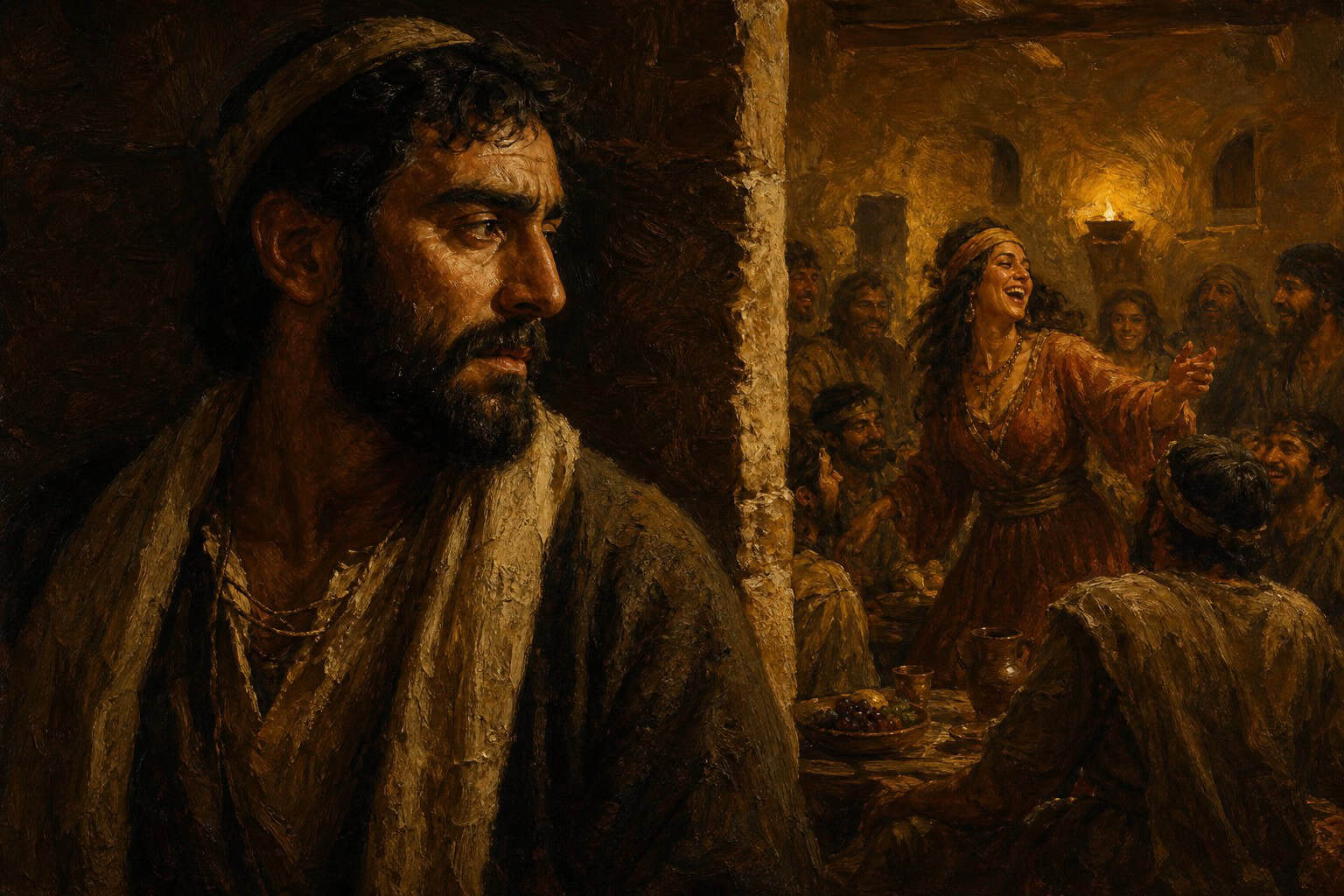
Years ago I stood at the edge of a crowded room and watched a woman I loved laugh at something a stranger said. I could not hear the joke. I could only see her head tip back, her hand rise to touch her own throat, the shine of her mouth as it opened. Bodies moved between us. Glasses clinked. A song I did not know pressed the voices down into a warm blur, and out of that blur I kept only her. From that distance I was not silent by virtue. I was silent because I could not cross the floor. My feet stayed planted on the same square of carpet while my whole chest leaned toward her, and the leaning went nowhere. Silence, I would learn much later, is never one thing. There is the silence of a man who has nothing to say, and there is the silence of a man who has too much to say and no way to arrange it into words that would not shame him. I was the second man. My mouth stayed shut and my mind went to work, and the work my mind did was cruel. I read betrayal into the tilt of her chin. I assigned meaning to the stranger’s easy grin. I built whole afternoons she had never lived, complete with rooms and hours and a tenderness she had given to someone who was not me. This is the quiet I want to talk about, because a person types a question about the power of being silent and imagines a monk’s calm, a still pond, a strength held in reserve like a coin. But there is a silence that is power and a silence that is a hiding place, and from the outside they look identical. In Fractions of the Soul the sixth chapter opens a strange door onto exactly this. It speaks of two tuning forks, one struck and one left alone, and how the untouched one begins to hum only when the two are set near each other. Move them apart and the humming dies. That small fact undid me. I had spent my life believing the safest place to know someone was from across the room, where I could study without being studied, read without being read. My silence felt like discernment. It was surveillance. It was the pose of a man who wants the fruit of nearness without paying its price. And the woman across that loud room was not a text I was decoding. She was a person, alive, laughing, entirely herself, and my quiet was doing something to her whether I said a word or not. Silence is never neutral. It arrives in the other’s life as a fact, a coldness, a withholding they can feel across any distance.
The Held Breath Before the Word Arrives
Watch what the body does in that kind of silence. Before speech there is a tightening. The chest draws in on itself. The shoulders climb. The breath halts at the top of the lungs and waits for a certainty that never comes. I know this because my own body kept the record long after my mind had lied to me about it. My silence in that room was not peace. It was a held breath, a swallow that would not go down, a heat rising into the face that no one else could see. It was the animal caution of a man who dreads being wrong out loud more than he dreads being alone forever. The chapter names something cruel and exact: the closer we stand to another soul, the more accurately we can read them, and the farther we stand, the more we guess. Distance and truth run against each other like two weights on a beam—raise one and the other drops. From across that floor I could invent anything I pleased, and I did. Proximity would have corrected me. Her real voice, close enough to hear, would have burned my inventions to ash. But proximity would also have exposed me, and exposure is the one thing the silent watcher cannot bear. So I stayed put. I let the guessing run like a fever. And here is where the silence stopped being wise and started being a sin against her, because my quiet distance did not protect me from suspicion. It manufactured it. I authored the very betrayal I feared, wrote it into her gestures, and then read it back as if she had written it herself. The jealousy that soaked those minutes was not information about her. It was the shadow my own refusal cast on the wall. A thoughtful reader might object: sometimes silence is love, sometimes it is patience, sometimes it is the tact that leaves another room to speak first. Yes. All true. I do not want to flatten it. There is a silence a wise woman keeps that is fuller than any speech, a silence that holds a whole marriage together while the man fumbles for words he cannot find. I have been on the receiving end of that mercy and did not deserve it. But I am confessing my own kind here, and mine was not mercy. Mine was a wall I called a window. The body knew the difference before I did. The tightness in the chest, the shallow breath, the jaw that would not unclench—these were not medical curiosities to be waved away. They were the exact shape of a relation I refused to enter honestly, forcing itself up into my flesh because I would not let it out through my mouth. When speech fails, the body speaks in its place. It always keeps the truer diary, and it never once lies.
The Untouched Fork Begins to Hum
Then, sometimes, the miracle. Rarely—I want to be honest about how rarely—the silence breaks, and not because I gathered the courage to break it, but because grace crossed the floor for me while I stood there stalled. I remember a later evening, quieter than the first, when I finally stood close enough to hear her actual voice and not the voice I had assigned her. The difference was physical before it was anything else. My body, which had been reading her from a distance like a specimen pinned under glass, suddenly could not hold her at that remove. The warmth of her came off her skin. Her real words, plainer and stranger than mine, landed in my ear and scattered the story I had built. Nearness undoes the pose. Up close you cannot study a person as an object on a table; they become a presence your own flesh answers before your mind has decided anything, a heat your skin registers, a rhythm your breath falls into without permission. I understood then what the tuning forks had been trying to teach me all along. My silence at a distance had never been strength. It had been the exact opposite—the refusal to be struck, the horror of being made to hum in answer to another life. And the terrible measure held true: only by coming close, only by letting the distance collapse, could I know her truly, and knowing her truly meant I could no longer keep myself intact and separate and safe. This is the wound at the center of every real love. To be understood is to be undone. To understand is to risk being wrong out loud, to grasp for another soul and come back with the wrong reading in your hands, exposed in your own incorrectness. The silent man protects himself from that exposure and calls it dignity. It is cowardice wearing dignity’s coat. What God showed me in that closeness was not a rescue out of my fear. He did not lift the trembling from my hands. He stood in it with me while it trembled, quiet, close, saying nothing I could turn into a lesson. That is the thing I keep returning to and cannot explain away with a tidy moral. The grace was not the removal of the risk. The grace was a companionship inside it, a presence so near it hummed in me the way the untouched fork hums, faint at first and then unmistakable. Silence is not the absence of reaching; it is the longest reach of all, and it always risks coming back empty. I had used quiet to reach for control. I was being asked to use nearness to reach for communion, which offers no control at all—only the chance of being known, and the equal chance of being missed entirely.
Silence is not the absence of reaching; it is the longest reach of all, and it always risks coming back empty.
What the Guessing Cost Us Both
The fallout is not clean, and I will not pretend it into a shape it never had. When I finally crossed the room and heard her real words, they did not always match my invented ones—and sometimes, God help me, they were kinder than what I had authored, and the kindness accused me worse than any betrayal ever could. I had spent hours convicting her of things she had never done. I had loved a phantom I built from fragments—a tilt of the head, a laugh I could not hear—and I had starved the living woman of the one thing she wanted, which was my nearness without my judgment riding in on its back. Here I have to hold two readings at once and refuse to choose between them too fast. There is a way of reading desire that says a man watches to guard what he believes is his, that the jealous gaze is old and animal and strategic, a sentinel posted against the fear of loss. There is truth in that layer, and I will not deny it in myself. But a layer is not a person. She was not a strategy playing itself out in a body. She was another consciousness lived entirely from the inside, with her own reasons, her own tenderness, her own private ache I never once thought to ask about because I was too busy decoding her from the safety of my corner. And she—I have to say this carefully—she may have kept her own silences too, and hers may have been the wiser kind, the patient waiting for a man to stop watching and finally meet her. I do not want to make her a mirror for my failure or a screen for my guilt. She was more than what I projected onto her. What I know for certain is that my distance produced a poverty in both of us. I never fed my own narrow horizon with hers, because I would not risk the misreading that reaching required. And she lived beside a man whose quiet she could feel as cold, who studied her the way you study weather you fear, never the way you learn a beloved’s particular grammar of joy. The body of another is not read like a book across a table. You always come to it from outside, through the whole world that stands between you, through time and space and every fear you carry into the space. That distance can never be fully closed. But it can be crossed, again and again, and the crossing itself is the whole of love. I refused the crossing and called it prudence. The cost was not paid by me alone. It is never paid by one alone.
Learning the Grammar of One Face
So where does the power of being silent finally sit? Not where I first placed it. The strength is not in the withholding. A man can go quiet for a lifetime and call it depth when it is only a locked door with a frightened animal pacing behind it, exerting no effort, expanding into nothing, hardening at last into the exact shape of his own narrow view. That is the silence I have to keep confessing, because it is the one I fall back into whenever I am afraid, and I am afraid often. But there is another silence I am still learning, slowly and badly, and it is the opposite of a hiding place. It is the quiet of a man who has come close enough to hear, who has learned over time to read one particular face—the specific dialect of a single beloved’s suffering and her delight, the meaning that only her features spell and no one else’s on the earth. That literacy is not abstract, and it cannot be bought cheaply. You do not get it from across a room. You get it up close, over years, by risking the wrong reading a thousand times and letting yourself be corrected each time, letting your own body be struck so that it can finally hum. That silence has power because it is full, not empty—full of a knowing purchased by proximity and exposure, full of a nearness that has stopped defending itself against being known. I do not have it yet. I turn the question on myself and it does not soften: how much of my life did I spend watching the people I loved instead of standing beside them, mistaking my caution for wisdom, my distance for discernment, my fear for a virtue? What did I refuse to see because seeing would have required me to be seen in return? Fractions of the Soul does not answer these questions and hand you a clean resolution to tuck away. It sits inside them—in the trembling, in the dark—where I have found that God does not always lift the fear but keeps company with it, near as breath, faint as an untouched fork beginning to answer a note it never chose. If you came here searching for the power of silence, I cannot give you the calm you imagined when you typed the words. I can only tell you that the silence worth having is not the one that keeps you safe behind glass. It is the one that comes after you have crossed the room, spoken, been wrong, been forgiven, and at last learned to sit close and quiet beside someone whose whole face you have finally learned, line by line, to read.