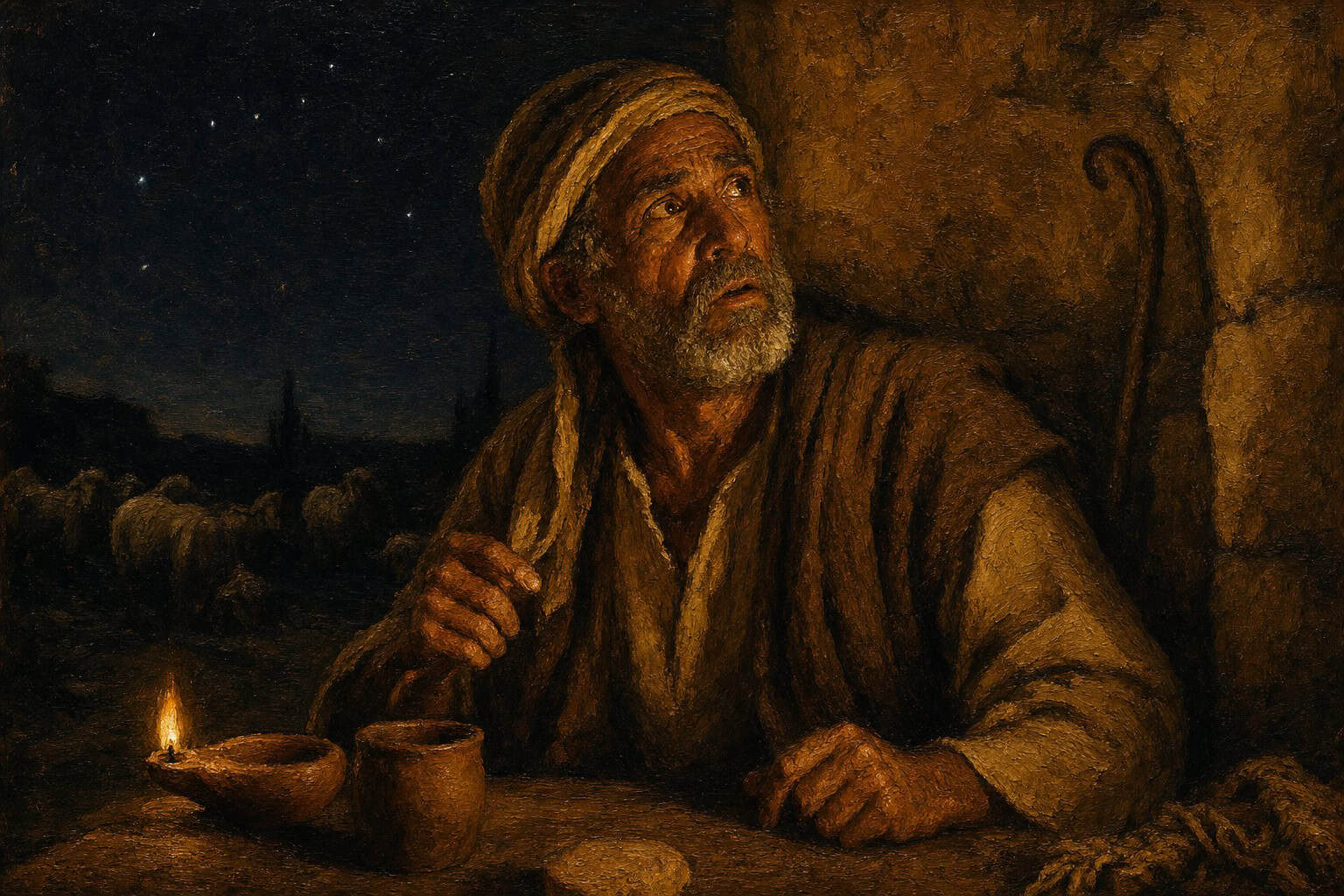
Want to be less quiet? A reflection on why silence feels safe, and how the ache to speak reveals who you already are.
The Breadcrumbs You Drop Without Meaning To
You want to be louder, and you have decided your quietness is a wall you cannot climb. I know that decision from the inside, because I made it for most of my life and called it a personality. In the opening pages of Fractions of the Soul there is a strange and patient idea, and it undid something in me the first time I sat with it: that a person is read not by what they announce but by the small traces they leave in a room. The crumbs dropped in ordinary talk. The way others lean toward you or away. The passage reaches for astronomers watching a black hole to say it plainly. No telescope sees the thing itself. They see only how the light around it bends, how nearby stars are pulled off their true paths, how something with mass at the center warps everything it cannot show. That is you, more than you believe. Even at your quietest, you are bending the room. The friend who softens her voice when she reaches you. The coworker who chooses his words twice before he speaks to you. The child who checks your face for permission before he laughs. These are your light, curving around a mass you keep hidden. You think silence covers you. It does not. It only changes the reading. Here is the first thing I could not see when I was young and mute with fear: I believed my quietness meant I was absent, that until I opened my mouth I did not count, that I stood in the room like a coat on a hook. But the observer of human nature does not wait for you to confess. He gathers the crumbs. He watches the give and take, the reciprocity, the thousand tiny nuances that pass between you and the people you love and the people who have wounded you. And from those small motions he deduces the mass at your center. You are not empty. You are dense. That density is exactly why speaking feels so heavy—there is so much pressing behind it, backed up against your teeth. The trouble was never that I had nothing to say. The trouble was that I mistook the pressure for proof that it should stay in. I want to sit with you inside that mistake before we rush toward any fix, because the fix is not what you think it is. Less quiet is not louder. Less quiet is more honest about a self that was never actually hidden, only mistranslated by everyone who could not read the curved light around a boy who would not talk, and could not see the weight that made it bend.
The Ghosts Who Crowd Every Conversation
There is a reason your throat tightens when the words should come easy. You are never speaking to one person. The book turns here on a hard truth about how we are made: the newborn does not choose his social world. He is thrown into it, handed to a waiting circle of caregivers and parents and half-strangers before he can refuse any of them. Your very individuality, the passage says, is a gift of other people’s sociality—you were spoken into being before you could speak. Your first word was learned inside a crowd. And so every conversation you enter now is crowded too. When you finally open your mouth to a new friend, you are not addressing her alone. You are addressing the mother who talked over you, the teacher who laughed at the wrong sentence, the table that went cold the last time you tried to be honest. They all come with you. They stand behind your tongue and take up the air. This is the séance no one warns you about—every meeting fills with the ghosts of everyone who ever welcomed or wounded you, and they set the choreography of your silence long before your will gets a vote. I did not understand this for years. I thought my quietness was cowardice, a private failing I could scold myself out of if I only tried harder. But it was memory, doing what memory does. My present mood kept summoning old shadows to confirm itself. When I felt small at a party, my mind reached back and handed me every proof that I had always been small, that speaking had always cost more than it returned. Sadness keeps an excellent archive and lies with all of it. It opens only the files that agree with the hour. So I stayed quiet, not because the moment in front of me demanded it, but because a sediment had settled in me—a whole habitual mood, laid down by repeated roles, through which I met every new face as if it were an old accuser come back for more. Here is the harder question I put to myself now, and I cannot answer it cleanly. How much of my silence was protection, and how much was refusal dressed as protection? Because to stay quiet is also to stay safe, and safety has its own gravity, pulling you back toward the familiar ache because at least the familiar is mapped. The anxiety of speaking freely, of not knowing how you will be received, is a real weight to carry. And I chose, again and again, the predictable suffering over the open risk. I told myself I was being humble. I was being afraid. The ghosts did not clamp my mouth. They only made the closing feel like fate, and I let it.
What You Guard Is What You Are
The turn came when I noticed what made me angry. There is a thread running under these early pages that I have never stopped feeling in my own chest: the things we guard most fiercely, with fury or with tears, are the very things that map our deepest tenderness. The defense is not the wall around the treasure. The defense is the sign pointing straight at it, planted in the ground where the treasure is buried. When I refused to talk about a certain thing, when a single question made me cold and clipped and hungry to leave the table, I told myself I was protecting my privacy. I was announcing my wound. The stronger my resistance, the more surely I was standing over the exact spot I could not bear to have seen. And this changes everything about being less quiet. You have been trying to become talkative, as if the goal were volume, more words shoveled into more air. That is not it. The observer never learns you from your fluent speech. He learns you from where the fluency breaks. He watches for the sentence you will not finish, the name you skip, the subject you steer around with such practiced ease that the steering becomes the confession. My silences were never blanks. They were shapes with edges, and each edge traced something true and unhealed. What I would not say told a clearer story than anything I managed to say. When I finally saw this—that my hiding was itself a language, and that everyone fluent in love could read it—I understood I had never been the mystery I imagined myself to be. I was legible. Terrifyingly legible. The people who loved me had been reading the curve of my silences for years, and they knew, better than I did, where I was bleeding.
We are never known by what we manage to say, but by the shape of the space we bend around ourselves when we say nothing at all.
After the Confession, the Bare Floor
So I began to speak, and it did not feel like freedom. That is the part no one tells you. When you finally say the guarded thing out loud, the first sensation is not relief but exposure—like standing on a bare wooden floor after the furniture has been carried out, nothing left to duck behind, the acoustics suddenly cruel and bouncing your voice back at you. I had imagined that being less quiet would make me lighter, as if words were ballast I could throw over the side. Instead it made me visible, and visibility has its own particular ache. The people around me responded, and their responses became new crumbs, new data I could not manage or take back. Some leaned in and stayed. Some, I could feel, adjusted their orbit, recalculated the mass at my center now that I had shown a little more of it. This is the cost the book refuses to pretend away: your social dimension has a life of its own, and once you speak, the meaning you make is no longer only yours to keep. It lives in the in-between, between you and the other, and you cannot govern what grows there. I grieved this, honestly. Part of me wanted the old quiet back, the clean illusion of a self kept private and unread. But the old quiet had been a lie, and you cannot un-know a lie once you have named it. What settled in, slowly, was stranger than relief. It was the plain recognition that I could not go back to being the man I was before I spoke. There was no returning to the sealed self. A small emptiness opened between the one who had guarded the thread and the one who had let it slip loose, and I had to live in that gap with no bridge across it. The future pressed against me differently now. Conversations I had dreaded became merely difficult instead of impossible. The ghosts still came into the room, but they no longer wrote the whole script; I could interrupt them, sometimes, with one honest sentence they had not approved. And the past began to reread itself in the new light. Memories I had filed under shame turned into something closer to grief—which is a great deal nearer to love than shame ever was. I will not tell you it healed. It did not heal. But the accompaniment was real. On that bare floor, in that exposed room, I was not alone in the way I had most feared. God was there too, I think now—not lifting the fear away, He rarely did that for me, but sitting inside the very silence I was too ashamed to open, near enough to touch, reading me the tender way the loved are read. He was not waiting for me to become eloquent. He was already there in the trembling, and openness, even clumsy, even half-strangled, turned out to be a kind of prayer.
Learning to Bend the Light on Purpose
You will not talk your way out of who you are. That is where this leaves me, and where I would leave you, gently. The longing that drives you to want to be less quiet is not really a hunger for words. It is a hunger to be met—for the mass at your center to be seen by someone who does not flinch and does not leave, for the light you bend to be read as beauty and not merely as damage. And here is the ache the book keeps circling and never fully soothes: that longing outruns everything it reaches for. Even when you finally speak, even when you are heard clean through, something in you strains past the moment toward a wholeness you can name but cannot hold in your hands. I used to think perfect words would close that gap—that if I could only say it all, exactly, in the right order, I would arrive somewhere and rest. I never arrived. There is always more mass than any confession can carry, always a singularity at the core that no telescope, no friend, no lover, no page will ever fully see. This used to feel like defeat, a locked place no honesty could reach. Now it feels almost like a promise held out in the dark. Because the reach that outruns its object is not a flaw in the design of you. It is a compass, and it swings. It points past every human room toward the only Reader who sees the singularity itself and not merely the light bent around it. To be less quiet, in the end, is to stop treating your silence as a fortress and start treating it as a language you are learning to speak on purpose—choosing which threads to offer, which ghosts to name aloud, which fear to walk straight into instead of around. It is slow work. It costs you the illusion of hiding. It sets you on a floor with no furniture and no cover. But you were always visible; you only refused to believe it. Fractions of the Soul opens right here, in this exact ache, watching a person read himself in the curve he makes across other people’s lives, refusing the cheap comfort of the sealed self. If you have felt the pressure of the unsaid pushing at your teeth, if you have mistaken the density inside you for a reason to stay shut, the first chapter will not hand you a trick for becoming loud. It will hand you something better and harder: the sight of your own quiet, read back to you as the most eloquent thing you own—and the first flicker of courage to bend the light on purpose, toward the ones with the steadiness to see.