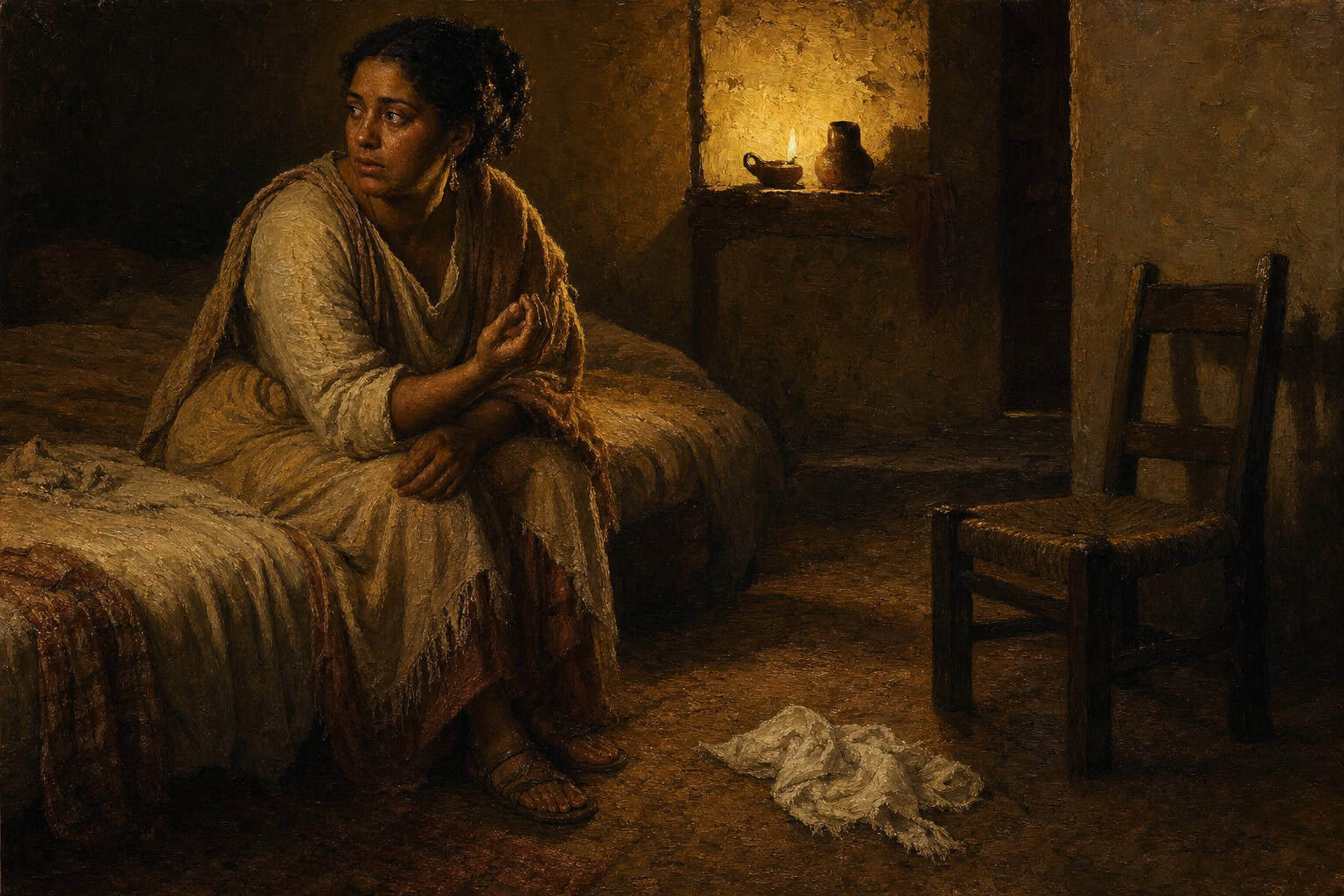
The crimes of love: what happens when you learn you were her second choice, her placeholder, the man she needed only to reach another.
Beer On Her Breath, Another Man’s Words In Her Mouth
Were you loved, or were you kept warm? I will not soften the question for you, because you did not soften it for yourself once it finally arrived. I remember the night it came disguised as her voice. She returned late again, and by then you had stopped asking where she went; the asking had worn smooth, like a coin rubbed featureless. The quiet still held the shape of her absence when she pushed inside, and the smell of beer reached you before her body did. She sat on the edge of the bed. The mattress dipped under her. She did not look at you when she spoke. She said she did not think she was pretty. She said she did not think she was attractive as a woman, and the words came slurred, dragged sideways by the drink. You heard a wound and you moved to dress it. You leaned toward her the way a man leans over a fallen thing, hands already open to lift. You asked her, in so many words, whether you had not shown her how deeply you wanted her. Silence answered. It sat there like a third body. That silence should have taught you faster than it did. You thought her confession was a hand reaching back for yours in the dark. It was not. It was the echo of a man who was not there and had never been there, a man who had told her once that she did not move him, and his verdict had lodged in her like a splinter she carried in and set down beside you. You inherited his damage as if it were a debt with your name on it. You did not plant that thought in her head. You knew that even then; you asked yourself who had, and knew it was not you. And yet you spent yourself trying to dig it out, night after night, as though your wanting could scrape his refusal clean off her. This is the first cruelty you must name, and it is a cruelty against yourself: you mistook an echo for a voice. You thought she was speaking of herself. She was speaking of him. Every reassurance you offered dropped into a space she had already walked out of. And underneath your tenderness, if you sit still and stop protecting the boy you were, there was a quieter thing you would not look at. You were flattered to be needed. You had decided, somewhere you could not see, that need was an opening love would eventually walk through. You believed that gentleness, patience, presence, faithfulness paid out in enough small nightly coins would purchase a heart. That belief was the lie you loved best, and it charged interest for years.
The Handkerchief She Dropped For Him, Not You
Look again at the small courtesy she was living out without knowing she lived it. A woman lets a handkerchief fall so a man will stoop and lift it, so a scrap of white on the ground becomes an opening into something larger between them. She had dropped hers for another man. He had walked past it. He had left it lying in the dust of his own indifference, and she, disappointed in a way that went deeper than that one man, had turned and retreated into your arms because your arms were the arms that opened. You were the awning she stepped under when the rain she wanted refused to fall on her. You were shelter, not weather. You were never the storm she stood in the open to feel. And here is the tension you could not hold then, young and starved to be chosen: she resented you for the very safety you gave her. Every time she rested her weight against you, your steadiness reminded her whose steadiness it was not. Your body was a body that was not his body. Your fidelity became a mirror, and the mirror showed her, without mercy, that she had settled for less than she wanted. She could not forgive you for being the proof of her own retreat. You read her resentment backward. You thought it meant you had failed her, said the wrong thing on the wrong night, loved clumsily. It meant the opposite. You had loved her fully for a chair you were never meant to sit in. There was a pattern in you as well, and you owe it your honesty. You had done this before, with the one who came earlier, the same steps under a different name, the same woman turned half away toward someone in the shadows while you held the half that faced you. You called your endurance devotion. But ask the harder thing: was it devotion, or was it a hiding place? A woman whose longing lives elsewhere never looks too closely at the man beside her. Her divided heart was a room where you could stay unseen. Her ambivalence kept you safe from being fully known, and you preferred safety to being known, though you would have denied it with your whole chest. That is a bitter sentence to send back to a boy who believed himself generous. Your generosity had fear laid down under it like a foundation. You gave and gave partly so that no woman would ever have to say, plainly, to your face, what she wanted and did not want. You would rather be endlessly needed than told once, cleanly, the truth. So you stayed. You bent down and picked up a handkerchief no one had dropped for you, and you told yourself the gesture ran both ways.
The Child Who Would Have Carried His Name
Then came the thought that split the floor open beneath you, and I will not step over it, because you did not step over it. You saw what would have happened had she carried your child. The body would have been yours. The blood, the small ribs, the weight in your arms at three in the morning, the face turning up toward you out of sleep, all of it biologically yours, made from you. But the name would have been his. She would have chosen a word woven through with a meaning shared only between herself and the man in the shadows, a character out of a book he had pressed into her hands, a line from a song the two of them once loved, something small enough to slip past you and keep his memory breathing inside the house you thought you were building. You would have raised a child whose most intimate syllable was a candle lit for another man’s absence. That is when you saw the whole of it at once. You were not the father she pictured when she pictured a family. You were the means. You would have poured your one life into a home that pointed, at its tenderest point, away from you. Counterpoint, you called it, that word for two melodies sounding together, hers climbing toward him while yours labored underneath, the two lines never folding into a single chord. You were living inside music that would not resolve. And here is the truth I carry back to you now, the sharpest thing I have learned:
To keep a woman’s body while another man keeps her longing is not to be loved; it is to be used as the place she waits.
You were her waiting room. The chairs, the dim lamp, the old magazines, the door she watched for someone else to walk through. Her real desire was never yours to earn, no matter how faithful you were, because it was already spoken for and simply out of reach of its own object. Your loyalty ran on a false account: that devotion breeds desire, that if you only loved hard enough her heart would turn its direction and settle on you. It does not turn. It follows its own hard compass, indifferent to the man kneeling next to it with his hands full of offerings. You knelt for years. You must feel the whole weight of that before you can set it down, and I will not lift it off your shoulders early. That lifting is not mine to do, and it is not yet time.
To keep a woman’s body while another man keeps her longing is not to be loved; it is to be used as the place she waits.
Cast Out From The Home You Thought You Were Building
So you find yourself, when it is over, a man exiled from a country he only imagined living in. This is the mood that colored every hour of it, the one you could not name while you were inside it: the ache of the cast-out, the homesickness of a man with no home to be sick for, because the home was never real. You grieved the loss of a love. But the love was a house you furnished alone. You hung the pictures. You set the table for two. She never moved in. So you were not exiled from her at all. You were exiled from the version of yourself who believed he had been chosen. That man is gone now, and you cannot mourn him without being, at the same time, a little glad he is dead, and that mixture is its own private desolation, a grief you are not permitted to grieve cleanly. You wanted to lay it all at her feet. Some nights, from where I sit, I still watch you try. But blame will not carry you out of this wilderness, because you helped build the desert. You walked into those rooms already decided. You wanted to be needed more than you wanted to be known. You saw a woman’s damage and mistook it for a passage you could walk through into her heart. And the harder thing, the thing you kept behind your back for years: your reaching for her was never as innocent as your loneliness told you it was. When a man senses he is not the one she wants, something low in him rises to mark her, to seize through the body what he cannot hold in the soul, to overwrite the other man by force and by withholding. You did not name that hunger. You called it desire. You called it tenderness. You called it need, and need sounded blameless. Look at it now without turning your face. There was a wish to possess folded inside it, and that wish soured whatever it touched, quietly, from underneath. Her drunken confession did not come to you begging for comfort. It laid bare the very need that drove you toward her, and in laying it bare, it judged you. That is why the silence after your question stung so long and so deep. You had asked, without knowing it, to be reassured of your own goodness, and the quiet would not grant it. So the exile is not only from her love. It is from the innocence you claimed for your own motives. You are cast out of the story in which you were simply the good man wronged. That story is finished, and it will not take you back.
Where God Walked Beside You In The Dark
I will not hand you a rescue, because none came, and I would be lying if I dressed one up for you now. The dark did not lift because you finally understood it. Understanding never quieted the craving; you learned that the hard way, the same way she learned that knowing her hunger was self-made did nothing to still it. You saw the pattern with your own eyes and stayed inside it anyway, for a long time, because seeing a cage is not the same as walking out of it. And yet. There is one thing I owe you, the only thing that keeps all of this from being pure rubble. In every one of those nights, in the beer-soured air, in the silence that came after your question, in the shame of your own reaching hands, you were not alone the way you felt alone. He was there. Not to pull you up and out. Not to mend the woman or repair the love or set the family in your arms. He was simply there, nearer to you than the ache pressing under your ribs, further inside you than your own wanting, present in the very sin you were busy committing, walking through the exile with you instead of lifting you clear of it. You had gone looking for yourself in the eye of your own flesh, wandering abroad in a woman’s confirmation, when the One you actually missed was closer than any woman had ever been. That is the homesickness beneath the homesickness. You thought you were lonely for her, or for the self she might finally verify. You were lonely for the One before whom a single word can be spoken with no strategy at all, no handkerchief picked up off the ground, nothing to be earned. He was in every tear you clenched your jaw against and refused to let fall. He did not drain the desert dry. He walked its length beside you, patient as packed earth, waiting for the day you would stop grasping after being needed and let yourself, at last, be known. You are not there yet. I will not pretend you are. But I write to you from the far rim of that wilderness to tell you the one thing you could not believe from inside it: it does not swallow you whole. There is more of this ground to cross, and every step of it is set down, the whole raw account, in a book I built out of what was left. Come and read what became of the man who was sure love was something he could deserve, in Confessions to the Empty Chair.