Why does it pain while having sex, even in love? A confessional reading of the ache beneath the closeness, and what it may be asking of you.
The Cry Beneath the Closeness
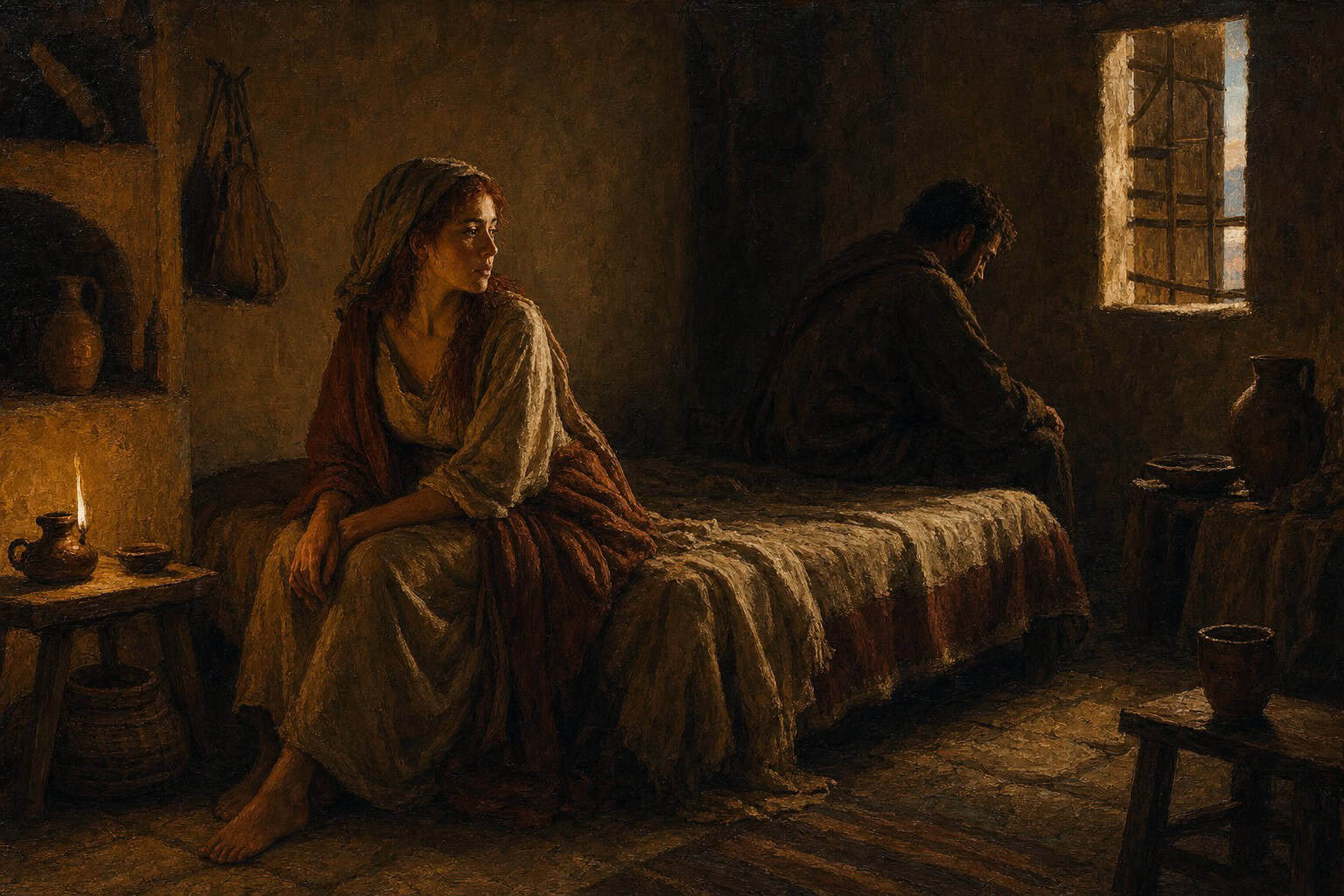
Why does it hurt while you are close to the one you chose? Not always in the body, though sometimes there too, but in a deeper place you cannot point to with a finger. You lie there afterward, or even during, and something tightens instead of loosening. You expected release and got a small grief instead. The sheets are warm, the skin is warm, and still a cold current runs underneath it all, the way a river stays cold beneath a sun-heated surface. You are held and yet you feel unseen, as if the person beside you reached for something in the dark and closed a hand around it, but the something was not quite you. This is a common wound and no one warns you of it. We are told that desire fulfilled is the end of longing, and then we discover it can sharpen longing instead, the way salt water sharpens thirst. The mind circles the same track: is something wrong with me, with them, with the act itself? You search the ceiling for an answer that does not come, and the room holds its breath around you. There is a hunger that two people can feed each other, back and forth, mouth to mouth, and for a while it feels like plenty, like a full table. But hunger fed by hunger only makes more hunger. You take and are taken, and at the bottom of it a small voice asks whether you were nourished or merely used, whether you used or were only consuming. That question is the ache itself. It is not the body failing you. It is the body telling the truth in the only language it has. It knows it was made for a meeting that goes deeper than sensation, deeper than the warmth of another person’s weight. It knows the difference between being treated as a person and being handled as a means, the way a child knows the difference between an embrace and a grip. And so, right in the middle of what should be union, it registers a distance, a subtle abandonment that no closeness of skin can cross. You feel it as pain because it is a kind of loss happening inside a moment of supposed gain, a small bereavement wearing the mask of pleasure. This is where we must begin, honestly, without pretending the pleasure erases it or that a better night will bury it. The pain is real. It is not neurotic and it is not a defect in your wiring. It is a witness standing in the corner of the room. Something in you keeps score of whether you were reached or only touched, and that scorekeeper does not accept the currency of pleasure alone. To sit inside this ache without rushing to fix it is the first honest thing. Only from there can we ask, quietly, what it wants of us.
The Loop That Feeds On Itself
Consider what actually happens between two people who come together only for the taking. There is excitement at first, a heat, a novelty that feels for all the world like it might be love. Each one reaches toward the other, and each one receives, and the exchange has a rhythm that seems generous, even lavish. But look closer at the direction of the reaching, the way you would watch water and notice which way it truly runs. It curves back on itself. I approach you to end my hunger; you approach me to end yours. We are not so much giving as trading appetites across a table, coin for coin. And appetite has a short memory. What thrilled last week feels ordinary now, so we push for more, or reach for something newer, and the pushing itself becomes a low anxiety humming under the pleasure like a wasp behind glass. This is the closed loop, and it slowly suffocates the two people caught in it. Two mouths breathing each other’s exhaled air until the air runs thin and stale. The pain you feel during closeness may be the first honest sign that the loop has begun to tighten around you. Your body senses the repetition before your mind will admit it. It senses that the person reaching for you is reaching for a sensation and not for your soul, and that you are doing the very same to them, and that both of you are slowly becoming furniture in each other’s private hunger, useful and then forgotten. There is a terrible loneliness in this, and it grows worse the closer you press, because nearness without genuine seeing is the cruelest distance there is. You can be a hand’s width away and separated by a country. The confessional truth is that I have stood on both sides of this loop. I have consumed another person’s love and, in an image I could not scrub from my mind for years, passed it through me and left it as waste, feeding on their tenderness and giving back nothing that would last the night. And I have been the one consumed, offered up and passed through and set down again, lying afterward and wondering why the closeness left me emptier than the solitude before it. The intellect wants to blame the other person, or the technique, or the wrong timing, or too much wine. But the honest question is harder and it points inward. What was I actually seeking when I reached for them? Was I present to a soul, a whole person with a name and a wound, or was I present only to a need, using their skin as a doorway back to myself? The pain during the act is the loop announcing plainly that something higher is missing. Not more skill. Not more passion. Something that breaks the circle open, that lets one person point past the flesh so the flesh can finally breathe again. Without it, the two just grind against each other in mutual consumption, and the grinding registers, quietly, faithfully, as hurt. You are not broken for feeling it. You are awake in a room where most people have chosen to sleep.
Mud Smeared Where The Wanting Lives
Here is the turn, and it will not comfort you the way you hoped. The pain during closeness is not a flaw in your capacity for pleasure or a sign that you love too little. It is your soul refusing, stubbornly, to accept a counterfeit of the thing it was built to receive. You were made to be met, wholly, down in the place you show no one, and no arrangement of two bodies can deliver that on its own strength. When two people come together with nothing higher than desire between them, they are trying to answer a summons with the wrong instrument entirely, like trying to read a letter by holding it against your teeth. The summons was written for the soul, and appetite alone cannot make out the letters. So the body, which is far wiser than we ever credit it, sounds an alarm from below. It grieves an absence it cannot name and cannot silence. I spent a long stretch of my life split into two hostile countries, a devout self crouching in the shadows of a chapel and a carnal self driven by a hunger that never once lay down. I built a fortress around my heart and told myself it kept me safe, kept me holy, kept the wolves out. What finally cracked it was not more intensity or a hotter night. It was the sudden, disarming warmth of being seen without being wanted for consumption, a long-locked gate swinging quietly open toward a joy I had no framework and no name for, arriving where I least expected it. That is precisely what the pain is pointing at. Closeness hurts when the gate stays barred, when you meet another body but no one meets your interior, the true country of you. The remedy is not less desire; desire is not the enemy here. It is desire made honest by something set above it. When one person carries something higher than the appetite into the room, the whole act changes its register the way a note changes when you sing it toward heaven instead of toward the floor. The body cries out during closeness because it was built to be met, and mere hunger cannot answer a summons written for the soul. The flesh stops being a thing consumed and becomes a language spoken between persons. The pain does not vanish by magic; I will not lie to you and say it does. But it changes meaning. It becomes the ache of longing rather than the ache of abandonment, and longing turned toward its true object is a holy and bearable thing. I do not hand this to you as a formula. I have watched people, myself first among them, hear exactly this and walk straight back into the loop, because the loop is easier and the fortress feels warm. But the pain keeps speaking. It is faithful that way, more faithful than we are. It will not let you settle for being handled when every fiber of you was made to be known.
The body cries out during closeness because it was built to be met, and mere hunger cannot answer a summons written for the soul.
The Bill The Ache Sends, And What It Won’t Cash
Do not expect the recognition to arrive as rescue. This is the part no one wants to hear and I resent having to say it. Naming the pain does not lift it out of your bed by morning. You may understand now that closeness hurts because your soul is asking for more than skin can give, and still lie awake beside someone, aching in the dark with your eyes open. The knowing does not fix the marriage or heal the partner or quiet the hunger before dawn. What it does is stranger and much slower than a cure. It reframes the pain as a companion rather than an enemy sitting on your chest. The old self wanted the hurt simply gone, wanted the act to be clean pleasure with no undertow dragging at the ankles. The honest self learns, painfully, to let the undertow teach him something. I have spent whole seasons scandalized by how little my pouring out seemed to change anything, how I gave and gave and reached and reached, and the emptiness sat there unmoved, drinking it all like dry ground drinks rain and stays cracked. There is a temptation hidden inside that fatigue, and it is not cruelty; it is quieter and more dangerous. It is the whisper that all of it is meaningless, that the tenderness I spent was simply spilled and wasted, that reaching for depth is a fool’s errand, and that I might as well settle for appetite and stop expecting more of anyone. That temptation is the true danger, far worse than the pain. Because the pain, at least, is telling the truth about you. The despair that trails behind it lies. And here I have to be careful not to tie this off with a neat ribbon, because the plain truth is that God does not usually swoop in and make the ache disappear on request. He is not a remedy you apply to a broken moment like ointment to a burn. What I have found, in the dark of these exact hours, is not the removal of the wound but a presence walking around inside it, unhurried, close. A nearness sitting in the very tears, not wiping them so much as staying for them. Not an answer that cancels the question, but a companionship that lets the question be carried without breaking your back. I present myself to Him as a problem I cannot solve, tangled in the very thing that shames me, and He does not solve me so much as sit with me in the unsolved dark, His mercy hovering near while I am still knotted in it. That is the fallout of this whole matter, the honest fallout. The pain does not leave on a schedule you set. But it stops being lonely. Something walks with you into it, and the walking-with is not nothing. It is, on certain nights, the only thing standing between you and the lie that says none of it ever mattered.
Wine, Then Warmth, Then Sight
So where does this settle? Not in a technique to make closeness painless. There is no such technique, and anyone selling one is selling you the same loop with a prettier label tied to it. It settles instead in a slow reorientation of what you are doing when you draw near another person at all, in bed or anywhere else. The pain during the act was never the malfunction. It was the summons, misheard, arriving in a form you flinched from. Once you begin to hear it rightly, you start to ask different questions of yourself and of the one lying beside you. Am I here to consume or to know? Am I offering a person or handing over an appetite dressed as devotion? Is there anything higher than the hunger passing between us, or are we just two mouths feeding each other in the dark until exhaustion decides for us? These are hard questions and I do not ask them from any height above you. I ask them as a man who kept his fortress long past the hour it should have fallen, who mistook safety for holiness and hunger for love for the better part of his youth, and who was startled awake not by punishment or by ruin but by an unexpected warmth in a room full of strangers with wine in their hands, a joy both foreign and familiar arriving disguised as ordinary talk and laughter. That is how mercy tends to come to men like me. Not as a bolt of lightning that leaves you no room to doubt. It comes as mud smeared across the eyes, unglamorous and almost insulting, dirt where you wanted glory, until you blink and realize you can suddenly see what had been standing in front of you the whole while. The pain you feel is that mud. It is grace wearing a form you did not order, doing work in you that you never asked it to do. I will not promise you the ache dissolves into bliss if you simply fold a prayer into your bedroom before sleep. That would cheapen both the pain and the God who chooses to meet you inside it rather than lift you out. What I can tell you is that the hurt is honest and worth honoring instead of numbing, that it points past itself toward a meeting your soul flatly refuses to stop wanting, and that even in the tangle and the shame there is a nearness that does not once flinch from the sight of you. If any of this has found the sore place under your ribs where the real question lives and waits, then you already know your fortress is older and more tired than you let yourself say aloud. The rest of that reckoning, the long and stubborn cracking of it, is what I set down in Confessions to the Empty Chair, not as a cure I am handing you but as a companion for the road you are already walking, aching, into a dark that turns out, against every expectation, not to be empty.