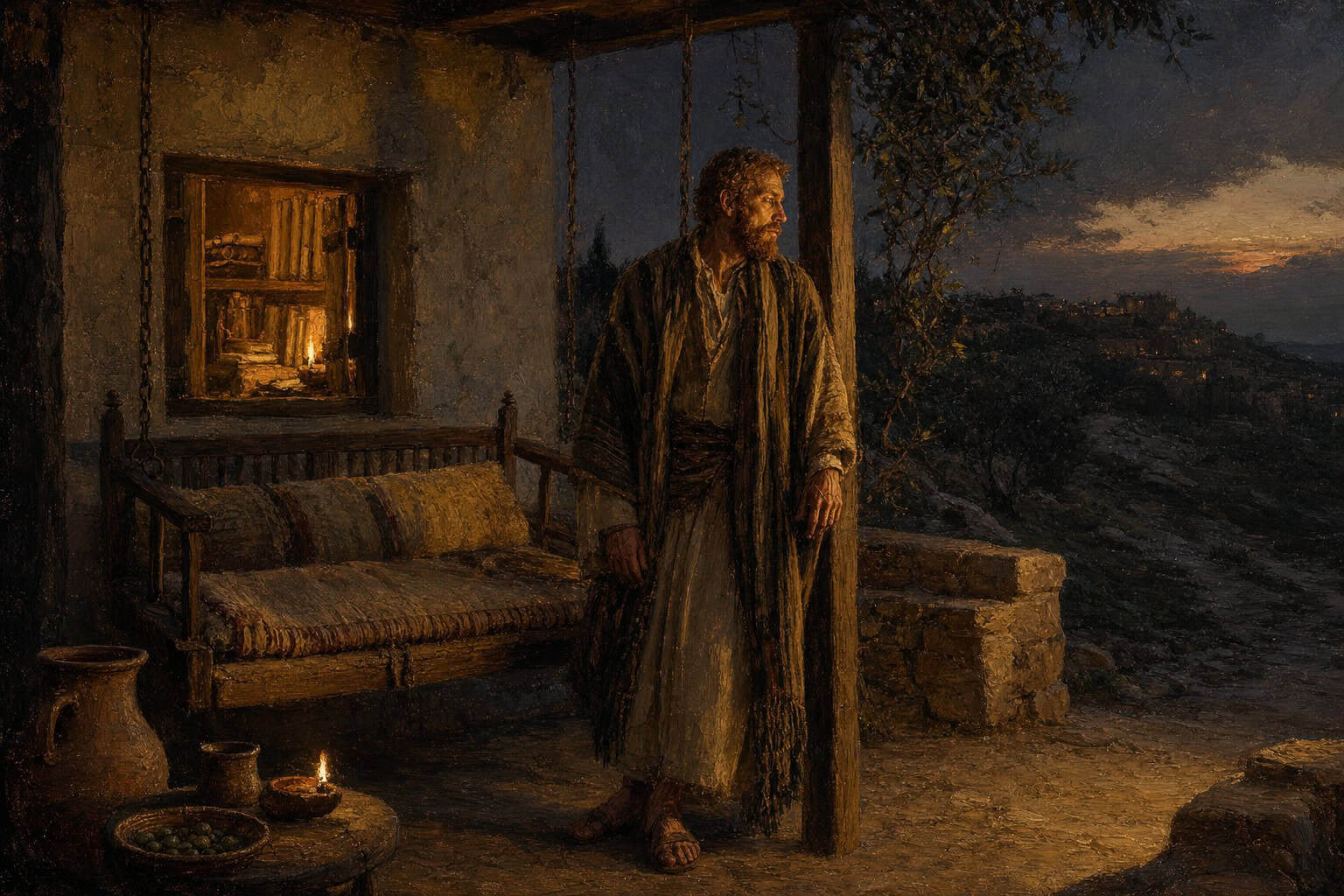
Does my ex-wife still love me? A reflection on abandoned love, false vows, and the man who left first — read through Confessions to the Empty Chair.
The Porch Swing You Traded for a Library
A question can run under your whole life like a low wind under a floor. Yours is simple and it will not let you rest: does she still love me. In the passage that grounds us, a young man from West Texas walks into a university and feels his mind come awake for the first time. He is humbled, intimidated, thrilled. This is a place that prizes thought over muscle, and he has spent his whole boyhood in a country that worshipped the opposite. He finds himself scattered across old books, meeting the dead who thought his thoughts centuries before him, and for one clean moment his hunger finally makes sense. He is not lost, he tells himself. He is arriving. But there is a girl he left behind, named Jeannètte, and she is not in the library. She is on a front porch swing, the same swing where he once rambled his half-formed ideas into the dark while she listened without laughing. That swing is the first concrete thing the scene hands us, and it matters more than the books. He learned to speak his soul there, before he had words worthy of it, and she gave him the room to try. Now he is somewhere else, drunk on new understandings, and she does not yet know the ground has shifted under her feet. Here is the hard thing for you, the one carrying the question. The man in this book is not asking whether she loves him. He already holds her love in his hands like something he can set down or pick up. He is deciding what to do with it, moving it around like a piece on a board. That is a different terror than yours, and a worse one. You want to know if the feeling still lives in her. He is discovering that the feeling in him was never as clean as he pretended. This part of the book does not glow warm. It hums with a quiet dread, the vertigo of a man who has just learned he is free — freer than he wanted to be, free to walk out of a vow he thought God had chained to his wrist. And inside that freedom Jeannètte thins into a name held at arm’s length, a decision he has not yet made but is already making. So sit here a while before you rush ahead. Before you ask whether she still loves you, ask a colder question. Ask what your love did to her. Ask whether you ever, on any porch, truly saw her at all, or only saw the way she made room for you.
A Fortress That Only Opens Upward
Study how this young man is built, because his machinery is likely your own. He tells us plainly, without a blush, that only those he sees as smarter can move him. Smarter means stronger. Stronger means allowed inside. Everyone he judges weaker simply bounces off the wall. This is the hidden engine running under the whole scene, and it will explain more about your marriage than any list of who said what. He has raised a fortress, and the drawbridge lowers only for people he ranks above himself. From the outside it looks like humility. He uses humble words — intimidated, awed among the great minds. But lean in and you see pride wearing humility’s coat. He will receive only from those who overpower him. He will not be changed by anyone who needs him back, anyone who comes to him soft instead of formidable. And that is the wound that decides your question. Jeannètte listened to him on that swing. She let him ramble into the night air. She gave him the space to become the man now bragging in his own head about arriving. She was the gentle place, never the towering one. And a fortress that only opens upward has no door for the person who loved you when you were nobody at all. Turn that toward your own house now. The wife who saw you before you had anything to show, who made your shoulders drop instead of stiffen, who was kind rather than intimidating — did some part of you quietly file her under weaker, and so under invisible? The body knows who it lets in before the mind decides anything. Certain people loosen your guard for no reason you can name; others make your jaw set. This man has built a rule that overrides all of it. Only power gets through. Tenderness knocks and knocks and is not answered. So when he stands in that library and feels himself climbing, Jeannètte does not climb with him. She stays down on the porch in his mind, shelved where he keeps the people who cannot alter him. The dread seeping in here is not that God has abandoned him. It is quieter and worse. It is the fear that the whole scaffolding he built his life on — the priesthood, the debt he thought he owed, the girl waiting at home — might all be made of paper. And if the scaffolding is paper, then his love for her was scaffolding too, propped up for reasons that had little to do with her. You came asking whether she still loves you. The harder question, the one this fortress forces, is whether the love you handed her was ever the kind that could be returned — or only the kind that keeps a running score and waits to be repaid.
The Vow He Made to Repay a Debt
Then the whole scene pivots, and it pivots on one word: repayment. For years this man was certain he had to become a priest. He believed God had marked that path and that he owed it, flatly and finally. Now, among the books and the living thinkers and the dead ones, he catches the crack in that belief. He was not answering a call. He was settling an account. He felt God’s kindness and mistook it for an invoice. The moment he sees this, the priesthood loosens its grip on his throat — not because his love for God cooled, but because a false weight slid off his back. He learns that no sinner can repay anything at all, that the Son alone was ever worthy, that grace is a gift and not a loan drawn against your future. This is true. This is the real light breaking into the scene, and it deserves to be honored. But watch closely what he does with the light, because here you must be brutal about your own marriage. Having freed himself from the priesthood, he turns on his heel and immediately decides to go home and confess his love for Jeannètte. He swings from one vow straight into another without pausing for breath. He promises God he will bring new souls into the world and raise them under His care. And in that single motion she stops being a person and becomes his fresh repayment, his new way to balance the books. He has traded a debt owed to God for a debt he intends to pay through her years and her body. Nowhere in this scene does he ask what she wants. He is arranging her into the architecture of his own rescue. Here is the sentence to carry out of this, the one that will not comfort you but will tell you the truth. You do not get to keep the love you left; you can only kneel in the space where it stood and ask what it cost her. That is the revelation the passage hands over. Love is not a ledger you quietly rebalance the day you finally feel ready. The moment you make a person your penance, you have already stopped loving them as a person and started using them as a sum. That is the exact danger buried in your own question. Does she still love me can be a real longing to be known and held. It can also be a longing to have the debt forgiven, the account closed, the guilt paid down so you can sleep through the night again. The man in this passage cannot yet tell the two apart, and that blindness is what will wound Jeannètte far deeper than his leaving ever could. The false premise is not gone. It has only changed its clothes.
You do not get to keep the love you left; you can only kneel in the space where it stood and ask what it cost her.
What the New Understanding Could Not Undo
Now sit in the wreckage, because the scene refuses to let him off easy, and you should refuse yourself the same mercy. He says it flatly, and it is the most honest line in the whole passage: Jeannètte paid the price for his ignorance. He knows it as he lives it. The older man setting it down on the page knows it too, and the knowing repairs nothing. This is the part your searching heart most needs to hear and least wants to. He got the theology right. He grasped grace. He shed a false vow that had been strangling him since eighth grade. And still, a flesh-and-blood woman on a real porch was hurt — hurt by the years he spent confused, by the way he held her at a careful distance while he sorted his own soul, by the way he made her wait inside a story she was never allowed to write. Being right did not undo the cost. Understanding arriving late is still late. New clarity does not reach backward through time and heal the person you have already failed. That is the true dread beneath all the triumphant language here — the slow discovery that light comes too late to save the very people it should have saved. You want to know if your ex-wife still loves you. Turn the lens the way this book keeps teaching you to turn it, back onto yourself. What did she pay for your ignorance? What did she carry while you were busy arriving at yourself, becoming the better version, finding your home among the great minds or the great whatever it was that pulled you upward? Did she wait on a porch of her own kind of dark? Did you file her under weaker while she was quietly holding you up? The air in this scene is not victory, though he reaches for victorious words. It is a man beginning to feel the floor tilt beneath him. He is free, and freedom weighs more than the cage ever did. Every path in front of him is now his, unforced, uncommanded, and the sheer openness of it makes his head swim. God has not vanished — that is the strange, stubborn mercy of the whole thing. God is right there in the confusion, walking beside him inside the very self-deception, present in tears he does not yet know he will one day cry. But God does not lift him out of the consequence. Jeannètte is still going to pay. The nearness of grace does not erase the bill; it only refuses to leave him standing alone with it. That is a harder gift than rescue, and you may have to learn to receive the same one, standing where you are, in a house that already went quiet.
Kneeling Where the Swing Once Hung
So where does this leave you, still holding your question like a cold stone in your fist. The honest answer this book offers is not the one you came for. Whether she still loves you is finally hers to know, sealed inside a body and a history you no longer have any right to open. You cannot reason your way into it. You cannot deserve your way back to it. You cannot pay the debt down installment by installment until the account clears and she takes you home again. That is the fortress logic all over again — the buried belief that if you become worthy enough, strong enough, changed enough, then the drawbridge will finally lower and she will let you cross. But her love, if it ever lived, was never a market you could bid in. She did not love you because you rose. She loved you, if she did, on the porch, before you were anyone at all, in the low murmuring dark where you had nothing to offer but your unfinished thoughts. The question that actually matters is the one the young man in this scene is only beginning to face: not whether she still loves me, but whether I ever learned to receive love from someone I could not rank above myself. Whether I looked at her and saw a person, or only saw the place where I set my burdens down. This is the ache the whole book lives inside — a man speaking at last to an empty chair, saying to bare wood what he should have said to a living face. The chair sits empty because he waited too long, because he sorted his soul first and confessed his heart second, because his understanding always arrived one season after the cost was already paid in full. That is the grief he cannot paint over, and he does not try. And yet, even in the emptiness, something keeps him company. Not a fix. Not her footsteps returning up the walk. Something quieter than that — the slow sense that the God he had mistaken for a creditor was never keeping score at all, was only waiting for him to stop paying and start seeing. If you want to know what it costs to finally arrive at yourself and lose the one who watched you become it, if you want the raw account of a man who got the theology right and the love catastrophically wrong, you will find it in Confessions to the Empty Chair. Read it not to learn whether she still loves you. Read it to learn how to sit in the hollow where the swing used to hang, feel the old ropes gone, and at long last tell the truth.