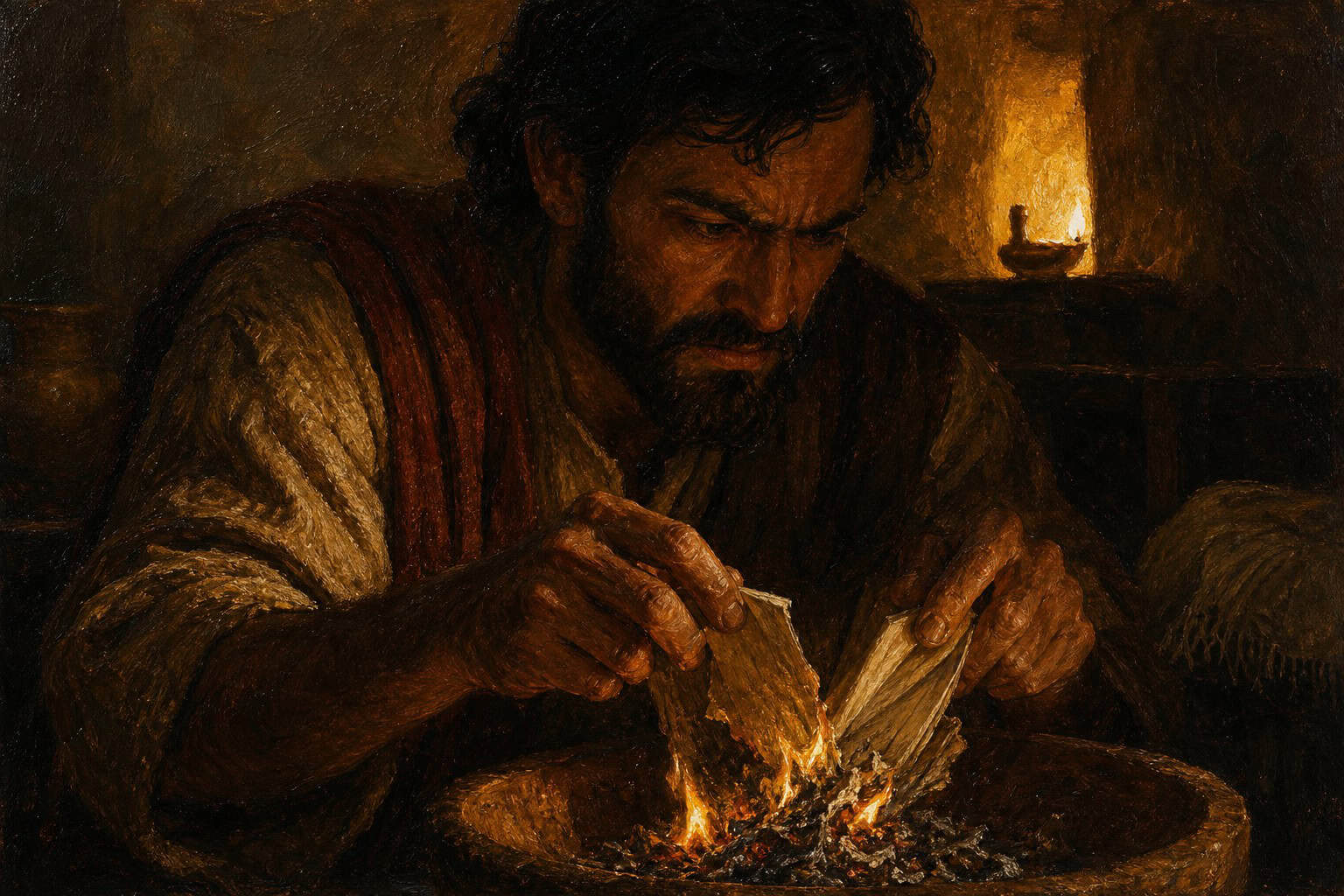
You burned the old love letters today. Here’s what the smoke can’t undo, and the grace that waits inside the wreckage anyway.
The Ash You Made This Morning
You burned the letters and thought that would be the end of it. I am watching you from years away, kneeling over the small fire, feeding each folded page into the flame, waiting for the heat to close the account. The paper curls and blackens. Bright flecks lift into the cold air of the room, and you tell yourself the memory will lift with them. You were wrong, and I am sorry, because I know now what you did not know then: fire changes matter but not meaning. The words she wrote, the little pet names, the promises, the crooked way she signed her name — those become smoke, yes, but the thing they carried settles somewhere the flame cannot reach. Watch your own hands as they work. They are steady in a way that frightens me to remember, the hands of a boy performing a ritual he half-believes will save him. You are three years old again in this, holding a punishment you did not understand, hating a world that gave rules without love and love without rules. That is where this began for you, long before her. You learned early that the adults around you gave to God what belonged to Caesar and gave to Caesar what belonged to God, that affection arrived inappropriately, at the wrong times, for the wrong reasons, and never when you needed it. So when her letters came you clutched them like proof that this time the accounting had finally come out fair. Now you burn them because the accounting was not fair after all. But hear me: the smoke on your fingers is not freedom. It is only evidence that you are still holding on with the other hand. The ache in your chest as the last page catches is not the ache of letting go. It is the ache of a boy who thinks destruction and release are the same gesture, when they are opposites. To let go, you have to open the hand. To burn, you have to grip. You gripped that whole box for months before you struck the match, sleeping with it under the bed, and even now, watching the last corner go dark, you are already reaching for what to grip next — a bottle, a stranger’s number, a fresh reason to stay bitter. I do not say this to shame you. I have too much love for you to shame you. I say it because someone must tell you the truth you cannot yet see from inside the smoke, and there is no one else close enough to say it. It is only me, reaching backward across the wreckage, and God, who is nearer than I am.
Loose Change on the Cold Ground
Here is what those letters were, and what you refused to understand about them while you had them. You gave her everything you had. The whole interior of yourself, the parts no one else got to see, the tenderness you hid from the world behind your careful, quiet face. And she gathered it the way a person bends to pick up loose change on the sidewalk — a small convenience, a minor find, not worth much, but why leave it lying there. That is the wound beneath the wound. Not that she left. That she treated what cost you everything as if it cost her nothing, as if your devotion were ambient, renewable, always humming there in the background for the taking. You wrote her back with your whole soul and she folded your soul into a drawer and went out into the night. She came home disheveled and warm from someone else, and you were still there in the morning, still available, still the one she called when the beautiful ones grew bored of her. You were her brother. Her orbiter. Her emotional battery. Do you hear those words? Not a man she desired. A utility, a thing that runs quietly and asks for nothing. And the cruelest part, the part that kept you chained to her door, was the precision of it. She gave you tenderness at the exact moment you tried to pull away, every single time, as if she could feel the current flicker and knew just how much warmth to spend to keep the battery charged. She probably did not even know she did it. You mistook that calibration for care. I want to ask you something you never once asked yourself back then, in all those long conversations you replayed at three in the morning: what did you actually want from her? Be honest with me. Comfort. Acceptance. Pleasure. Peace. You wanted the world and its girls to hand you what you believed God had promised and then withheld. You went to her the way a starving man goes to a feast he was never invited to, pressed against the glass, watching. And when you asked her for bread you were handed a stone. When you asked for a fish you got a snake, coiled and cold in your open palm. You had obeyed everything you were taught — love, be patient, be kind, be present, be good — and the obedience stung. It did not feel holy. It felt like being made a fool in front of everyone. So you kept her letters as proof that you had once been chosen, however briefly, and you burned them this morning because the proof had become unbearable to hold. Both acts, the saving and the burning, came from the same starving place. You did not love her, not entirely, and this is hard for you to admit. You needed her to fill a hole that was older than she was, older than any girl, dug when you were three.
The Larva That Sealed Its Own Tomb
There is one moment I need you to see clearly, and it is the moment you built the wall. You stood outside the bright hall of the world and watched the beautiful, effortless ones feasting — trading stories and touch and belonging, moving from one partner to the next like children in a game of musical chairs, no depth of conversation required, no charity of spirit, just skin finding skin. And you stood in the shadow, contemplative, watching, telling yourself you were the higher thing. The deeper soul. The one who understood the transaction and nobly refused to pay its price. You imagined yourself as a monster crouched at the edge of their warmth, half in envy and half in disgust, holding some terrible knowledge they were too shallow to possess. But hear me now, because this is the turn you missed entirely: the disgust you felt for their shallow feast was disgust at your own hunger. You wanted in. You ached to be at the table, and you could not get there, so you rewrote your exclusion as a choice and your rejection as a noble exile. You told yourself you were guarding something. And to guard it you built walls around your heart, thick ones, meant to keep the chaos and misunderstanding of the world outside. Do you understand what you actually built? Not a fortress. A cocoon. A larva spinning silk around itself, sealing every gap, certain the shell was protection. But nothing was transforming inside that shell. You were not becoming a wider self. You were entombing the self you already had, wrapping it tighter with every rejection. The walls that keep the wound safe are the same walls that keep the wound alive.
The letters were strands of that silk. Burning them was you clawing at the shell from the inside, panicked, finally sensing that the thing you built to save you was suffocating you instead. And here is the mercy I could not have told you then and can barely bring myself to say now, watching your hands over the fire: God was in the cocoon with you. Not waiting outside for you to earn your way into the light. Not withholding Himself until you performed enough love to qualify. He was already inside the dark with you, closer than the silk, quieter than your own held breath, present in the exact tears you were certain proved His absence. You thought the sealed room of your soul was yours alone, kept private, kept safe from every interfering hand. It was never empty. He was already there, sitting in the dark you built, refusing to leave.
You can burn what her hands touched, but not the shape her leaving pressed into you.
He Was Nearer Than the Smoke
You believed, in that season, that the Christian universe was a trap with no exit — a place with a transcendental Interferer set at its center, someone who wanted to invade the one private territory you had left, the small dark room of your soul you were determined to keep for yourself and no one else. You hated authority. You hated being seen, being understood against your will, being known before you chose to reveal. So you kept your interior locked and let no one in. Not her. Not your friends. Certainly not God, whom you suspected most of all. But grace does not knock politely and wait outside for permission the way you feared it would. Grace was already in the room before you turned the lock. That is the thing about mercy that terrified you and that I have come to understand from the far side: it arrives before you deserve it, before you ask, before you have cleaned yourself up or made yourself presentable. You were sitting in your fallen state, drinking through the long city nights, wearing your dark refusals like leather armor, living one clean life by day and another punishing one after dark — and He did not leave you for it. He did not demand the light first. He walked with you in the sin itself, in the very stumbling, in the anger you turned against the world and against Him and against your own reflection. You wanted a rescue. You wanted the darkness simply lifted, the girl returned to your arms, the ancient hole filled, the whole unfair world set right. That kind of rescue almost never came, and I will not lie to you now and pretend it did. What came instead was quieter and stranger and harder to notice — accompaniment. A presence seated beside you in the ash on the floor. You were not alone over that fire this morning, though you felt more alone than you had ever been. The nearness you could not feel was not therefore absent. This is the hardest lesson of the whole long descent, and I need you to carry it: farness from God is a feeling, not always a fact. You measured His distance by the size of the ache and concluded He had gone somewhere far off. But the ache was the very place He was standing. The stone you were handed when you begged for bread — you never once considered that He might have been weeping beside you as you turned it over in your hands, that He hated the injustice of it as fiercely as you did, that He was not the one who put the snake in your palm.
What the Fire Could Not Reach
So let me tell you where this settles, though it does not settle neatly, and I refuse to pretend it does. The letters are gone. Her hands touched that paper and the paper is smoke now, drifting up past the low ceiling, and you will feel for a few days a false lightness, the kind that follows any purging. Then the shape she pressed into you will ache again, because you burned the object and not the meaning, and meaning does not answer to fire. This is not the counsel you were hoping for. You wanted me to say the flame worked, that you are free at last, that the account is finally closed and balanced. It is not closed. But here is what I can promise you from this far side, and it is more than you are able to believe as you kneel there: you are not the monster you cast yourself as, lurking outside the feast with your terrible secret knowledge. You are a beloved thing who mistook a starving need for love, who mistook a jailer’s calibrated warmth for tenderness, who built himself a tomb and called it a shelter. And the God you were so certain had abandoned you was, the whole time, the one who never once bent to pick you up like loose change on the ground. He gathered you instead as though you cost Him everything — because to Him you did, you always did. You cannot earn your way out of the cocoon. You could not manage it if you spent your whole life trying, and you will try. The way out is not a wall you scale by force but a hand you finally open. Put down the match. Stop scanning the room for the next thing to grip and destroy. Let Him find you exactly here — in the smoke staining your fingers, in the season you are most ashamed of, before you are ready, before you are clean, before you have anything to offer but wreckage. That is what mercy actually is. It does not wait for the dark to burn itself out. It moves into the dark and stays there and does not flinch. I know you cannot see this yet, kneeling there with the last ember dying on the hearth. I am writing to you across all these years so that someday, when you are burning something else, some other proof of some other wound, you will remember this one thing and let it stop your hand: you were never watching the feast alone. Someone had already left the table to come and sit with you in the shadow, and He is still sitting there now.