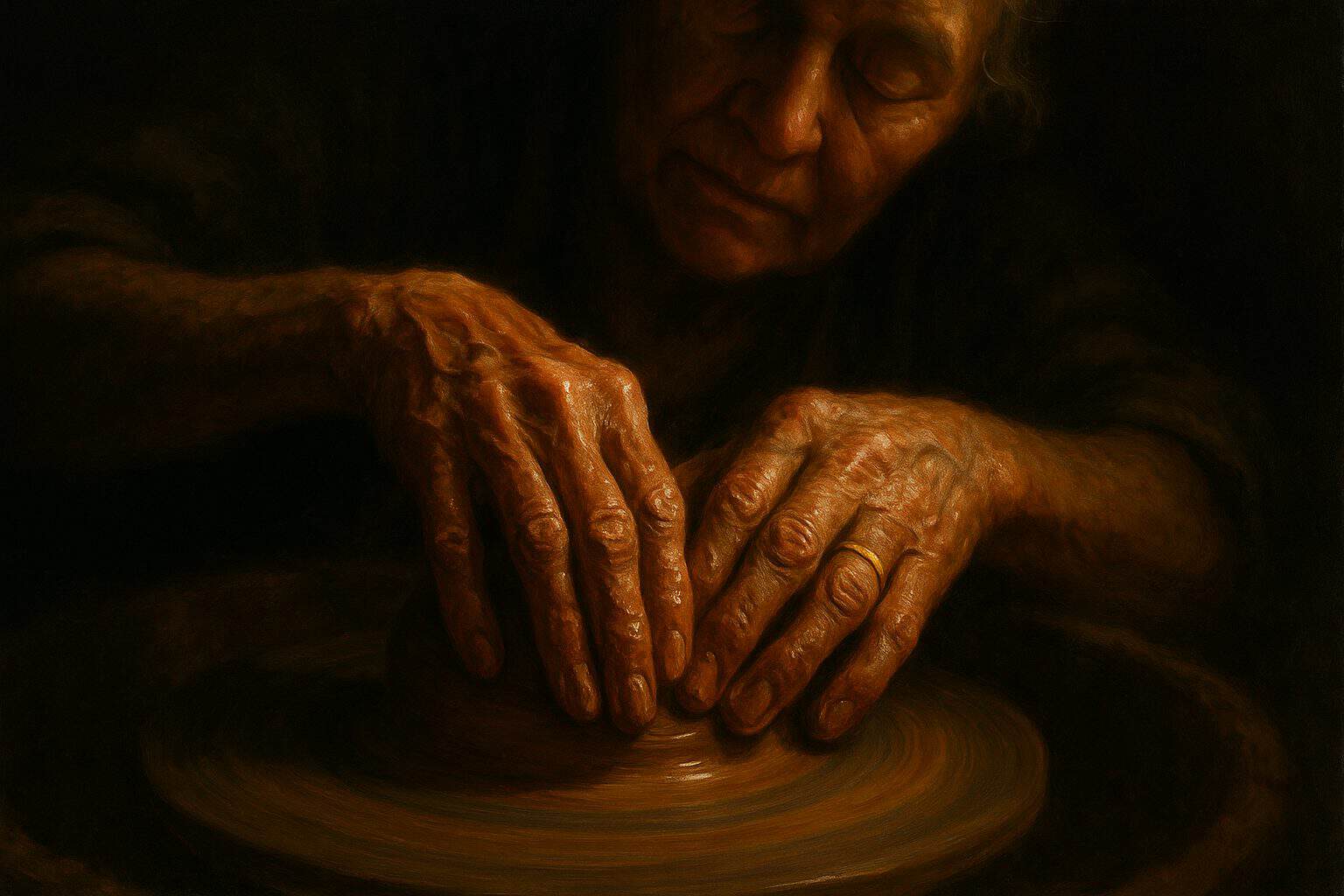
Where consciousness first stirs in the weight of bone and breath, before any word rises to name it.
The grain of the table under your palm—pause there. Not the idea of wood, not the category of furniture, but this particular roughness meeting these specific fingertips. Before you think “table” or “hand,” something has already happened. A world has been given, received, inhabited. Your body knew before you did.
The Anonymous Life
Each morning, consciousness doesn’t switch on like a lamp. It seeps through the heaviness of limbs still weighted with sleep, rises with the rhythm of breath that has continued all night without your permission or awareness. The body has been keeping faith while you were absent, maintaining its dialogue with gravity, temperature, the texture of sheets. This anonymous life—what Merleau-Ponty calls the pre-personal—carries you forward before any decision, any thought, any “I” announces itself.
Watch how you navigate a familiar room in darkness. Your hand reaches for the light switch at exactly the right height. Your body turns the precise degrees needed to avoid the corner of the dresser. This isn’t memory in the mind but memory in the muscles, in the very arc of your gestures. The body holds a map that thinking never drew.
“The one doing the action is or was always-already aware, at least on some faint, shadowy primordial level, of their inspirational object.”
The Thickness of Presence
When someone you love enters a room, you feel it before you see them. Not mystically, not through some ethereal sixth sense, but through the subtle redistribution of presence that bodies create simply by being. The air shifts. The quality of silence changes. Your skin knows another skin has drawn near, the way one tuning fork begins to hum when another sounds its note.
This is why absence has such weight. Clothes hanging in the closet still smell like them, but they are nowhere to be found and their garments remain undisturbed. The body they shaped, the particular way they displaced space, the rhythm of their breathing that your breathing had learned to match—gone. Pictures that went unnoticed when they were alive are brought closer to the face as the living search for some hidden angle of presence the photograph might have caught and held.
The flesh remembers what the mind would forget. Your hand reaches for them in half-sleep. Your body turns toward their side of the bed. These are not thoughts but older certainties, written in nerve and sinew.
The Dialogue of Touch
Touch becomes a separate dialogue, more ancient than words. When lovers’ hands meet, it’s not two objects making contact but two lived bodies recognizing each other. The warmth that passes between palms carries more than temperature—it carries the whole history of what hands have held, have released, have reached toward.
In that moment where touch culminates in sensuality—the point in sex where the spirit of each resonates in the flesh—we discover that the body is not the prison of the soul but its native language. Unlike angels, we cannot feel without flesh. This limitation is also our glory: we know through thickness, through resistance, through the sweet burden of having to be somewhere particular, someone particular, touching this particular other.
The body grounds our thoughts. The physical anchors the spiritual. Even in our highest flights of contemplation, we remain these breathing, pulse-keeping creatures. The mystic’s vision comes to eyes that blink, to a heart that quickens. The philosopher’s insight arrives in a brain that needs glucose, oxygen, rest.
The Primordial Faith
Before belief, before doubt, the body has already said yes to the world. Every perception is an act of faith—that the floor will hold, that the air will nourish, that the visible conceals no lethal surprise. We walk forward trusting ground we haven’t tested, breathe in assuming air remains air. This isn’t naivety but the primordial faith without which no life could proceed.
When we as humans perceive anything with our body, through our body, and because of our body, we are not perceiving the thing itself—some pure object stripped of relation—but the thing-for-us, the thing as it gives itself to these particular eyes at this particular angle in this particular light. Yet this limitation is precisely our access. Through the narrow portal of our situated flesh, a world floods in.
“These things dwell within permeable reach only to those who first believe with faith the size of a mustard seed that they are able to reach it.”
The Wisdom of Descent
Do not resent the descent; it is where the ascent finds its meaning and purpose. Every spiritual elevation begins in the humble acknowledgment of weight. The saint’s levitation means nothing without the years of feeling gravity’s honest pull. The resurrection presupposes the tomb.
We are not spirits temporarily housed in flesh, nor machines mysteriously generating consciousness. We are this living paradox: flesh that thinks, thought that bleeds. Each brings their bodies with them to every act of consciousness, beginning and ending from the perspective of the first-person plural—never the isolated mind, always the embedded, extended, enacted being-with.
The wisdom of the dead becomes the wisdom of the living precisely through this fleshly inheritance. Their gestures live on in our gestures. The way a grandmother held her teacup becomes the way her granddaughter holds hers, without teaching, without thought—the flesh remembering across generations what it was never explicitly told.
The Inhabited Moment
Anchor yourself in the tangible: the grain of the table under your palm, the rhythm of your own breath moving from belly, not throat. This isn’t a spiritual exercise but a return to what you’ve never actually left—the inhabited moment where body and world are distinguishable but not separate, where consciousness is always intentional, always directed at the world through a living, sensing body.
Notice how differently you breathe when anxious—high in the chest, quick and shallow. Notice how your whole world constricts with that breath, how possibilities close down, how the future darkens. Then feel what happens when breath drops to belly, when the diaphragm remembers its ancient rhythm. The world opens again. Not because you’ve thought different thoughts but because your body has assumed a different stance toward existence.
This is why certain gestures carry such power. The practiced movements of ritual—kneeling, bowing, hands opened in supplication or raised in praise—these aren’t symbols of interior states but their very accomplishment. The body doesn’t represent humility; it is humility in its bending. The hands don’t signify receptivity; they are receptivity in their opening.
The Unnamed Hierarchy
Even our social existence reveals itself first through the flesh. Exclusion occurred not through overt declarations but through practiced gestures—an instinctive reassertion of an unnamed hierarchy. Watch how bodies arrange themselves in any gathering: who stands where, who yields space, who expands into it. Before any word of welcome or rejection, bodies have already spoken their elaborate codes of inclusion and distance.
The one who feels unwelcome knows it in their skin—the slight tension that won’t release, the way their gestures become smaller, more careful. The body reads what the social smile conceals. It knows the difference between genuine warmth and performed politeness, between real invitation and mere tolerance.
The Horizon of Flesh
Yet for all its wisdom, the flesh knows its limits. There are limitations or parameters to the reality we inhabit, and our apprehension of the most important divine things occurs through our flesh and through the limitations of our intellect, emotions, and spirit. We reach toward what exceeds us through the very boundedness that makes reaching possible.
The infinite touches us precisely at the point of our finitude. The eternal enters through the temporary door of now. Some kind of human movement toward the divine always occurs first—even if just the movement of turning, of opening, of acknowledging our incomplete estate—and the divine’s response always occurs second, even if that response is silence.
The flesh before thought isn’t lesser than thought but its constant companion, its necessary ground, its first and final home. In recognizing this, we discover that consciousness isn’t trapped in a body but accomplished through it, with it, as it. We are not ghosts operating meat machines but this single, seamless, miraculous event: flesh that has awakened to itself and its world, thought that has never ceased being flesh, spirit that knows no other native tongue than this sweet, limiting, revelatory bond with all that is.