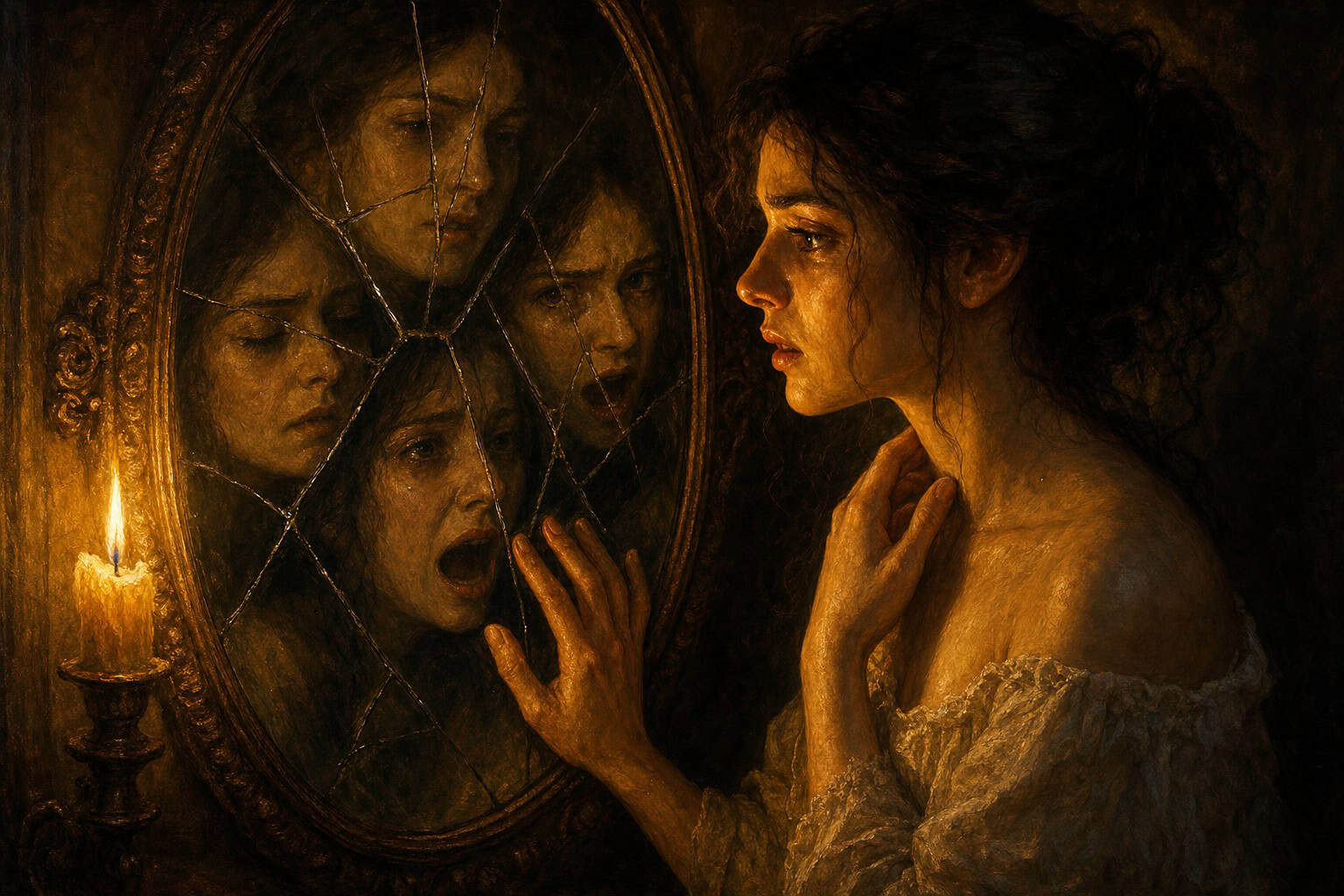
Why do girls play games? A hard, honest answer through Fractions of the Soul: the hunger, the mask, and the wound underneath the moves.
The Advertisement She Never Agreed to Be
You have watched a girl run you in circles and called it a game, and you are right, but you do not yet know what the game is for. So start where the game starts, before she knows the rules herself. In Fractions of the Soul, the second chapter opens on a girl whose body changes faster than she can understand it. Her hips widen. Her waist narrows. Her chest fills out, and one morning she is a message she never wrote, broadcast to men who read it without asking her permission. Notice how fast this happens in her own skin. Last summer she wrestled her brother on the floor and it meant nothing. This summer the same touch carries a charge, and the wrestling stops, and she cannot say exactly when the wall went up. The clear skin, the bright eyes, the long shining hair, the color she paints on her lips and cheeks, all of it says one thing to older men, and the book says it without flinching: she looks like she can make life. She did not sign this contract. She did not agree to become a poster her own flesh hangs up for strangers to read. The chapter is cold and exact about what nature wants here. It does not care about her thoughts. It does not care about her fear or her shyness or the fact that she is still a child in most of the ways that matter. It wants the species carried forward, and her body has been drafted into that work without her consent. So the flesh begins speaking a language she has never learned, and the men who hear it turn their heads on the street, in the store, in the corners of every room she enters. This is where the games are born, though no one calls them games yet, and she least of all. Before she can name what is happening to her, the safe and easy physical world of childhood is simply gone. The rough play, the piggyback rides, the ordinary closeness with father and brother, all of it now hums with something that makes it impossible. She is cut off from the body she used to live in without thinking. She stands inside a new body that pulls hungry eyes toward her, and she has no map for any of it. That is the raw ground under the question you typed into the search bar. Girls play games because the board was set up around them before they could read a single square. The pieces are their own faces and bodies. The stakes are things they barely understand. She is still inside herself, wondering how she got locked out of her own childhood.
Power in a Body Too Young to Hold It
Now watch what she does with the attention, because this is the part that stings, and the part most men refuse to see. She discovers the attention feels good. The book reaches for one sharp word and lets it sit there: intoxicating. A boy in her class holds his eyes on her a beat too long. A man twice her age slows his walk when she passes. And something in her chest lifts, warm and dizzying, because for the first time she holds a power she never had to earn with grades or kindness or effort or patience. She only has to exist inside this new body, and grown men bend toward her like plants toward a window. If you want to understand why girls play games, you have to sit inside this exact feeling and not rush past it. The power arrives years before the wisdom to hold it arrives. Someone handed a child a loaded thing and called it a toy, and she is playing with it because it lights up when she does. She learns she can command a man’s gaze long before she learns what that gaze is hungry to take from her. That gap, between the power in her hand and the understanding in her head, is the exact soil where every cruel game grows tall. And Fractions of the Soul traces this hunger down past simple vanity, into something older and sadder. The girl in these pages carries a hollow dug out early, by a father who was absent, or worse than absent. When the first man in your life teaches you that you are not enough to be kept, you spend the rest of your years auditioning to be kept by everyone else who has a pair of eyes. So the male attention is not really about lust for her, not at the root. It is about proof. Every look is a small, trembling answer to the question her father left lying on the floor: am I worth staying for. But here is the cruelty built into it. The answer never sticks to her. One man’s attention cools and drifts, and the hollow opens back up, hungrier than before. So she reaches for more eyes, more proof, more reassurance that she is real and that she matters to somebody. The chapter shows her arranging how she appears, one face turned toward this watcher and a different face toward that one, managing every gaze while staying, underneath all of it, unseen by anyone. That is the engine grinding under the game. She is not toying with men for sport or for laughs. She is feeding a hunger no single man can ever fill, because the wound it pours out of is older than any man she will meet. She performs the girl worth wanting and buries the girl who fears she is worth nothing. You called it a game. She calls it staying alive one more day.
When the Mask Grows Into the Face
Here is the turn that changes everything you thought you had figured out about her. The games are not a mask she slips on for the evening and peels off at night. Somewhere along the road, the mask grew roots and became her face. The chapter names this with a cold and patient precision. She has told so many versions of herself to so many different people that the lying is no longer a thing she does in a tight spot. It has become a thing she is. She keeps one story for one man and a wholly different story for another, and she keeps the two apart the way you keep a lit match away from a page of paper. The deception is not a tool she grabs when cornered. It is the very air moving in and out of her lungs, her first and most reliable way of surviving a world that let go of her early. This is exactly what makes her tragic instead of merely wicked, and the difference matters. A child raised inside abandonment learns fast that honesty earns her nothing and cleverness earns her a little safety. So she becomes clever. She learns to spread a soft fog around her true attachments, a gentle nothingness that lets her deny anything to anyone, so that no man can ever pin her down and no man can ever leave her, because in truth he never held her to begin with. The book reaches for an old and frightening picture to name what she has become. One person, but somehow not one person at all. Many selves crowded into a single body, each of them denying that the others even exist. It is the image of a soul split so far down that it can no longer answer honestly when someone asks its name. That is the true price of the games, and she pays it in full long before any man she plays pays his share. She wanted to be whole. She wanted, like anybody, to hold all the loose threads of herself in one steady hand and call them one life. Instead the threads pulled apart, and each fragment learned to lie to the fragments beside it. A girl learns she can command a man’s eyes long before she learns what those eyes are hungry for. So she keeps commanding, keeps arranging, keeps splitting herself, and the wholeness she once longed for slides further out of reach with every fresh performance. The games you feel from the outside are her scattered fragments trying to stay alive with no center holding them together. Each self stands guard over the wound. Not one of them knows how to close it. She cannot simply stop, because stopping would mean standing still in the open and being seen all the way through, and being seen all the way through is the single thing the wound will never allow.
A girl learns she can command a man’s eyes long before she learns what those eyes are hungry for.
The Sugar That Was Never Bread
So what actually happens after the game works. Follow her past the moment of triumph, past the man who fell for the version she carefully built for him. The book hands her no medal. It hands her the emptiness that had been waiting the whole time underneath the win. She controlled every gaze in the room. She arranged exactly how she appeared to each watcher, and it worked, and they wanted her. And still, at the dead center of it, nobody saw her, because there was no single her left in there to be seen. This is the slow subtraction running under the whole chapter. The more selves she performs, the less of the real one survives the performing. She wins the attention and loses the person in the same motion. She becomes so skilled at appearing that she quietly disappears, dissolving into the roles until even she cannot locate the girl who first started to play. That is the specific loneliness the games buy her. You may have stood on the other side of it, feeling handled and used and made a fool of, and the book does not pretend any of that costs you nothing. But it holds your face and makes you see the fuller frame. The girl who plays does not walk off full and satisfied. She walks straight back into the same hunger, only now she carries fresh proof that people can be moved and still no proof at all that she can be loved. The father-shaped hollow is exactly where she left it. The attention was sugar, never bread. It spiked and burned off and dropped her lower than before. Fractions of the Soul refuses the lazy story where she is only a hunter and the man only meat. It shows two wounded people circling each other in the dark, each one reaching for a thing the other simply cannot give. Her strategy shielded her from being left, and by the same walls it guaranteed she would never once be held. She built the walls so high that safety and loneliness became the same locked room. And here the shame rises up quiet and real underneath the whole show. Beneath the confident performance sits a girl who half suspects she is wanted only for the message her body sends, never for the person hiding behind it. She covers herself in the very attention that strips her bare. She hides in plain sight, wrapped in every man’s wanting, and the wish underneath all of it is simply to vanish from a gaze she can no longer stand, including the hardest gaze of all, her own in the mirror. The applause dies. The people file out. She is left alone with the self she abandoned in order to play.
The Communion the Games Keep Trying to Fake
You came asking why girls play games, and now you are holding something heavier than a tidy answer. The game is a symptom, not the sickness. Underneath it lies a hunger for wholeness that no man’s attention will ever feed, a longing that keeps reaching past every man it grabs toward something it can almost name and cannot yet hold. She wants to be one person. Seen and kept and safe, all three at once, in one steady set of arms. She was made for exactly that. Every soul is made for a love that sees the whole self and does not fracture, a communion where no part of you has to hide from the other parts. But the wound got there first, before the love could. The father let go. The body began signaling to strangers before the girl was anywhere near ready. The attention arrived, dizzying and empty, and she learned to survive it by splitting and performing and hiding, until the surviving itself became the cage. Fractions of the Soul does not sell you a trick for outsmarting her next move. It offers something far harder and more honest. It offers a way to see the whole person underneath the game without ever pretending the game costs nothing. The book carries severity and mercy in the same hand. It names the deception plainly, without softening the edges, and refuses to pretend the games leave no bodies behind. And it also refuses to let you settle into contempt, because contempt is only a clever way of not looking at all. If you have been played and are still angry about it, this chapter will not comfort you cheaply or cheaply talk you down. It will lay out the machinery, the hunger, the split soul, the old wound that started every bit of it, so that your anger finally has somewhere true and solid to rest. And if you recognize your own reflection in the girl, if you have tasted the intoxication and later paid the loneliness in full, this book will find you exactly where you actually stand. It will not flatter you and it will not shame you into silence. It will name the ache the games were built to bury, that reach toward a wholeness you can feel humming just past your fingertips and cannot yet grasp. That is the real pull of this memoir. It takes the thing you typed in a moment of frustration and opens it slowly into a full human tragedy, patient and clear-eyed and unwilling to look away. The games are real. The hunger under them is realer still. And the only thing that has ever answered a hunger cut that deep is not one more gaze, not one more win, but a love that gathers the whole scattered self into its hands and stays. This chapter leaves her standing at the far edge of that question, wondering whether such a love can actually reach a soul so torn, and it leaves you leaning after her to find out.