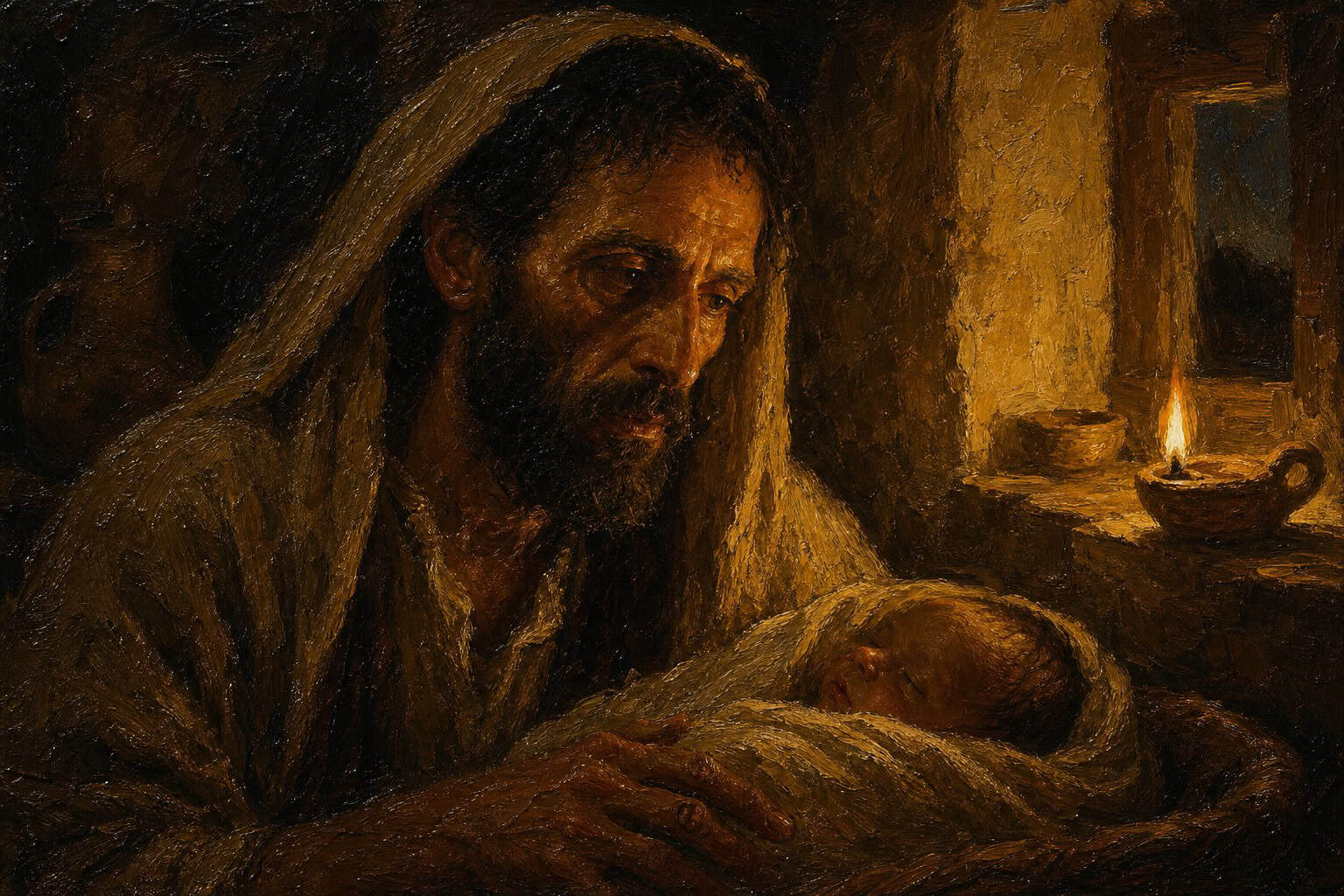
Before you chose a shirt, a face twelve inches away taught you how to be seen. A raw reflection on mimicry, appearance, and the first bond, from Fractions of the Soul.
Twelve Inches From a Face You Cannot Focus
Long before you picked a shirt for the day, before you chose which shoes said something honest about you, there was a face twelve inches from your own. You could not steer your eyes yet. The small muscles that aim them had not learned to obey, so the world past that arm’s length was a blur of warmth and shadow. In Fractions of the Soul, the third chapter lowers us into this earliest room of the human story, the minutes just after birth, when everything is only warmth or cold, light or dark, pain or comfort. There is no name yet, no boy or girl, no self to defend, no memory forming that you will ever carry. An adult leans close and sticks out a tongue. In and out. The infant, minutes old, stares, its face working in visible confusion, then copies the motion, and the adult beams, and the child copies the beaming too. That is the whole event. It looks like nothing. No one spoke a word to teach it. The book dwells on how strange this is, how a creature with no language and no sense of where its own body ends can already reach across the gap and match another’s mouth. When you ask about missionary dress and appearance, about hemlines and collars and the pressed neatness of people sent out to be seen, you are really asking about this beginning. How much of what we wear and show was learned before we could choose it. The tongue moving in and out is the first proof that we came into being by imitation. We were shaped by faces before we had a face of our own to arrange. The clothes come much later, and so does the collar, the careful voice, the practiced posture. I think of my own reflection before Mass, tugging a collar straight, tilting my chin, and I wonder whose approval I am still reaching for. The infant learns its tongue calls up delight in the adult. That is the primal transaction. The grown man learns the same, only now the tongue is a wardrobe, a way of standing so others read us kindly. This was the first fitting room, and we cannot recall a moment of it.
The First Thread Pulled Through a Nameless Self
The frightening part is not that we imitate. It is that we imitate before we can refuse. An infant cannot yet say no to the emotional weather it drinks in. It cannot decline the anxious mother, the absent father, the room thick with a tension it has no words to name. It takes the load, tongue first, then everything less obvious. If a baby can copy a stranger’s mouth within its first hour, I have to ask what quieter freight it hauls in without any consent: how often it was bathed in warmth, how consistently the people leaning over it modeled what they claimed to believe, how much love or how little saturated the air before it could taste the difference. The chapter names it without flinching: that first face leaves the deepest and best-hidden blemish in the lens through which we see everyone else for the rest of our lives. It is the first thread woven into the first tapestry, the first foreground and the first background. There is a vertigo in that phrasing I did not feel as a young man and cannot unfeel now. I used to think my style, my bearing, my manner in a room were mine, picked freely from a menu spread before me. Now I see the menu itself was handed to me before I could read a word of it. When kindness comes to a person trained early to expect refusal, it cannot land as gift. The tightened gut is not a decision to distrust. It is the mark left in the flesh where a small child once reached toward a face and met it closed. So appearance is never only vanity. The braced shoulder, the guarded voice, the habit of presenting a version received well rather than the raw self behind the shirt, can be armor stitched in the dark. And still we walk out each morning and perform. The performed self is not a modern sin invented by mirrors and photographs. It is the oldest human motion, the tongue answering the tongue. That does not excuse me. It only tells me how deep the excuse would have to reach to be honest, and that reach terrifies me. To refuse the pattern now means fighting a hand I cannot picture, in a nursery I will never see again.
When the Made Thing Refuses Its Making
Here is where the passage turns and cuts deepest. If an infant can copy a tongue minutes after birth, the book asks, how much less obvious information is that same infant taking in to imitate? That single question breaks the scene wide open. The small game over the crib is not a game at all. It is the master key to everything that follows. The child is not learning one gesture. The child is learning how to be a person, drinking in tone and fear and tenderness and contempt, the unspoken freight of a home, folding all of it into a self that will look, one day, like a free adult making free choices before a mirror. There may be no such thing as a purely chosen appearance. Every collar we straighten, every garment worn to signal humility, carries a thread first woven by hands we can no longer name. And the same force runs the other way, in the child who turns from a parent. To become human is to be handed to ourselves by a nearness that came before us; not one of us authored our own beginning or reached the first tongue toward the first mouth unprompted. So the child who rejects a parent is doing something staggering and terrible and, in its own way, necessary: claiming a self against the very source of that self, proving they exist apart by the sheer force of refusing. The refusal is not the opposite of the first bond. It is the first bond turned to face the other way, the same wordless intensity aimed now at getting free of the hands that shaped it. And yet, right inside this hard truth, mercy is present. The shaping was involuntary, but we were made for this receiving. We did not build ourselves out of nothing. The tongue reaching toward another mouth is the first bridge from a sealed self to another person, the body’s own wisdom crossing the gap, the very root of empathy. To be given is the beginning of grace, not its enemy. The intimacy and the violence of it are the same size, and there is no place to set one down without the other coming with it.
We dress the self we were handed long before we had hands to refuse it.
After the Glass Cracked, What Was Left
When the performed self finally breaks, the fallout is not relief. It is dread, the sick lurch of standing on ground you thought solid and finding it gone. Somewhere between the infant’s imitation and the adult’s mirror, a gap opens, a widening space where the self begins to lie to itself. I dressed the part. I extended the tongue and drew the smile and told myself the smile was love. The real self, chaotic and unmanageable, I kept behind glass. This is what I refused to see for years. The deepest wound I gave was not anything false I offered. It was what I withheld completely, the refusal to risk my own darkness with another living person. I once wrote that a woman who chooses a weak man commits the original sin of withholding her chaos, keeping her true self locked away from the one who claims to know her. I aimed that line outward. It was always about me. I built what I called an artificial dam against the terror of standing alone, and mistook fusion for depth, two frightened creatures lashed together and calling it love. When the dam ruptured, what I took for a shared gaze turned out to be my own eye reflected back, enlarged and indulgent. God did not remove the vertigo. He did not hand me a clean lens, a self untouched by any other face. That is not how grace works in these pages. He was present within the tangle, walking with me in the very place where my appearance and my wound are stitched into one seam. I felt Him nearest not when the glass was clean but when it lay in pieces at my feet and I could not pretend anymore. And the mercy hidden in it is that the shaping was never once outside His sight. The face over the crib, whatever it gave or withheld, was itself held by something larger. The child who learned trust or mistrust was already loved before it could earn love or fail to earn it. The mirror cannot undo the past. There is no whole portion left to offer. There is only the offering of the little that remains, unglassed at last, terrified, and seen by the one who was there all along.
A Lamp Kept Burning at the Reach of Twelve Inches
So the search that brought you here, whether about missionary dress or a child who will not turn toward you, opens onto the oldest ground of the self. What you wear and how you present yourself are the long descendants of a lesson taught before language, in a nursery you cannot remember, by a face you needed far more than you knew. The book will not tie a bow on any of it. It offers a chilling word about love: no one loves with a whole heart. Every grown person carries a legion of ghosts, fractions already handed out to all who came before, so each new love inherits only what is left after the others took their portion. I fought this. Then I saw it running both directions at once. My child does not owe me their whole heart, and I was wrong to quietly expect it. And I did not love with a whole heart either, though I told myself the beautiful lie that I did. This is not despair. It arrives, strangely, as relief. If love was never total, then this rejection is not the shattering of a perfect thing but a shift inside an exchange always partial. What is asked now is smaller and harder than winning the whole child back. It is to keep offering my fraction faithfully, with no promise of return, the way you keep a lamp lit for someone who may never walk up the path, pouring a second coffee that goes cold on the counter. God refuses to force even His own grace on the unwilling. He waits at the reach of twelve inches for the creature to lean in of its own accord and does not close the gap by force. If the Maker of a soul will not coerce it, what right have I to coerce the soul I only helped to shape? I hold this without certainty. Perhaps the shove itself is a strange form of trust, that they can survive refusing me without my vanishing. Or perhaps some wounds are only wounds, and the tenderness is my hope wearing their coat. Fractions of the Soul does not hand your child back. It walks you down to the first ground where you began and stays there in the dark, teaching you to love the portion you are given as if it were enough. Some nights, against all sense, it very nearly is.