Why do people like pain during sex? A raw, honest look at how loneliness hides inside desire, and what the sharp edge is really reaching for.
The Small Bruise That Says Someone Was Here
A hand grips harder than it needs to, and something in you goes quiet and awake at once. You ask why that matters, why teeth and pressure and the small controlled ache feel like more than pleasure, why softness alone leaves you hollow and staring at the ceiling. Start where the question really lives, which is not the mattress but the loneliness folded under it. In Fractions of the Soul the narrator watches men and women circle each other across a room, and he names the thing without decoration: the whole dance is born from a hunger that will not sit still. He calls it restlessness, and he does not mean boredom. He means the low steady hum in the chest that keeps a young man returning to the same kind of night, reaching for skin because he has forgotten how to reach for anything larger. When you want the sting in bed, you are often not chasing the sting at all. You are chasing evidence. Pleasure blurs. It can be faked, half-felt, gone by morning like breath off a cold window. A sharp sensation cannot be blurred. It pins you inside the second it happens. It says, flatly, this is real, and you are the one it is happening to. The narrator understands this from the inside, which is why his voice never goes cold or medical. He is not studying a stranger through glass. He is describing a man who learned early that to be handled roughly was to be, for one breath, believed in. So the first honest answer is small and made of flesh. A hand that presses leaves a mark. A mark means someone was in the room with you. For a person who has spent years feeling passed over, half-remembered, never quite enough to be kept past sunrise, that faint bruise is almost sacred. It is a receipt for being alive. The strange part is that the wound underneath is not a love of pain but a dread of vanishing, of thinning out under someone’s eyes or their leaving, of being looked through instead of looked at. The sharp edge is a rough fix for that dread. It burns the moment into the body so the moment cannot slip away unnoticed like all the others. This is where the chapter begins its slow work. Not by scolding the appetite, but by climbing down into it, into the flat heavy mood that colors everything the narrator reaches for, and asking, plainly and without flinching, what the appetite is truly starving for. Because if it were only pleasure, softness would be enough. It never is.
Two Strangers Who Cannot Stop Performing
The tension tightens when you watch the choreography around the act, because the pain never stands alone. The narrator studies a woman arranging herself, her clothes, her signal, the practiced call that pulls a man across the floor toward her. He studies the man answering it, then taking quiet pride in the answering, in the technique, in the running count of conquests he carries like coins in a pocket. Both of them are on stage. Neither is at rest. This is the second layer of your question, and it is harder to hold than the first. People reach for pain during sex partly because pain slices through the performance. When two people are both managing a face, both curating a self, both half-lying about what they actually came for, the sensation becomes the one thing in the room that cannot lie. A flinch is honest. A caught breath is honest. The body cannot act its way out of a sharp enough contact. So the pain turns into a rough kind of truth-telling inside a dishonest game, the single place where two lonely people briefly stop pretending. But the narrator turns the lens back on himself here, and this is where the writing earns your trust instead of asking for it. He does not hover above the scene and grade it. He confesses to being inside it, to setting the trap and being the trap, to wanting the pleasure of a body more than he wanted anything worth building a life on. He puts the hard question to himself. What was he actually reaching for, in all those rooms, with all those hands? Not the person. He can barely call up their faces now. He was reaching for a sense of being chosen, of being watched and wanted, that might finally still the storm behind his ribs. And the sharper the contact, the more it seemed to swear it could deliver that stillness. This is worship pointed at the wrong altar, in its most tender and most ruinous form. A man with no firm ground of his own takes another body and hangs all his light on it, bows to it for a night, begs it silently to save him. Pain deepens the worship because intensity feels like meaning, and a man who cannot feel that he matters will take a hard grip as counterfeit proof that he does. The chapter does not flatter any of this. It sits down inside it and lets it ache without rushing to explain it. It refuses to pretend the counterfeit was ever real currency. And it lets you feel, slowly, how a man can spend years mistaking the sting of being handled for the warmth of being loved, and never once notice that he rose each morning exactly as restless as he lay down.
The Stone That Sharpens the Blade Against Its Will
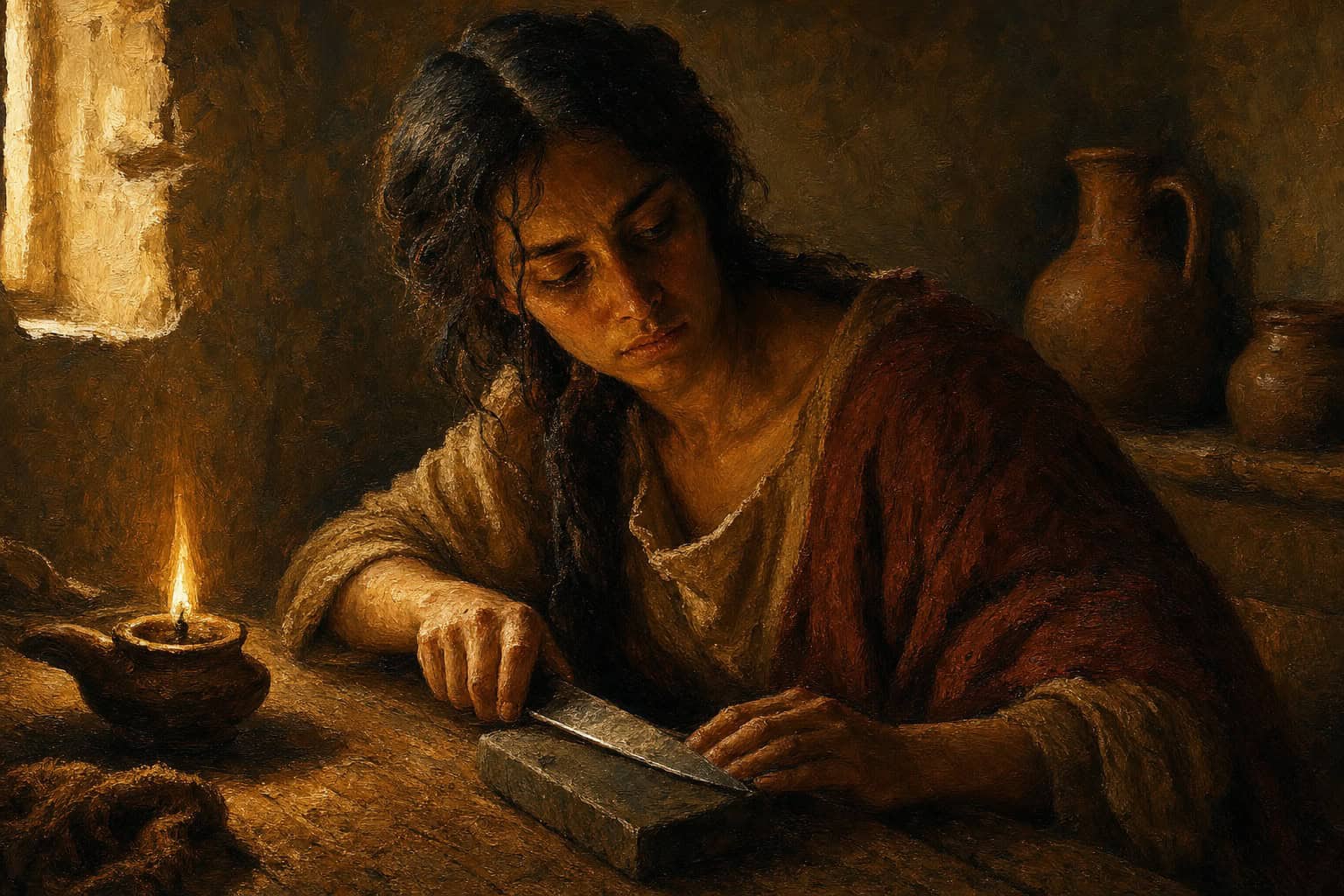
Here the floor shifts beneath you. The narrator offers an image that reframes the whole appetite, and it does not soften the truth so much as open it wider than you expected. Some souls, he suggests, are fashioned to be whetstones. Their calling is to sharpen others through abrasive contact, and the scraping is not cruelty but craft, a kind of work done on you against your comfort. Read your own history of painful attractions through that lens and something turns over low in the chest. The people who cut you, who told you a truth you did not ask for, who ground against the dull places in you until something finally gave, may not have been accidents thrown across your path. And you, in your turn, may have been the grinding surface for someone else, the rough stone their edge needed pressing against. This is the revelation the chapter climbs toward and does not blink at. In youth we reach, without knowing it, for the ones who will break us in exactly the ways our soul needs breaking, while being reached for by the ones who need the specific edge only we can give. It is not chaos. It is design. Now hold that against your question about pain in bed and feel the small physical thing crack open onto something vast. The wanted sting, the marked skin, the hard hand, may be the body dimly acting out a spiritual truth it cannot yet put into words. The soul senses it must be scraped to become anything at all. The flesh reaches for a crude rehearsal of that scraping and gives it the name of desire.
The sting you reach for is the soul rehearsing a truth the flesh cannot yet say: that nothing sharp is made without being ground.
But the narrator will not let this harden into an easy excuse. He knows the gap between a stone chosen in honesty and a body used to dodge honesty. The forge does its work whether or not you grasp what it is doing, and the tears are still real salt on the face, and the loneliness does not evaporate the instant you name it. What breaks open here is not comfort. It is a stranger and heavier thing. It is the sense that even in the rooms he is least proud of, something was being shaped in him, that the God he was running from was walking at his side in the very running, quiet, unhurried, present in every hollow morning, not hauling him out of the dark but refusing to leave him alone down in it. The scraping had a maker. That does not make it hurt less. It makes the hurt mean something the narrator could not see while it was happening.
We do not want the hurt; we want a witness sharp enough to prove we are still here.
By Noon the Skin Has Forgotten
So what falls out once the turn has landed and the room goes still? The mark fades by afternoon. That is the part the appetite never wants to look at squarely. Whatever the sharp contact seemed to prove in the dark, it quietly un-proves by lunch, and the restlessness comes back to sit in its old chair, unchanged, sometimes heavier than before. The narrator has ridden this cycle enough times to lay it out without shaking. The pursuit, the performance, the intensity, the brief blazing minute of feeling seen, and then the flat gray return of the same loneliness, exactly where he left it. He echoes, in his own broken way, an old man who chased his appetites in youth and looked back near the end to say the heart stays restless until it comes to rest in something larger than itself. That is the fallout of the whole thing. Pain in bed can do many small things, but it cannot give you rest, and rest was the true prize all along. It can pin you to a moment. It cannot keep you past it. And being kept was what you wanted underneath everything, to be seen and held and not set back down like a tool returned to a drawer. Here the fear of vanishing circles back with its full weight. The entire hunger for the sharp edge was a hunger not to be erased, not to become a body someone borrowed and forgot. But the sharp edge, used this way, does the very thing you dreaded. It turns you into a sensation, an instrument, a means to another person’s night. It thins you out faster while promising to make you solid. The narrator sits inside this contradiction and does not tidy it away. He cross-examines his own part in it. Did he ever see the women, or did he hold them up like mirrors to check that he was still there? Did anyone ever see him, or was he the mirror in someone else’s hand? He does not know, even now, and he lets the not-knowing stand in the open. What he does know is that the numbness came first, before any belief about himself, a dull ache that kept dragging him back to the same scene, a young man pulled toward bodies he could not fully live inside. The fear of never loving back, of being made wrong for it, showed up not as a doctrine but as that flat feeling in the flesh, arriving before the words for it did. The chapter hands you no fix. It lets the morning stay gray and unresolved. And somehow that refusal to lie consoles more than any bright answer could, because it does not pretend the sharp thing can heal what only being kept could heal.
A Restlessness That Finally Knows Its Own Shape
Where does it settle, then, this question you carried in through the door? Not in shame, which the narrator will not hand you, and not in permission, which he withholds just as firmly. It settles somewhere more useful and more demanding. The wanting of pain in bed is real, and it is telling you something. It is the soul speaking plainly that you are starving for a witness sharp enough to prove you are still here, that you are frightened of dissolving into someone’s forgetting, that intensity has quietly become your counterfeit for love. Read it that way and it stops being a private humiliation and becomes a window into your own making. The narrator does not order you to stop wanting. He shows you what the wanting keeps overshooting. This is why the book keeps its grip on you even here, in its least comfortable pages. It does not treat you as a fault to be corrected. It treats you as a soul under the file, sometimes brutally, in a forge you never asked to be placed in. Every hard attraction, every abrasive tie, every night that left a mark and no keeping, is being read backward now for what it was doing to the shape of you. Some of it was worship pointed wrong, plain and undeniable, bowing to a body because you had no ground of your own to stand on. Some of it, harder to say out loud, was formation, the grinding you genuinely needed, carried out by people who never once knew they were the stone. The narrator holds both truths at the same time without letting either swallow the other, and he does not pretend to have finished the sorting. What lingers when you close the chapter is not a solution to why the sharp edge feels like closeness. It is the odd, undeserved nearness of a God who did not wait for the narrator to scrub himself clean, who walked with him through the very rooms he cannot speak of without wincing, present in the gray mornings, present in the salt of his crying, showing Himself not by lifting the dark but by staying down inside it with him. That nearness is the thing the sharp edge was always faking. It is being seen without being used, held without being thinned to nothing, sharpened by a hand that means to keep you and not simply to mark you and walk out. Fractions of the Soul does not swear you will reach that rest by its last page. It swears only that the restlessness is not meaningless, and that even now, in the raw middle of the wanting, you are not walking through it alone.