How to stop being quiet: why your silence isn’t emptiness but a crowded room, and what it costs to finally speak.
The Word That Stalls Behind Your Teeth
Why can’t you just say it? You know the moment exactly. You are at the table, or standing in the kitchen while someone waits, and the sentence is already there, formed whole, pressing against the back of your teeth. And nothing comes out. Your jaw tightens. Your breath goes shallow and short, high in the chest, the way it does before a fall. You swallow, and the word goes back down into you like a stone dropped into a well, and you hear it fall and fall and never hit bottom. You tell yourself later that it wasn’t the right time. You tell yourself you didn’t want to make things worse, that you were being kind, that you were being wise. But you know, in the honest part of you, the part that does not lie even when the rest of you begs it to, that the silence was not a fresh choice made in that particular moment. It was old. It came pre-installed, wired in long before this room, this person, this waiting face. Somewhere back there you learned that speaking cost something and that the cost was almost always paid by you. So the quiet feels like safety, though when you pay attention it tastes like copper, like a coin held too long under the tongue. You imagine that to be silent is to be empty, a still pond, a held breath, a room where nothing is happening. That is the lie beneath the lie. The quiet is not empty. Your mouth stays shut and the inside of your skull roars. You are running the sums of every past reaction, every face that fell when you said too much, every time honesty got you punished or mocked or filed away for later use. The stillness on the outside is bought at the price of a riot on the inside, and no one across from you can see the riot, which is the whole terrible point. And here is the vertigo underneath it all: you are free to speak. Nothing physically stops your tongue. No hand covers your mouth. No law forbids the sentence. The entire weight of the moment rests on you and only you, and that groundless freedom is precisely what makes your stomach drop. You would rather blame the room. You would rather blame the other person’s mood, the bad timing, the tiredness in the air. But the truth, when you sit still with it, is that you are the one holding the door of your own mouth shut, and you have been holding it so long that your hand has cramped closed around the latch. To stop being quiet is not first to find words. It is to feel, all at once, how thoroughly you have been the author of your own silence.
The Crowd That Enters When You Open Your Mouth
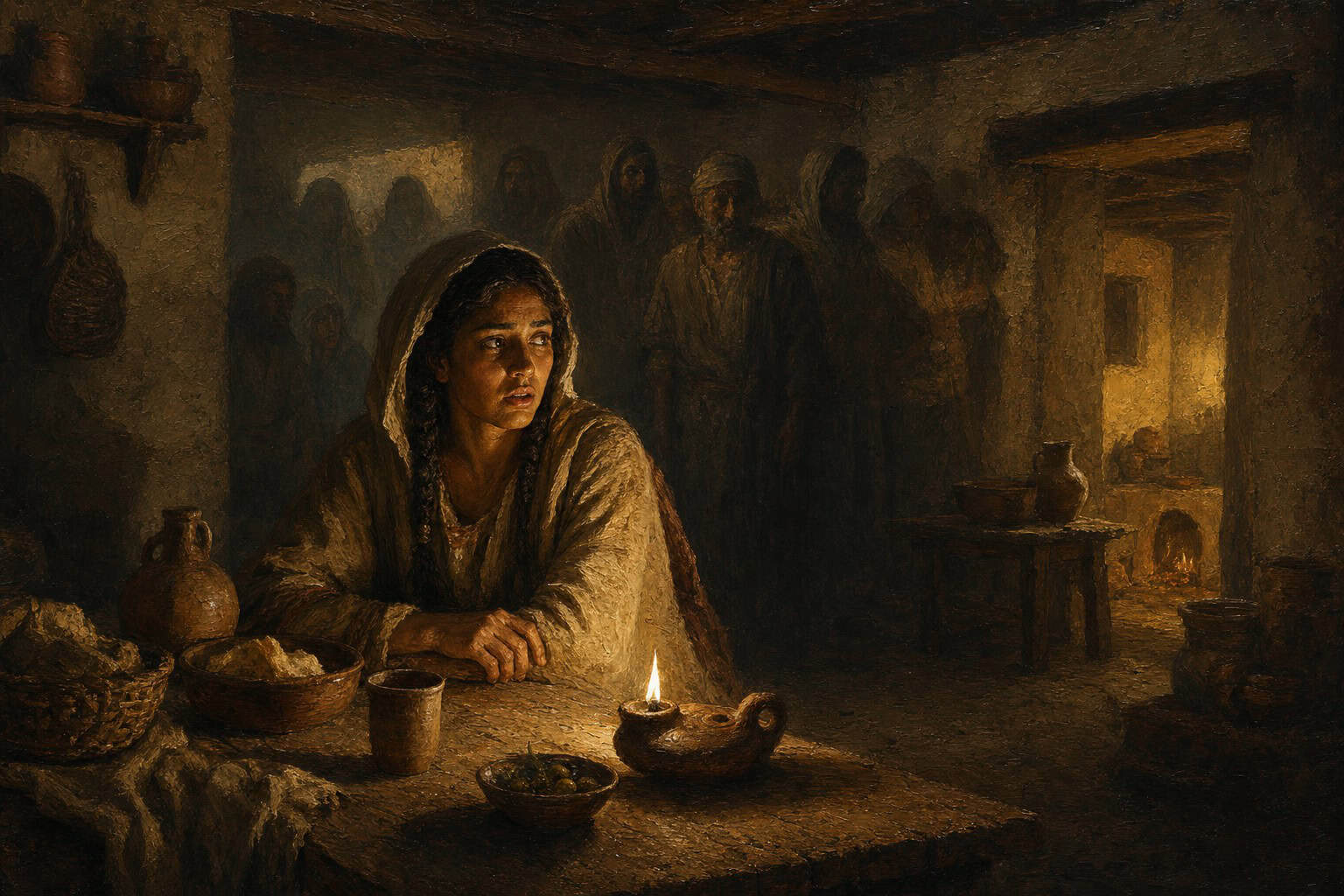
Notice who is actually in the room with you. Not just the one person across the table. Everyone. When you go to speak and the words stall, listen closely to what stops them, and you will hear a crowd. There is the parent who went cold when you talked back, and whose coldness taught your small body that speech is a switch that turns off love. There is the friend who used your honesty against you months later, calmly, in the middle of an argument, and whose calm taught you that whatever you say becomes evidence to be kept and later read aloud. There is the teacher, the first person who laughed at your voice cracking, the lover who sighed and looked at the wall instead of at you. You never meet anyone alone. You bring all of them into the room, a whole standing crowd, and the person in front of you brings their own crowd too, their own dead and living ghosts of who they were with others and who others were with them, and so the simple act of trying to speak becomes a kind of séance in a small, ordinary space. This is why new situations feel mysteriously heavy, weighted with rules that no one ever wrote down. You are not reacting to this face. You are reacting to a face-shaped echo of a hundred earlier faces. Your body knows the choreography before your mind consents to any of it. Your shoulders climb toward your ears. Your voice, if it comes at all, comes out thin and careful and already flinching, apologizing before it has said a single word. The dread is not paranoia. It is memory wearing the mask of the present hour. And here is the harder thing to admit, the thing that turns the lens back on you: some of those ghosts you have been feeding on purpose. You have kept certain wounds warm because they conveniently justified your quiet. If speaking is dangerous, then you never have to risk it, and staying safe begins to feel like wisdom instead of what it actually is, which is fear dressed up in a borrowed robe of prudence. The crowd in the room did put you here, that much is true. But you have been paying the rent to keep them here. You have chosen the predictable ache of the unsaid over the wild uncertainty of the said, again and again. That choice is small and daily and almost invisible, made a thousand times in a thousand kitchens and hallways and parked cars. And each time you make it, the groove wears a little deeper, and the next silence comes a little easier, and you become a little less able to remember what your own voice sounds like when it is not asking someone’s permission to exist.
The Latch Gives Way And You Are Terrified
Then comes the day it breaks. Maybe it breaks because you are simply too tired to hold it any longer. Maybe grief loosens your grip, or anger, or the plain animal exhaustion of one swallowed sentence too many. The word comes out. Your own voice, saying the true thing, out in the room, out in the air where it cannot be taken back. And the first sensation is not relief. It is horror. You have spent so long protecting the unsaid thing that finally saying it feels like stepping onto a floor that suddenly is not there. Your heart slams against your ribs like something caged and trying to get loose. You scan the other person’s face for the coldness you were promised, the sigh, the turning away, the confirmation that speaking was the mistake you always suspected it would be. This is the vertigo of freedom in its rawest form: you have done the thing you cannot undo, and now you must live inside the world your own voice just made. And you notice, standing there shaking, how much smaller the actual moment is than the crowd had made it seem. The words that took thirty years to say took four seconds to speak. Your silence is not a blank page; it is a page scribbled over by every voice that ever taught you to hold your tongue. To speak is not to write on some pristine emptiness. It is to write over the old scribbling, in your own hand, at last, pressing your true letters through the mess of everyone else’s. And here is the strange mercy hidden inside the terror: you are not struck down. The floor that vanished holds you anyway. You do not vanish either. You feel, perhaps for the first time in years, the actual edges of yourself, the plain fact that you are a person who can bend the space in a room, who leaves a wake, who was never nearly as invisible as you both hoped and feared. The defenses you guarded most fiercely, the words you swallowed with the most violence, turn out to have been guarding your most tender and most truthful self. What you hid the hardest was exactly who you most were. And now it is out, and it cannot be put back in your mouth, and you are trembling, and you are more alive than you have been in a long, long while. This is not triumph. It is closer to being born, which is to say it is bloody and it feels unchosen even when you chose it, and no one in that room, least of all you, has any idea yet what will grow up out of the words now lying on the floor between you.
Your silence is not a blank page; it is a page scribbled over by every voice that ever taught you to hold your tongue.
After the Words, the Ringing Quiet
What comes next is not clean, and you should be warned. The silence that follows your speech is a wholly different silence, and you have to learn to sit inside it without lunging to grab the words back. The other person may not answer the way you rehearsed. They may go quiet themselves, working their own crowd, consulting their own ghosts. The relief you were counting on may not arrive on any schedule you set for it. Sometimes speaking the true thing makes everything harder before it makes anything easier, and you will be sorely tempted to conclude that the old silence was the wiser policy after all, that you should crawl back behind your teeth and pull the latch shut and never do this to yourself again. This is the fallout, and it is real, and no tidy little lesson wipes it away. You lie awake at two in the morning replaying the whole thing. You wonder if you said it wrong, too sharply, too late, too much all at once. You turn the lens on yourself, honestly this time, and you ask the hard ones: was that courage, or did I just finally snap under the load? Did I speak to reach them, or only to relieve the pressure in my own chest? These are not questions with clean answers, and you dishonor yourself by pretending they are. Because your motives were mixed, as your motives are always mixed, and the very same mouth that spoke a true thing may have spoken it partly to wound, partly to punish, partly to be free of you rather than close to them. You have to hold all of that at once. You have to let it stay uncomfortable and refuse to sand it smooth. And in that discomfort, if you are quiet enough to notice, you find you are not as alone in it as you dreaded. There is a presence in the raw hour after speaking, not a voice that swoops in to fix the mess, not a hand reaching down to tidy the room and reassure you that everything is fine. It is a nearness. A companionship inside the very confusion. It does not lift the dread off your shoulders. It sits down inside the dread with you and stays. It walks alongside you through the second-guessing, the sleeplessness, the low hum of fear that you have broken something you can’t repair. This is not the comfort of resolution. It is the stranger, harder comfort of not being left to face the ringing quiet by yourself. And your finitude presses in here too, the plain fact that you have only so many true words left to say before you die, that every sentence swallowed for good is one you may never get another chance at, that death turns the unsaid permanent. That is what finally makes the quiet unbearable. Not that speech is safe. It isn’t. But that silence was never free either. It has a price, and the bill always comes due.
The Voice You Thought You’d Buried
So how do you actually stop being quiet? Not by deciding, one bright morning, to be brave. Deciding to be brave does nothing at three in the afternoon when the word stalls again behind your teeth and your breath goes thin. You stop being quiet by learning to see the crowd in the room and calling it by its right name, old fear wearing today’s clothes, so that when the dread rises up your throat you can say to yourself, low and steady inside, this is memory, this is not the present, and then speak anyway, straight through the shaking hands and the racing pulse. You stop by letting the small daily silences become genuinely intolerable to you, by feeling the true weight of each swallowed sentence, by refusing to keep paying rent to the ghosts who long ago taught you to hold your tongue. You stop by accepting that your motives will always be mixed and speaking regardless, because waiting for clean motives is just one more elegant excuse to stay silent forever, one more robe for the fear. And you stop, finally, by understanding all the way down that the alternative to speaking is not peace. The alternative is a whole life scribbled over entirely in other people’s handwriting, a page where your own voice never once got a line of its own. You do not owe the world every passing thought that crosses you. But you do owe your own soul the words that are true, the ones that have been fermenting in you for years, going sharp and strange and half-poisonous from being kept too long in the dark. There is a self down there you were sure you had buried, and it is not dead. It is only muffled. It has been knocking on the inside of your chest all this time, patient and stubborn, waiting for you to open your mouth and let it out into the light. The terror of your own freedom does not go away. It never goes away, not fully. But you can learn to speak with it rather than instead of it, to let your voice tremble and come out trembling, to become a person who bends a room a little, who is felt, who is undeniably here. This whole ache, the crowded silence and the cost of the word held back, runs beneath the pages of Fractions of the Soul like water moving under a frozen field, and if you have read this far because you kept recognizing your own face in it, then some buried part of you is already knocking. Do not wait for the perfect hour. There has never been one. There is only this narrow, uncertain, finite stretch of days in which your voice is still yours to spend. Say the thing. Say it clumsily if that is all you can manage. But say it while there is still a mouth to shape it and someone left in the room to hear.