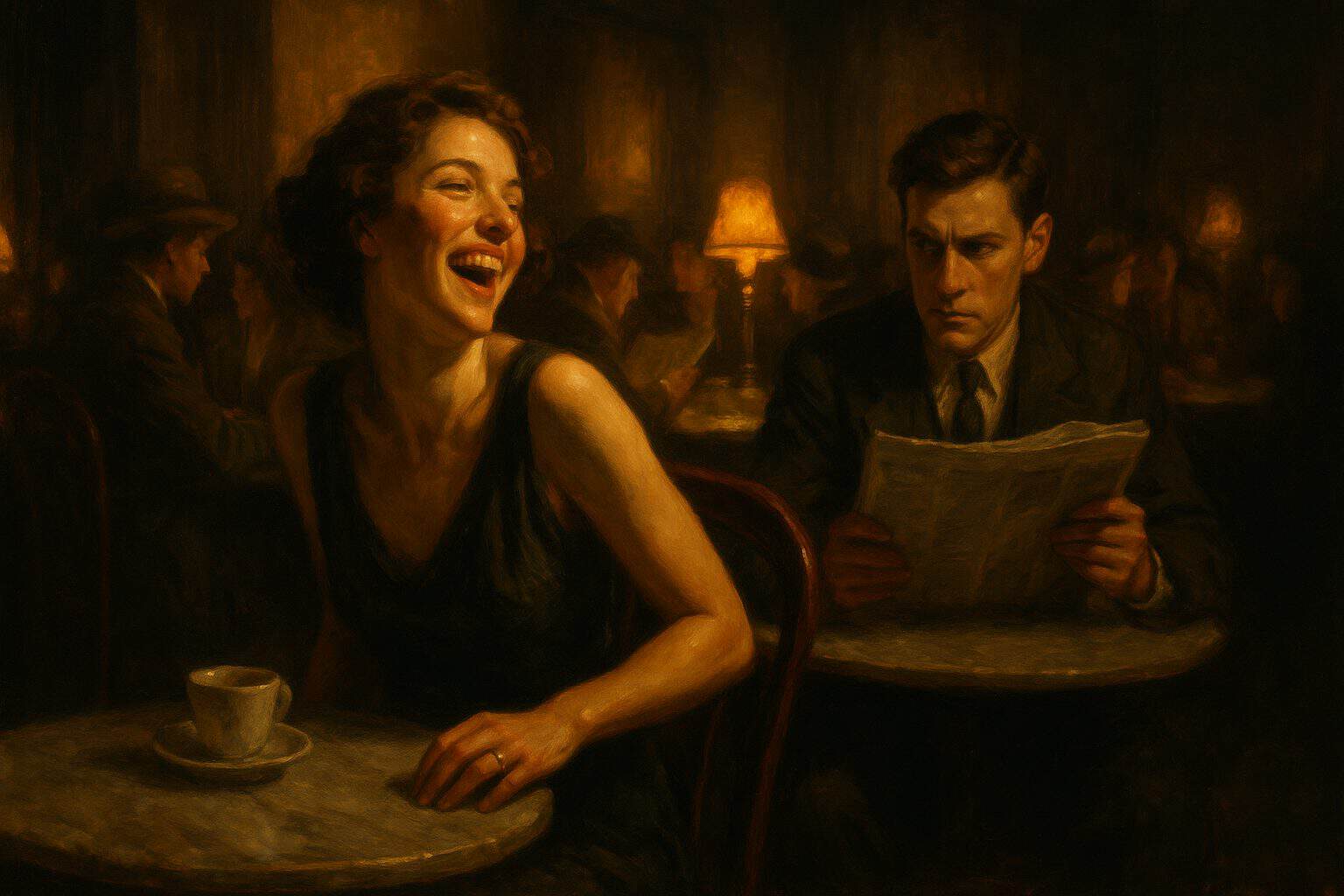
Where the ancient script of survival writes itself through every glance, every hunger, every betrayal of the heart
The woman across the café shifts in her chair, and something older than language stirs. Not in her—through her. Through the angle of her shoulders drawing back, the unconscious smoothing of fabric across her thigh, the sudden brightness that enters her eyes when she laughs. Through the man three tables over who has been pretending to read the same page for ten minutes, his peripheral vision attuned to her movements with the precision of a hunter who doesn’t yet know he hunts.
This is how it announces itself, this force that David M. Buss names but cannot capture: not as idea or intention, but as the very medium through which bodies move, eyes seek, hearts calculate their secret mathematics. We are, each of us, archives walking through the world—but archives that cannot read their own texts. The script writes itself through us in a language we speak fluently but cannot translate.
The Inheritance That Chooses
A young man enters a room full of strangers at a gallery opening. Before thought, before decision, his body has already begun its ancient inventory. Height relative to other males—the measurement happens in the muscles of his neck, the micro-adjustments of posture. The women present sort themselves in his peripheral vision not by conscious assessment but by something that moves beneath consciousness, older than consciousness. One woman’s laugh cuts through the ambient noise and his entire nervous system reorganizes around that sound, though he hasn’t yet looked at her directly.
“Evolution designed him not to see her as she is—she is for mating not for understanding.”
But what does it mean to be designed by forces that have no designer, shaped by purposes that predate purpose itself? The man doesn’t experience himself as a product of millions of years of sexual selection. He experiences the sudden dryness in his throat, the way his voice drops half an octave when he finally approaches her, the strange confidence that seems to come from nowhere—or rather, from everywhere, from every successful approach made by every ancestor whose approach succeeded enough to make him possible.
She, meanwhile, experiences something else entirely. Not his approach but the entire field of the room reorganizing around his approach. The other men’s subtle tensions, the other women’s evaluative glances, her own body’s instantaneous calibration—is he taller than her in heels? Does his watch suggest resources? His shoes? The way he holds his drink? All of this happens faster than thought, a kind of somatic mathematics that evolution has been refining far longer than humans have been human.
The Marketplace We Cannot See
“One woman is just as good and pleasurable as the next,” Adoré writes, channeling the brutal democracy of pure biological drive. Yet in the next breath, he recognizes that solving “the loneliness problem” requires looking to differences that evolution cannot quite account for. This is the paradox that lives itself through every dating app swipe, every first date, every relationship that begins in biology and tries to transcend it.
Watch how it works in the lived world: A woman prepares for a date, and her preparation is both utterly contemporary and timelessly archaic. The makeup that “enhances natural beauty” is also the amplification of youth markers—the flush of arousal, the clarity of health, the symmetry that signals good genes. She knows and doesn’t know what she’s doing. The knowledge lives in her hands as they apply the mascara, not in her mind that tells itself stories about self-expression.
The man picking her up has spent forty minutes choosing a shirt, though he would deny caring that much. The shirt must signal resources without trying too hard, must suggest fitness without being too tight, must be appropriate to the venue he’s chosen—which itself was selected through unconscious calculations about what kind of environment will make him appear most advantageous while making her feel simultaneously special and safe.
This is what Buss maps but cannot quite capture: the way evolutionary imperatives live themselves through cultural forms that seem to transcend them. The candlelit dinner is both a resource display and something more. The conversation about dreams and fears is both mate-quality assessment and genuine human connection. We are always doing two things at once, and the tragedy—or perhaps the comedy—is that we can never quite separate them.
The Sisterhood of Scarcity
“The War Brides Dynamic,” as filtered through Adoré’s reading of Tomassi, reveals something essential about how evolution’s logic lives itself through female solidarity. The captured women of defeated tribes who survived by bonding with their captors—this ancient pattern allegedly echoes through every women’s bathroom where strangers become instant allies, every whisper network warning about dangerous men, every unspoken agreement to maintain certain illusions.
But observe how this actually manifests: Three women at a wine bar, friends since college. One mentions she’s been seeing someone new. The others lean in, and what follows is not mere gossip but a kind of collective intelligence gathering. “How does he treat the server?” one asks. “Has he mentioned his ex?” asks another. They are performing an ancient ritual of mate-quality assessment, pooling their collective wisdom about male deception patterns, sharing intelligence about resource reliability and commitment probability.
“Evolution reward females in their youth with fertility and beauty, and few are the ones who fail to take advantage of nature and evolution.”
Yet what does it mean to “take advantage” of what takes advantage of you? The young woman at the peak of her beauty experiences it not as power but as a kind of visibility she didn’t choose. Men’s eyes follow her, but their gaze sees something that both is and isn’t her. She is visible as fertility signal, as youth marker, as genetic potential—and invisible as the particular person living behind that face evolution shaped to attract.
She learns to weaponize what weaponizes her. The beauty that makes her visible also makes her vulnerable, so she develops what Adoré calls “plausible deniability”—the art of being desired without appearing to invite desire, of maintaining options without seeming to shop for them. This isn’t conscious strategy but embodied knowledge, learned through ten thousand micro-negotiations with male desire.
The Calculus of Commitment
A couple sits in a restaurant, three years into their relationship. She mentions, seemingly casually, that her friend just got engaged. He feels the familiar tightening in his chest—not quite anxiety, not quite anger, but something evolution hasn’t quite given a name to. His “commitment skepticism,” as Buss might term it, is both personal psychology and species memory. Every male ancestor who committed too quickly, too fully, risked investing in offspring that weren’t his. The hesitation lives in his nervous system as surely as his heartbeat.
She feels his withdrawal as clearly as if he’d physically stepped back. Her “commitment urgency” carries its own evolutionary logic—every month matters in a way his months don’t. But she experiences this not as biological countdown but as a kind of restlessness, a growing irritation with his contentment with the status quo, a suspicion that he’s “wasting her time”—a phrase that means more than either of them consciously knows.
“The ideal mate,” Adoré suggests, “is one who excites both evolution, the physical and material, and the spirit, the mind and the passions.” But what happens when these two excitements pull in different directions? When the body wants what the spirit knows will destroy it? When the mind recognizes compatibility while the genes scream incompatibility?
The Veil We Cannot Lift
“He cannot see her as she is because evolution designed him not to see her in such a manner.” This is perhaps the most tragic aspect of what Buss’s framework reveals: we are designed to misperceive each other in highly specific ways. Men overperceive sexual interest because false positives cost less, evolutionarily, than false negatives. Women underperceive men’s commitment readiness for the opposite reason.
Watch a man in the grip of new attraction: His entire perceptual field reorganizes. Her flaws become invisible or charming. Her ordinary kindness seems extraordinary grace. Her sexual interest appears greater than it is. He’s not deceiving himself—evolution is deceiving him through himself. The deception is so deep it doesn’t feel like deception but like clarity, like finally seeing truly.
She experiences something different but equally distorting. His attention feels like recognition of her unique self, not attraction to her youth and beauty. His resources seem like generosity rather than display. His jealousy feels like caring rather than mate-guarding. She’s not naive—she’s experiencing the world through perceptual filters shaped by millions of years of female ancestors who survived by making exactly these misperceptions.
“After those first encounters, disfigured by my confession about Angela, she never again burned with spontaneous desire.” Here Adoré touches something Buss’s framework struggles to explain: how knowledge can poison attraction, how consciousness can interrupt the unconscious programs that generate desire. Once you see the strings, the puppet show loses its magic.
The Competition We Cannot Escape
Every social gathering is also a mating market, whether we acknowledge it or not. Watch how people array themselves at a party: The men unconsciously establishing hierarchy through body language and verbal sparring. The women unconsciously advertising their mate value while simultaneously evaluating the men’s relative standings. The coupled people unconsciously mate-guarding through subtle touches and positioning.
This is exhausting precisely because it never stops. There’s no exit from the sexual marketplace, no retirement from mate competition. Even the married couple, decades into their union, still performs these ancient dances. He still tracks threats to his possession. She still monitors his attention for signs of wandering. They’ve just gotten better at disguising it—from others, from each other, from themselves.
“One part of me back then wanted to fall in love again—I hated myself for that; love would make me vulnerable, dulling my senses and intellect.” Adoré recognizes what evolutionary psychology confirms: love is a kind of blindness, but a blindness that serves reproduction. The dulling of senses and intellect that accompanies new love isn’t a bug but a feature—it overrides the prudent calculations that might prevent mating.
The Sin That Precedes Sin
“When humanity fell from grace, Lucifer claimed equal parentage with God and forever bound his essence to our own.” Adoré frames in theological terms what Buss describes in biological ones: we are creatures at war with ourselves, bearing within us contradictory imperatives that guarantee suffering.
The man who wants both novelty and stability, who desires both the virgin and the whore, who seeks both conquest and comfort—he’s not confused or immature. He’s expressing the fundamental contradiction of male sexual psychology, shaped by the different adaptive problems of short-term and long-term mating.
The woman who wants both the dangerous and the safe, the alpha and the beta, the provider and the lover—she’s not indecisive or manipulative. She’s embodying the essential tension of female mate choice, trying to optimize across incompatible virtues.
“God’s warning against lust focused less on the sexual act itself and more on the idolatry and greater sin that the underlying desire bred.” What is this idolatry but the elevation of evolutionary imperative to ultimate concern? When we mistake the whispers of our genes for the voice of our true self, when we let ancient programs run our modern lives, when we sacrifice the spirit to the flesh that the spirit inhabits?
The Hope That Survives Knowledge
“No fortress can protect the human heart from hope,” Adoré writes, and here perhaps is where the Darwinian map finally fails. Evolution can explain attraction, competition, deception, even love—but can it explain the hope that persists after all illusions have been stripped away? The couple who knows exactly how their mutual deceptions work but chooses to continue anyway? The love that survives seeing clearly?
There’s something in human mating that exceeds mating, something in human love that transcends its evolutionary function. Not because we escape our biology but because consciousness of our biology becomes part of our biology, creating recursive loops evolution never predicted.
The man and woman in the café—remember them?—they’re still there, still performing their ancient dance. But perhaps one of them, or both, carries Adoré’s bitter wisdom: knowing the game doesn’t exempt you from playing it, but it might—just might—allow you to play it with something approaching grace.
“The greatest risks are sometimes the sole path to the grace we claim not to need.” This grace isn’t escape from our evolutionary inheritance but conscious participation in it. Not transcending the Darwinian map but reading it clearly enough to choose our route with open eyes.
We remain animals, but animals who know we’re animals. We remain programmed, but programmed beings who can observe our own programs running. We remain in the marketplace, but perhaps—sometimes, briefly—we can love each other not despite the market’s brutal logic but through it, beyond it, carrying it with us into something it never meant to create.
The script continues writing itself through our bodies, our glances, our choices. But occasionally, in moments of grace that evolution never selected for, we write back.