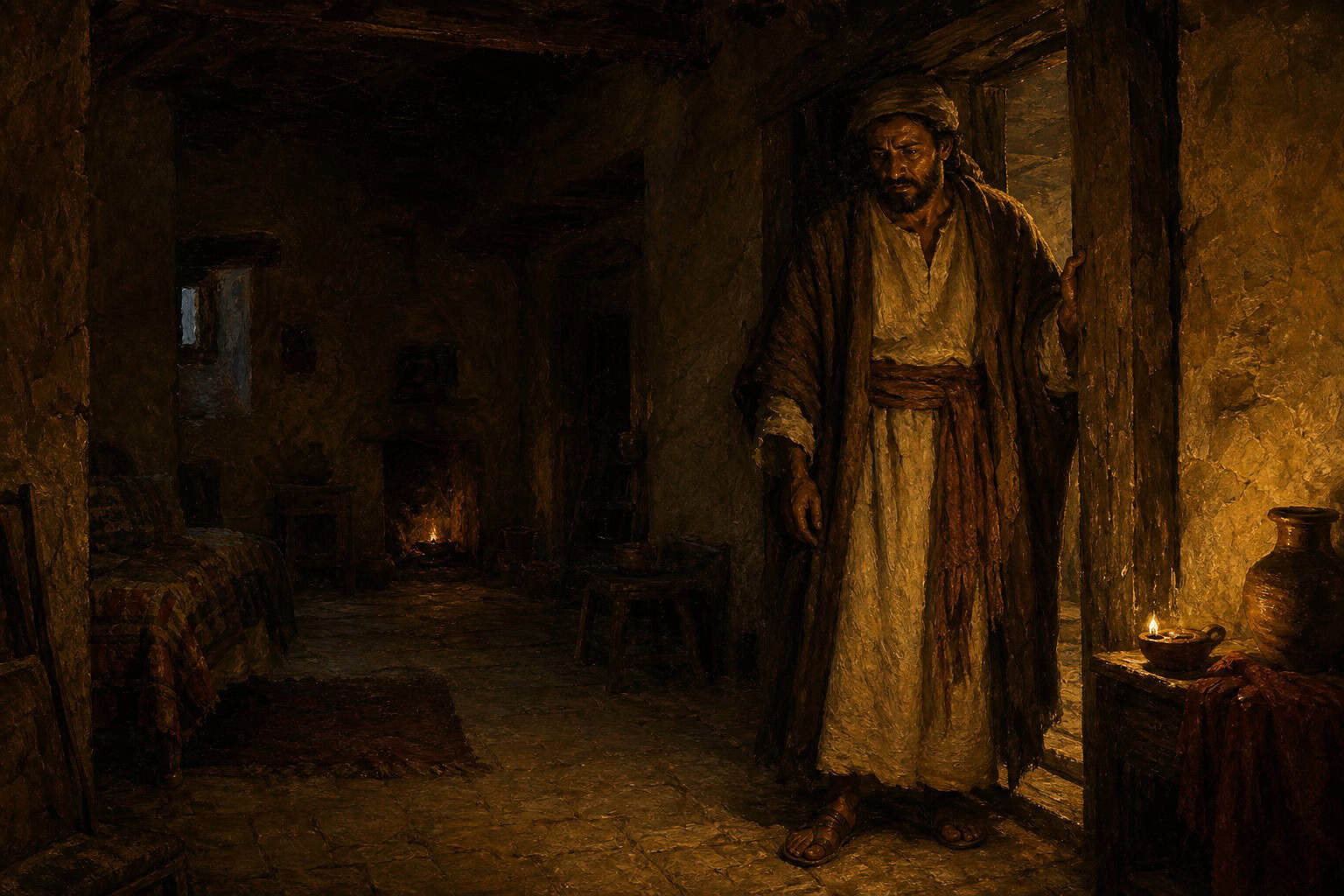
Feel trapped inside your own head? A reflection on the narrow perception we mistake for the whole world, and the vastness we never see.
Standing at the Edge of the Room I Called Everything
You feel trapped, and you cannot name the bars. That is the first cruelty of it. A man locked in a cell can at least run his hands along the cold stone and count the walls, press his palm to the mortar until his fingers ache, and know exactly what holds him. But the trap I am describing has no walls you can touch. It is the shape of your own seeing. In Fractions of the Soul I turned this over slowly, the way you turn a coin you suspect is counterfeit, tilting it toward the light for an edge that will not come. Picture someone pausing at the mouth of a restaurant, taking in the tables and the low amber light from exactly where they stand. What they see is real. But it is only a slice, cut clean by the angle of their body in the doorway. Here is the mercy of a room, though: its size hints at more. You sense there are corners you cannot see, a kitchen behind a swinging door, a back table around a bend you have not walked. The physical world is generous that way. It leaves crumbs. It tells you, quietly, that it exceeds you, that if you take three steps forward the whole geometry of the place will rearrange itself and give you something new. But the mind offers no such generosity. When you look at the world through one lens, the lens does not announce itself. It does not whisper that a better way of seeing waits just past the frame. It simply lets you believe you see what is. That phrase has haunted me for years. Most people live accustomed to their own limits, dead certain that the sliver is the whole. I was one of them, and I was proud of it. I built a life on the confidence that my perception delivered the truth clean and entire, and I never once felt the edges of it, because edges you cannot feel do not feel like edges at all. They feel like the far horizon. They feel like the honest limit of what there is. The dread creeps in only later, in some quiet hour, over a cup gone cold in your hands, when you begin to suspect that the walls of your world were never the world’s walls at all. They were yours. You built them. And you carry them with you into every room you will ever enter. The trapped feeling is not that reality is small. It is that you cannot tell where you end and reality begins. That is the vertigo. That is the groundless hour I keep returning to, the one I want to sit inside with you now, without pretending I have already climbed out of it.
The One Percent That Divides Us From the Beasts
The book pushes the thought into stranger territory, and I followed it there because it frightened me in a way that felt useful, the way cold water frightens you awake. We share ninety-nine percent of our genetic code with the chimpanzee. Every cathedral, every symphony, every scientific breakthrough, every ache of prayer whispered at midnight into an empty room — all of it lives in the one percent that separates us from the animal. Let that number sit on your chest for a moment until you feel its true size. Our entire glory balances on a fraction so thin it should embarrass us. And yet even that thin margin is enormous. There are apes who have learned signs, who understand hundreds of our spoken words, who reach toward us across the gap with clumsy, deliberate hands. A bonobo named Kanzi. A gorilla named Koko. Creatures who tried to enter our world and could only press their faces against the glass of it, understanding just enough to know there was more, never enough to cross. The difference is not only in the folds of the brain but in the throat, the tongue, the plain anatomy that makes our speech easy and their speech impossible. A chimpanzee cannot grasp the meaning of its own suffering, because it cannot step into the human world where suffering acquires meaning at all. It hurts, and the hurt is mute. It has no dimension large enough to hold the pain in, no room behind the pain where the pain becomes something. And here the dread turned back on me like a blade turned in the hand. If the ape cannot enter our world to find the sense of its pain, then what makes me so certain my world contains the sense of mine? What if the ultimate meaning of everything I have endured lives in a dimension I am as sealed out of as the ape is sealed out of speech? I sat with that for a long time in the dark. I still sit with it. Imagine, the book asks, a species one percent beyond us in the very same direction we stand beyond the beast. To such a being, our proudest achievements — our science, our love, the whole reach of human potential — would look like a chimp fumbling with a stick to reach an ant. Our theology, our art, the tenderness between two people who understand each other. All of it, to them, a monkey’s grief. This is not a comfortable thought and I will not pretend it comforted me. It humiliated me. It stripped the varnish off my confidence in one hard pull. But somewhere down in the humiliation there was a strange loosening, the first hairline crack in the certainty that had been my prison all along. If my seeing is that partial, then the trap I feel is real — but its walls are not the edge of what exists. They are only the edge of what I can, right now, receive. That is a wholly different sentence, and I had to learn to breathe inside it.
The Hour the Floor Fell Away Beneath My Certainty
The turn came not as relief but as terror, which is the honest thing to say and I have stopped lying about it. Because if my perception is a keyhole and not a window, then I have spent my whole life living inside a claim I never once examined, never held up to any light. And worse than that: every new way of seeing I might reach for to replace this one, I would have to reach for from inside this one. I cannot climb out of my own eyes to check whether my eyes are working. There is no ledge to stand on outside myself. That is the vertigo in its purest and most sickening form. You reach for a firmer patch of ground to steady yourself and discover that the ground itself was the very thing in question. In the book I confess a version of myself who did far worse with this than merely stand there feeling dizzy. I took the softness of perception and I sharpened it into a weapon against my own conscience. If facts can be re-seen, I reasoned, then facts can be dissolved. I taught myself to strip events of their weight until they floated, to subordinate what actually happened to whatever I needed to feel in the moment, to hold former loves inside a cage I politely named friendship while the old fire kept burning low and quiet beneath the innocent word. I curated my presence and my absence like a man arranging photographs, keeping the record clean, the face I showed the world untouched by the mess underneath. I told myself I had not chosen these things, that some other self within me had done them while I merely watched, and I stood back with my hands open as if I were only a stunned witness to my own hands. I split into pieces so that no single piece would have to carry the whole. This is the ugliest use a man can make of the truth that all seeing is partial — to pretend, from that truth, that you are not the author of what you see and what you do. I made a doctrine of my own fragmentation and called it survival.
> You are not caged by the world; you are caged by the size of the window you were handed and called a view.
And the horror of it was that the doctrine worked, for years, right up until the floor gave out.
You are not caged by the world; you are caged by the size of the window you were handed and called a view.
After the Idol of My Own Eyes Was Broken
So what does a man do the morning after the floor gives way beneath him? He does not wake healed. That is the lie I most want to refuse, because I believed it once and it cost me. The dread does not lift like fog burning off a field in the first hour of sun. It stays. You go on making the coffee, warming your hands on the mug, going to work, kissing the people you have wronged on the cheek at the door, and the whole time you carry a new and terrible knowledge under your ribs: that you cannot fully trust the one instrument through which you meet the entire world. In the book this is where I stop performing my innocence and begin the slower, harder reckoning with the fragments I had scattered on purpose. If I split myself into pieces to escape the sheer weight of my own freedom, then the healing cannot be a quiet return to the comfortable single lens I used to love. It has to be the harder thing: staying awake inside the fracture, refusing to let the pieces close back over the wound. What follows is not a plot with a shape but a slow, humbling undressing. I had to admit that the people I loved were never characters in a story I was authoring. They had their own worlds — as real, as full, as sealed off from me as mine was from them — and I had bracketed them, held them at arm’s length, refused to let their reality push its way into the little kingdom I had built and lit and furnished to my own taste. That refusal felt like power at the time. It felt like being the one who decides. Now it looks like the deepest chamber of the trap. Because a self that will not let the other one in is a self that has quietly nailed shut the last window it had left. The strange grace — and I choose that word with great care, because it was in no sense a rescue — was that in the very hour of admitting all this, I was not alone in it. I do not mean a light broke through the ceiling. Nothing was fixed. No angel took the dread away. But there was a Presence walking with me in the sin itself, unhurried, close, not hauling me up out of the dark but lowering Himself down to sit in it beside me on the floor. This is what I could not have understood before, back when I still believed my two eyes handed me the whole. The vastness beyond my own threshold was never only a bigger country of ideas to explore. It was Someone already standing in the parts of the room my seeing could not reach, waiting patiently in the corner the doorway had always hidden, present in the very despair I had assumed was the surest proof of His absence.
The Wider Room I Did Not Know Was There
Where does this finally settle? Not into a solution, because a trap dissolved by a clever enough argument was never a real trap to begin with, only a puzzle. It settles into a changed posture, a different way of holding my own head. I no longer believe I see what is. I believe I see a slice, angled by my position and my hunger and my old fear, and that the slice, however vivid, is not the world. This is not despair, though it is a close cousin of despair and shares its heavy bones. It is the raw beginning of humility, which is the only way I have found out of a cage whose bars are made entirely of certainty. The physical restaurant taught the first and easier half of the lesson: its size alone promised further rooms, and you could trust the promise and go find them. The mind, offering no such promise, no crumb, no hint, taught the harder half — that I must go looking for the wider space on faith, entertaining new ways of thinking and feeling that do not announce themselves, that must be chosen before they can ever be seen. Every genuinely new thought is a small, trembling act of trust that the world exceeds you, that there is more behind the swinging door than the tables you can count from where you stand. I think now that the feeling of being trapped was never a lie my mind told me. It was true, dead true, and it was also a summons. The dizziness at the edge of my own limits was the first honest measurement of how small I had made my world by mistaking it for the whole one. What I did with that trap for years was crawl inside it and call the hiding freedom, arrange the furniture, and lock the door from within. What the book slowly becomes is the record of a man who stopped calling the hiding by that beautiful name. If you are reading this because you typed those exact words into a search bar — I feel trapped inside my own mind — I will not hand you a tidy exit. There may not be one visible from where you are standing tonight. But I can tell you plainly that the walls are the shape of your seeing and not the edge of what is, and that a Presence you have not yet learned to perceive may already be standing in the part of the room your eyes have never once reached. That is where this chapter of Fractions of the Soul leaves me, still on my feet, still walking, slow, toward the corner I cannot see.