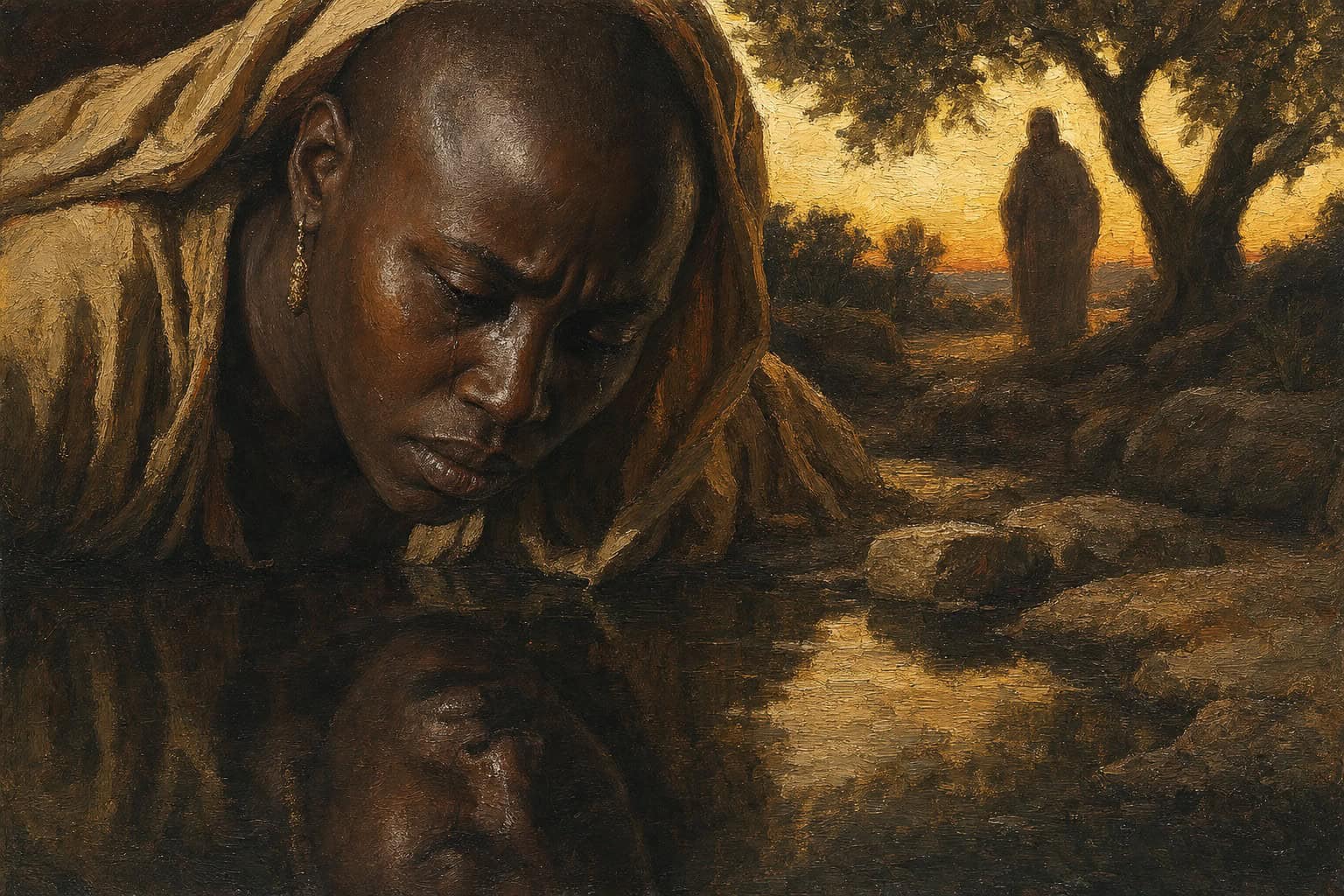
The world is a cruel place. A reflection on wounds that don’t match, temptation that studies us, and where the ache toward wholeness points.
A Face Held Too Long in Still Water
You woke up already tired of it. The alarm, the traffic, the message that went unanswered, the way a person you loved looked past you as if you were a coat rack in the corner. You typed the words into the search bar because they sat like a swallowed stone in your chest: the world is a cruel place. I know that stone. I have carried it up stairs and into churches and to the edge of my own bed at two in the morning. In Fractions of the Soul, the fourth chapter turns back to the oldest garden and finds the cruelty was already there before the first bite of forbidden fruit, hidden in something quieter and lower than any hiss from a snake. Picture Eve bent over a pond in the cool of the morning. The water is still, unbroken, dark under the trees. She has arranged her hair with her fingers. She has softened her expression until the face looking back at her pleases her. She lingers there. She does not want to leave. And the lingering itself is the new thing. Adam does not do this. His gaze runs outward and practical, fixed on the work of naming beasts and keeping the order of the place. But Eve finds a private sweetness in the still water, a pleasure that answers only to itself and needs no one else to complete it. This is not yet sin. It is a tell. It is a small crack in her attention, a place where her love bends back on itself instead of running outward. And the book asks a harder thing than the one you typed into the machine. The cruelty of the world may not begin with malice at all. It may begin with a mismatch woven into us from the first morning, a hunger that never quite fits the shape of the world set in front of it. The scene sets this down plainly and without decoration. Eve was drawn from Adam’s loneliness, from the hollow left when the rib was taken out of his sleeping side. But her own spirit reshaped that loneliness into something similar yet different. She loved Adam, truly, and yet not with the same total surrender he poured toward her. She held a portion of herself back, from him and from her Creator alike. Before any temptation, before any fall, there was already this quiet imbalance humming under the garden’s peace. One heart made to give everything. Another built, by its own grain, to keep a little for itself. That is where the book locates the first cruelty. Not in a punishment. Not in a serpent’s lie. In the plain fact that love, at its origin, did not run equal in both directions. The pond does not warm to Eve. It only shows her back to herself, cold and flat and lovely.
The Rib-Wound That Would Not Match
Here is the tension the chapter refuses to soften, and I will not soften it for you either. Adam’s loneliness was a real thing, a hollow God carved into him on purpose and then filled with the woman drawn from his own bone. When she stood before him, he found his fulfillment. The empty room in his chest had a tenant at last, and he could rest in her. But the book insists on something painful and precise. Eve did not receive a matching hollow. She carried only a modified echo of his wound, individuated by her own spirit into something that did not demand him the way his ache demanded her. She could love and still stand a half step apart. She knew in her bones that she was made for him and he for her, and yet she never fully gave herself over, not to her husband, not to the One who made her. Read that slowly, with your own hand pressed flat against your ribs, because it explains more of your life than you want it to. You have felt this exact imbalance and called it something crueler. You loved someone with your whole body and your whole day and watched them love you back with three-quarters of theirs. You gave until your hands were empty and received a careful, measured, rationed portion in return. And you told yourself the fault was yours. You were too much. You were not enough. You were badly built, wired wrong, asking for what no sensible person owes. The book offers a colder and truer mercy than that self-blame. Sometimes the imbalance is simply there, in the grain of two souls, and no amount of trying planes it flat. Two people can both labor honestly and still not match. One capacity for total surrender meets another’s built-in withholding, and the gap between them opens into a wound that no effort on either side can close. This is the tragedy that arrives before the fall, older than any sin you could confess. The world feels cruel because it is stitched together out of these mismatches, and we keep walking into them expecting a symmetry the garden itself did not contain. We want the one we pour into to pour back at the same rate. We want God to fill us as quickly as we empty ourselves toward Him. There is a longing here that runs out ahead of anything that could satisfy it. You reach for a wholeness you can name to the letter but cannot yet hold in your two hands. You know exactly what a fully returned love would feel like, and its absence aches precisely because you can picture every inch of it. The chapter lets Eve stand at her pond, loved and unequal. It lets Adam stand nearby, filled and unaware that his own filling is not returned in kind. That quiet gap is the first cruelty, and it leaves an opening that something patient has been waiting, for a very long time, to walk through.
The Scholar Who Kept Better Records Than We Do
Now the watcher moves. He has been observing from a distance the whole while, and the book makes the rule clear before it makes the danger clear. The Creator set a law that no being may enter a soul against its free will. So the adversary does not batter the gate or break the lock. He studies it. He becomes a scholar of the human heart, patient across long stretches of time that mean nothing to him, gathering every tell, every glance, every small vanity like a collector pinning specimens. At first he is more often wrong than right, and each failure sharpens his craft rather than discouraging him. He learns, slowly, that Adam’s weakness is Eve herself, and that Eve’s weakness is her own reflection. He notices the pond. He notices how long she stares into the dark water, how she alters her hair and her face and then takes a strange, private delight in the altered image gazing back at her. He files it away without a sound. This is the turn that should make the hair rise on your arms, because it answers the sharpest edge of your question. The world does not feel cruel at random. Temptation, when it finally comes, arrives with terrible aim, driven straight into the softest place you own. You have felt this and blamed bad luck. The exact wrong offer that finds you on your worst afternoon. The single voice that knows precisely which lie you are already half leaning toward believing. It is no coincidence. Something has been keeping the ledger. Evil works like a patient student of your freedom, remembering what you long ago forgot, watching the very spot where your eyes lingered too long, learning the shape of your particular hunger better than you have ever troubled yourself to learn it.
The devil keeps a more careful account of your nature than you do; that is why temptation always seems to know your name.
And notice where the watcher chose to begin his work. Not against Adam’s outward strength, not against the man’s ordered and dutiful gaze. Against Eve’s inward look, against the private worship already taking shape in the still water. The idol was there before the tempter ever opened his mouth. She had built a small altar to her own reflection in the pond, and all he had to do was walk up beside her and name it. This is the book’s severe and unflattering insight, and it lands on us as much as on her. The serpent does not manufacture our weakness out of nothing. He finds the idol we assembled in secret and simply calls it aloud by its name. Here the cruelty of the world sharpens down to a single point you can feel against your skin. It is not chiefly that we are ambushed from outside by a stronger enemy. It is that our own self-fascination cut the first opening in the wall, and something intelligent and utterly unhurried was watching from among the trees the entire time, waiting only for the water to go perfectly still.
The devil keeps a more careful account of your nature than you do; that is why temptation always seems to know your name.
Dust That Does Not Sort the Faithful from the Fleeing
After the turn, the chapter lifts its eyes past the garden and lands hard on the plainest fact of your one life. You are going to die. So is everyone who ever wounded you, and everyone you ever wounded, and everyone whose love ran short of yours by a quarter. This is where the cruelty seems to reach its full and crushing weight. The book calls death the ocean that borders the small island of the living, an edge that no resistance and no surrender can push back even an inch. It does not sort the good from the wicked at the shoreline. The man who spent his days chasing after meaning and the man who spent his fleeing from it are both ground into the same grey dust, washed off the sand, forgotten within a few short generations of grandchildren who never knew their faces. There is no favoritism in it, no reward held back for the deserving. That levelling can feel like the final courtroom proof that the world is cruel and blind and indifferent to everything we bled for. But watch how the chapter takes the same flat fact and splits it into two roads. Faced with the certain end, one person retreats into distraction, cramming the hours with noise and errand and screen so that the fear can never quite catch up and tap the shoulder. Another owns the boundary, lets the nearness of the water make each remaining hour urgent and rare and worth spending well. Same ocean at the foot of both. Two completely different ways to stand upon the shore. The book also names the particular grief of losing someone, and it does not hand you a cushion. When a person dies, the forward reach of their life is snuffed out mid-motion, and what remains behind is a heavy absence you can feel in the rooms they used to move through. You take out the old photographs hunting for the fire that once lived behind their eyes, and you find only cold pixels, flat paper, a surface that cannot answer you back no matter how long you stare. The believer tries to dull the blow by splitting spirit from flesh, whispering that the soul flew free and the body was only a discarded shell. But the physical fact of the death breaks straight through the tidy theology like water through sand. The chair by the window is still empty in the exact shape of the one who sat there. Here the ache of erasure surfaces without disguise. The self thins out, becomes somehow not enough to be kept, dissolves under the same tide that erases everyone who came before. This is the honest fallout of a cruel world faced without flinching. The book sets the loss on the table under a plain light and makes you look, because it believes the only love worth the name is the love that has stared into the waiting dust and chosen to go on loving anyway. Cruelty is not the last word here, but it is an early and unavoidable one, and any comfort that leaps over it is a counterfeit.
A Servant Feeding Sheep That Wander Off Full
So where does the book let all of this finally settle. It hands you an image both bitter and strangely holy. Picture the servant of God who pours out the ripe fruits of his own soul because he was told plainly to feed the sheep, and who then stands and watches the flock eat their fill, foul the good ground where they grazed, and wander off toward some greener slope without a single backward glance at the one who fed them. He gave them the best of himself. They took it and left him standing alone in the trampled mess. If you have ever raised a child, taught a stubborn student, poured years into someone who then walked away from the whole road you carried them down, you already know this ache in your gut. The book names it the broken lineage. The master pours his hard-won wisdom into the apprentice hoping to cheat the silent grave, hoping some living thread of himself survives in the one he taught, and then the student sets down the tools and walks off, and the master drops into doubt, turning over in the dark whether any of it ever mattered at all. This is the world’s cruelty in its most personal clothing. Not a far-off grey ocean, but the near, warm betrayal of the very ones you fed from your own hands. And yet the chapter does not end down in that pit, and neither will I leave you there. Look back once more at the garden. The imbalance was real. Eve held her portion back. The watcher studied her and struck the exact soft place he had marked. The dust waits patiently for all of us at the shoreline. But underneath every reading in this chapter runs one stubborn conviction that will not lie down. The ache you feel is not the proof that the world is empty of meaning. It is the proof that you were shaped for a wholeness this world is not yet able to hand you. The longing that outruns every object you chase is not a defect in your wiring. It is a compass needle swinging toward true north. Eve bent over her pond wanting to be loved completely and found only her own cold face in the water. You want that same complete love and keep finding the shortfall, the three-quarters, the measured portion. The book dares to say that the shortfall itself is pointing somewhere real, that the hunger stays honest even after the food has run out. This is why I cannot tell you how Fractions of the Soul closes this chapter without robbing you of the descent it asks you to make first with your own two feet. The cruelty is real, and the book names it without blinking, more plainly than most would ever risk. But it holds that cruelty inside a wider frame, where the servant keeps on feeding the sheep, where the doubting master still teaches, where the dust is not the final judge of what a life was worth. If the world’s cruelty is the stone lodged in your chest, this chapter will not reach in and pull it out. It will teach you how to carry it, and toward the only ground where it can at last be set down and left.