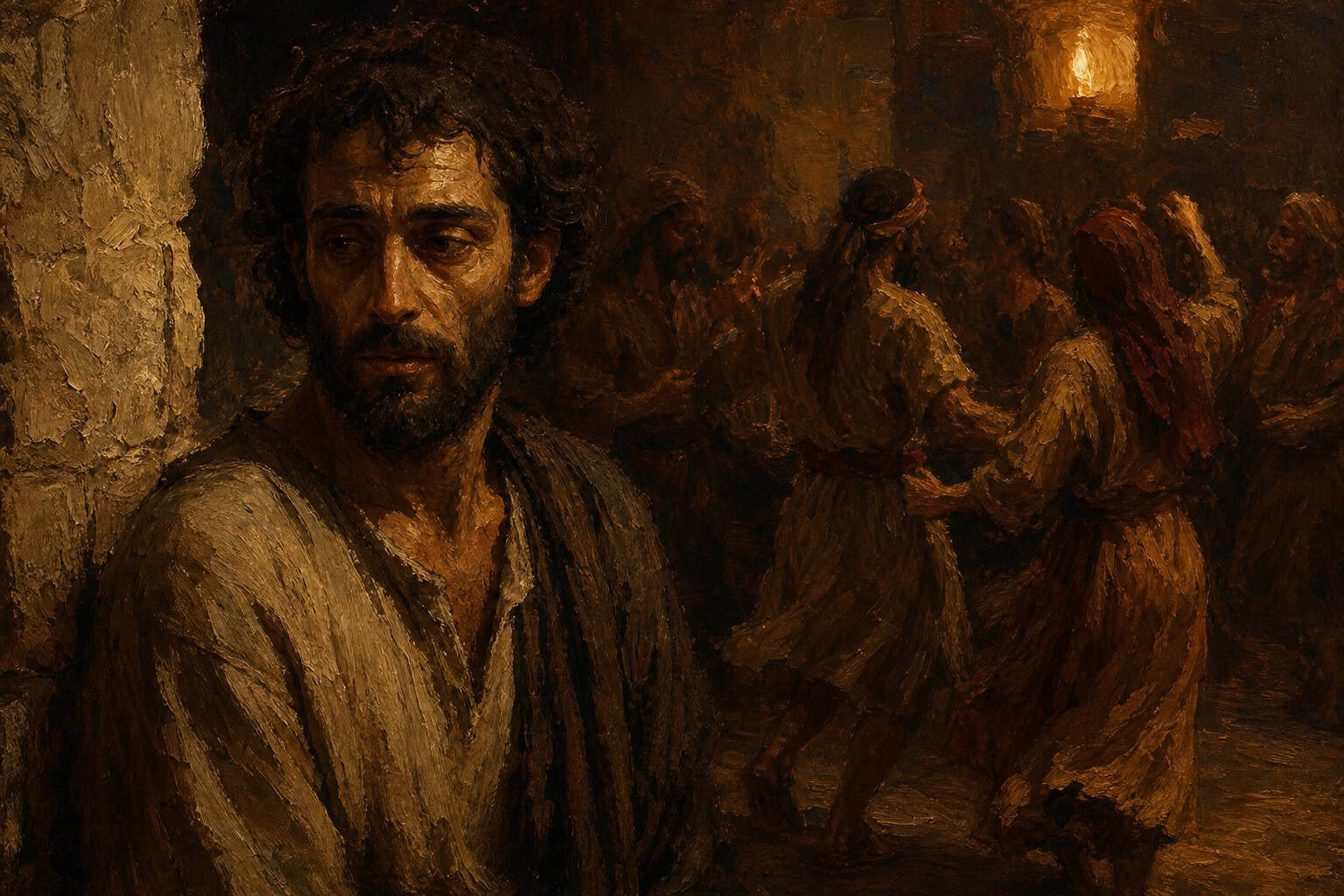
The world does not belong to you. A raw reflection on a dance-floor night, borrowed permission, and the shame of treating people as your own.
Two Strangers Danced and I Called It Mine
It began with music too loud for words and two women who chose, for reasons I never earned, to make me the center of their game. They took turns pressing close, granting me a permission I had not asked for and did not deserve. I remember the heat of it, the sweat gathering under my collar, the way clothing felt like a nuisance and the whole night felt intoxicating in the mouth. I felt powerful. I felt validated. I felt, for the first time in a long freeze, alive in a body I had half forgotten I owned. But read this now with older eyes and something curdles under the pleasure. I was not receiving those two people as people at all. I was receiving them as proof — proof that I mattered, proof that my eighteen-year-old spirit was not entirely dead beneath its ice. They danced and I turned their dancing into a mirror, and in the mirror I saw only myself restored, gleaming, wanted. That is the first lie the body learns to tell in a crowd: that the aliveness surging through you means the world has finally arranged itself around your need. It had not. The women had their own night, their own reasons, their own interior weather I never once thought to ask after. Hector moved off through the room, dancing with men, unafraid, showing me a courage I applauded without understanding a thing about what it cost him. Everyone in that place was a whole and specific soul, carrying wounds I could not see, thawing griefs of their own under the same loud rhythm. And I, obstinately, made the entire floor into a stage for my own recovery. I touched only backs and waists, places with clothing, and told myself this counted as decency. The scene that seems like joy is also, quietly, a theft. I took the gift of their attention and spent every coin of it on myself. The shame I feel now is not the shame of pleasure — pleasure is not the sin buried here. The shame is that I stood among living people and treated them as scenery arranged for my hunger. I did not see them. I saw what they did for me, what their nearness returned to my starved sense of worth. That is where every wrong turn in that night was already hidden, long before any whispered decision about who would sleep where. The world does not belong to you. I had to grow very old before I could feel how far I stood from believing that then, and how much I would take from strangers before I learned it.
The Nod of the Head Before the Mind Woke Up
Watch how the decisions got made that night, and you see something disturbing about the shape of my own movement. My body said yes before my mind arrived at the table. A nod, a lean, a step closer — the machinery of desire ran ahead of any thought, and by the time my consciousness caught up, the choice was already made and only needed a caption for cover. There is a mercy buried in this, and I will not deny it. A frozen spirit sometimes has to move before it understands why it should want to move; the muscles remember life before the heart remembers the reason. That breath of fresh air was not nothing. But there is a terror in it too, and the terror is exactly what shame keeps turning my face back toward. If the body decides and the mind only ratifies, then who am I when I act? I told myself I was reasoning. I told myself I was weighing arrangements, calculating the odds, staying a gentleman by keeping my hands to cloth and shoulder blade, as though geography could purchase innocence. That was the intoxicating self-deception: that I steered a scene which had already swept me under its own current. The truth is harder to hold. I was carried, and I dressed the current up in the language of choice. The women pressed close and I let appetite do the deciding while my clever mind supplied respectable explanations after the fact, like a clerk stamping papers on a decision made in another room. What I refused to see was that they were not the only ones surrendering their sovereignty. I was surrendering mine, and I mistook the surrender for freedom. There is a hunger that arrives like a visitor who does not knock, who sits down in the soul’s own chair and starts giving orders in your own voice. You obey and you think it is you speaking. Only later, in the cold, do you notice the furniture was moved by a hand that was not yours. I wanted so badly to believe I was the buyer in that room — the one appraising, the one choosing, the one in charge of the night. I was, in plain fact, being spent. And the deepest shame is not that I lost the reins. It is that I never once looked at Cindy, or at the other woman, and wondered what current carried them, what old freeze they were thawing, what they might have needed that had nothing to do with me. I saw two players in a game whose rules I flattered myself I understood. I did not see two souls, at the same table, trying as hard as I was to feel real again in the noise.
The Whispered Arrangement and the Reckoning It Forced
The reckoning came in whispers. I returned from the community bathroom down the hall, changed into night clothes, and walked into a conversation already underway — the three of them working out sleeping arrangements, who would take the bottom bunk, who would climb to the top with me. I found it fascinating. That word, now, shames me more than any other in the whole account. Fascinating. As if I were bent over a specimen, standing outside the room while my own life was decided inside it, weighing three human beings and myself as data in an interesting configuration. I offered the floor. Everyone protested. And then all three of them looked at me, waiting, reading between the lines, handing me a decision I did not want and could not honorably refuse. Here is the exact place the whole prideful architecture cracked. I had a system for this. I trusted logic, calculation, the cold arithmetic of what a body could take when a body was offered. Old appetite suggested one answer, blunt and total. Decorum and expectation suggested another, tidier one. And in the narrow gap between what I wanted to take and what I let myself take, the machinery I trusted simply failed to tell me who I was. Because the real question was never how many, or which one, or how to stay technically respectable in the eyes watching me. The question was whether I could see even one of them as a person and not a prize. I could not. I chose Cindy, and I called the choosing restraint. But restraint that still treats another soul as a dish selected from a menu is not virtue — it is appetite with cleaner manners and a better vocabulary.
The world does not belong to you; the people in it are not yours to arrange, and the shame you flee by disappearing into a crowd is the very self you were made to become.
That is the sentence I could not have written at eighteen. I was too busy being fascinated by my own clever predicament to notice that I stood in a room full of people I had quietly reduced to a problem of logistics, warm bodies to be sorted into bunks, and never once let myself feel the terrible fact that each of them would wake tomorrow as someone, carrying whatever this night had cost.
The moment I treated other souls as furniture for my hunger, I forfeited my own place among them.
After the Music Stopped, the Self I Could Not Face
What lingers is not the pleasure. It is the strange, cold quiet after, the way the loud music had let me vanish while it lasted. That was the secret gift of the crowd, and now I see it was a poisoned one. In the noise and the press of bodies, I stopped being someone specific — someone with a specific grief, a specific freeze, a specific name that carried specific failures I could not outrun sober. The vastness of that dark room erased my edges, and erasure felt like relief poured over a burn. This is the thing shame teaches slowly, over years, against your will: we do not always seek crowds to find ourselves. Sometimes we seek them precisely to set down the unbearable weight of being who we are. I walked into that night carrying something I did not want to hold, and the dance let me put it down by letting me become no one at all. But no one is not a person God can walk beside. And here the older reading turns most unsettling. The very aliveness that broke through my ice — real, undeniable, a genuine crack running through a genuine tomb — was bought partly by refusing to be myself. I felt alive by ceasing to be accountable. That cannot be the whole of resurrection, though it may have been a faint rumor of it, a note held under the bass. The morning after any such night, the edges return, unwelcome as light on a hangover. You become someone again. And you have to look at what the no-one did while you were gone from your own life. I had used two strangers and my own friend’s courage as fuel for a fire that warmed only me. I had called it living. I had called their attention validation, as though other people were placed on the earth to certify my worth like a stamp on a form. The shame is not that I wanted to be alive. Wanting to live is holy; the frozen spirit longing to dance is not the sin. The shame is the price I was willing to let other people pay for my thaw without ever asking their consent to the true cost, or even counting it. And the deeper shame, the one that still will not release its grip on my throat: I do not think I was present enough to have known I was doing it. I was fascinated. I was intoxicated. I was, in the truest and loneliest sense, absent from my own life even as I clutched at everyone else’s. The room emptied of music, the lights came up gray, and I was left holding the one thing I had spent the whole night running from — a self I could not face.
What the Cold Return Taught Me About Belonging
I have carried this night for years, and only in the writing of it, in the pages of Confessions to the Empty Chair, have I understood why it would not let me alone. It was not a great sin by the world’s reckoning. Nothing catastrophic happened; the arrangements were settled, decorum was met, a kind of order was kept and a face was saved. But the small sin at its root is the one that structured half my life: the conviction that the world was mine to consume, that other people were resources laid out for my use, that my hunger conferred a right upon me. The world does not belong to you. I write it plainly now because I spent so long living its opposite without ever daring to say the opposite aloud. When you believe the world is yours, every person becomes a means, every room becomes a market, every offered warmth becomes a currency you tell yourself you are owed. And the terrible mercy is that this belief eventually starves the one who holds it. You cannot be fed by people you refuse to see. You can only be fed by communion, and communion stays impossible for a soul that treats every other soul as furniture to be moved. What I know now that I could not know then is that God was in that loud, sweating room. Not to lift me out of it — He rarely lifts, in my long experience, and He did not lift me here. He was simply present, in the strobe and the bass and the whispered sorting of bunks, walking beside a young man who was using everyone within reach and calling it life. He did not take the darkness away. He was inside it, quiet, watching me not as a prize to be won but as a son to be waited for. That is the difference I missed completely at eighteen. I looked at everyone that night for what they could hand back to me. He looked at me for nothing I could ever give Him, and He stayed anyway, unhurried, in the dark. If you have ever disappeared into a crowd to escape the weight of yourself, if you have ever felt alive at a cost you carefully refused to count, this account will not comfort you cheaply. It will do the harder thing. It will help you name the theft so quietly woven into your hungers that you had learned to call it joy. These confessions keep circling this one wound like water finding a drain. The world was never mine. It was never anyone’s to own. And the moment I stopped trying to swallow it whole was the first moment, at long last, that I could begin to belong to it.