You feel younger than your age, out of step with your own years. Here is why the wound that studies love can leave you a stranger to it.
The Boy Who Still Answers to Your Name
You feel younger than your age. Not lighter, not fresher — younger the way a sapling stays soft in the middle and never hardens at the edge. The people around you carry themselves as if they finished growing years ago. They settled into their skin. They know where their hands go in a room, how to hold a glass, when to lean in and when to wait. You sit among them and feel like a guest at your own life, copying manners you never learned. Somewhere inside you a boy is still holding his breath. He is still waiting for the moment love was supposed to teach him how to be a man, and instead taught him to stand back and watch. That is the ache under the strange count of years. You have the age, but not the seasoning the age was supposed to bring. In Confessions to the Empty Chair, the narrator turns back on his own first book and calls it something forged in observation — a language built to cross the dangerous ground between man and woman. Say it plainly and it sounds like mastery. Read it the way he reads it now, older, and it sounds like grief. A man does not build a map of a country he lives in. He builds a map of a country he watched from a hill — close enough to see the roads, too far to walk them. The boy in you understands this without being told. He learned early that being seen by a woman was not safe. So he stepped back. He began to study instead of enter. Studying kept him alive. It also kept him young, frozen at the age when the freezing happened. This is the first thing to name without flinching: your youthfulness is not innocence. It is arrest. Some part of you stopped when the wound arrived, and it has been standing there ever since — patient, unfinished, listening for a permission to grow up that never came. The chest still cracks a little when you enter a room where you might be wanted. The old fear moves faster than thought, faster than the will, faster than any decision to be different this time. You are not immature. You are interrupted. And the interruption has a date, a scene, a cold you can almost feel again if you sit still and let yourself. The body remembers what the calendar forgot. Your hands know it before your mind admits it. That is where any honesty about this feeling has to begin — not in the theory of it, but in the flesh that kept the count the mind refused to keep. The boy answers to your name. He is still here. He never left the hill.
Building a Codex So You Never Have to Cross
Sit with what it actually cost to forge a language sturdy enough to navigate men and women. It means you found the terrain too dangerous to walk unarmed. It means love, for you, became a landscape to survey rather than a home to enter. The narrator of that first book was doing two things at once, and both were true. He was sharp-eyed. He was also hiding. He was so wounded by love’s chaos that he tried to make it legible — to turn the thing that broke him into a thing he could name, and therefore hold at arm’s length. There is real intelligence in that. He saw patterns others missed. He could pick apart the currents that pull two people together and the ones that grind them apart, and he could put clean words to it while the people caught inside those currents only bled. But watch what the mapmaker surrenders to make the map. He surrenders being lost. He surrenders the risk of not knowing, which is the very soil love grows in. You cannot be swept away when you are standing at the drafting table with a compass in your hand. Here the tension sharpens to a point. The same clarity that made him a witness is what kept him a stranger. The younger self’s chest cracks open, and instead of staying open, it seals into method. The fear does not vanish. It becomes analysis. Analysis feels like strength. It is really a cover — a way to stand inside love’s country without ever being exposed there. You do this too, if you feel younger than your age. You watch relationships the way a man reads weather he has no intention of walking out into. You can name the vices that dress up as fulfillment. You know how lust mistakes consumption for connection, how a hollow gets crammed with the wrong weight, how a soul mistakes a full plate for a full heart. You know these things about other people with a precision that unsettles them. What you do not know is what it feels like to be foolish and safe at the same time — to hand someone your unfinished self and not immediately begin taking notes on how they hold it. The codex was armor. Armor keeps the wound from being touched. It also keeps everything else from being touched — the warm hand, the risk, the chance of being wanted and staying in the room to feel it. So you arrived at your years intact and untouched at once. Aged in the mind, unlived in the body. A man who understands love the way a chart-maker understands a sea he has never once sailed. The precision is real, and it is genuinely rare. The distance it cost is just as real. Both are true. You have been paying for both, quietly, for years, without ever letting yourself read the bill out loud.
The Silence That Was Not Rejecting You
Here is the turn, and it rises out of the part of the book where the narrator wrestles with the empty chair — the silence he mistook for abandonment. He strained his ears in a desolate quiet and heard nothing back. For a long time, nothing meant no. He had been weighed and found wanting, and the wanting was answered with absence, and absence felt like a verdict handed down. Anyone who feels younger than their age knows this silence from the inside. You waited to be finished. You waited to be told you had grown up, to feel the click of arrival that everyone else seemed to hear. The years kept passing and no voice said you were ready. So you read the quiet as judgment. You read it as proof you had failed some test the others passed without studying. But the narrator learned, slowly and against his own instinct, that the silence was not one thing. Sometimes it was hard grace, forcing him to keep seeking when he wanted to stop. Sometimes it was sacred space, held open on purpose so his own spirit could finally find its voice. And sometimes it was the only stillness quiet enough for a whispered voice to be told apart from the noise. This is the revelation, and it lands straight on the wound you are naming. The gap between your age and your inner age is not a failure God is standing over with folded arms. It may be the space He is holding open — the unfinished room where you were meant to become something, not the emptied room where you were left behind. The boy in you did not stop growing because God abandoned the growing. He stopped because the ground was not yet safe, and grace does not force green things to harden before they can bear the cold. What felt like arrest may have been tending all along. The frozen part of you was not forgotten. It was kept. This does not make the ache dissolve — the narrator is far too honest for that, and the quiet still presses the body flat against its own refusal, breath after breath meeting only the chair’s unmoving surface. But it changes what the ache means. You are not a defective adult. You are a soul held in a slower season by a patience you mistook for neglect. The silence that watched you not-grow was not looking away from you. It was the only kind of presence that could stay near a wound without tearing it open before its time. That is a harder mercy than rescue, and a stranger one. It is God walking beside the unfinished thing instead of finishing it on demand — near in the dark, not lifting you clean out of it. The stranger inside you was never alone in there. He was accompanied the whole time. That is the one thing the map could never show him, because a map has no room in it for a companion.
The part of you that watches love so carefully is the part that never got to be inside it.
What It Costs to Set the Compass Down
Grace like that does not arrive as relief. It arrives as exposure. Because if the silence was holding space rather than condemning you, then the armor you built — the codex, the surveying eye, the careful distance kept from every warm thing — was never as necessary as you believed. That is bitter to see at your age. It means the caution you called wisdom was partly fear wearing wisdom’s clothes. The narrator sits in this without turning away. He named the seven vices. He mapped the currents that drag a soul toward desolation while dressed as fulfillment. And part of him now has to ask whether the mapping itself was one of them — whether the hunger to understand love from a safe remove was its own quiet refusal to be loved. Love, he insists, is free. It cannot be coerced, cannot be bought through compliance, cannot be held by obligation. God Himself will not force it; He seeks consent even while He holds every sovereignty. Love arrives as a gift, or it does not arrive. Here is the sting for anyone who feels younger than their years: you cannot analyze your way into being loved, and you cannot earn back the growing you missed by performing enough insight. The codex will not finish you. No map ever completed the man who drew it. Only being seen, and staying inside the seeing without bolting, can do that — and that is exactly the thing the wound taught you to run from. So the fallout is not comfort. It is a hard question put to the body, not the mind. Does freedom draw you closer, or does fear hold you in place? The younger self answers with his flesh before thought can catch up. The chest tightens. The hands that once reached remember their reach as empty. The old cold climbs back up the arms. Fear is faster. It always was. And yet the narrator does not shame the boy for it. He does not tell him to grow up, to snap out of it, to act his age at last. He rests his hands where the wounded hands rest, and he says they will move at the pace the heart allows and not one step faster. That is the loosening here — not a cure, but a slackening of the grip. The compass does not have to be smashed to pieces. It only has to be set down on the table long enough to feel, just once, what it is like to stand in love’s country with nothing in your hands. That may be the growing you have been waiting for all along. Not a click of arrival. A single unguarded moment in which you let yourself be seen and do not immediately reach for the pen to record it. The years cannot hand you that moment. Only the risk can. And the risk is still terrifying, because the flesh has not forgotten why it learned to flee.
Green Wood, Still Waiting for Its Season
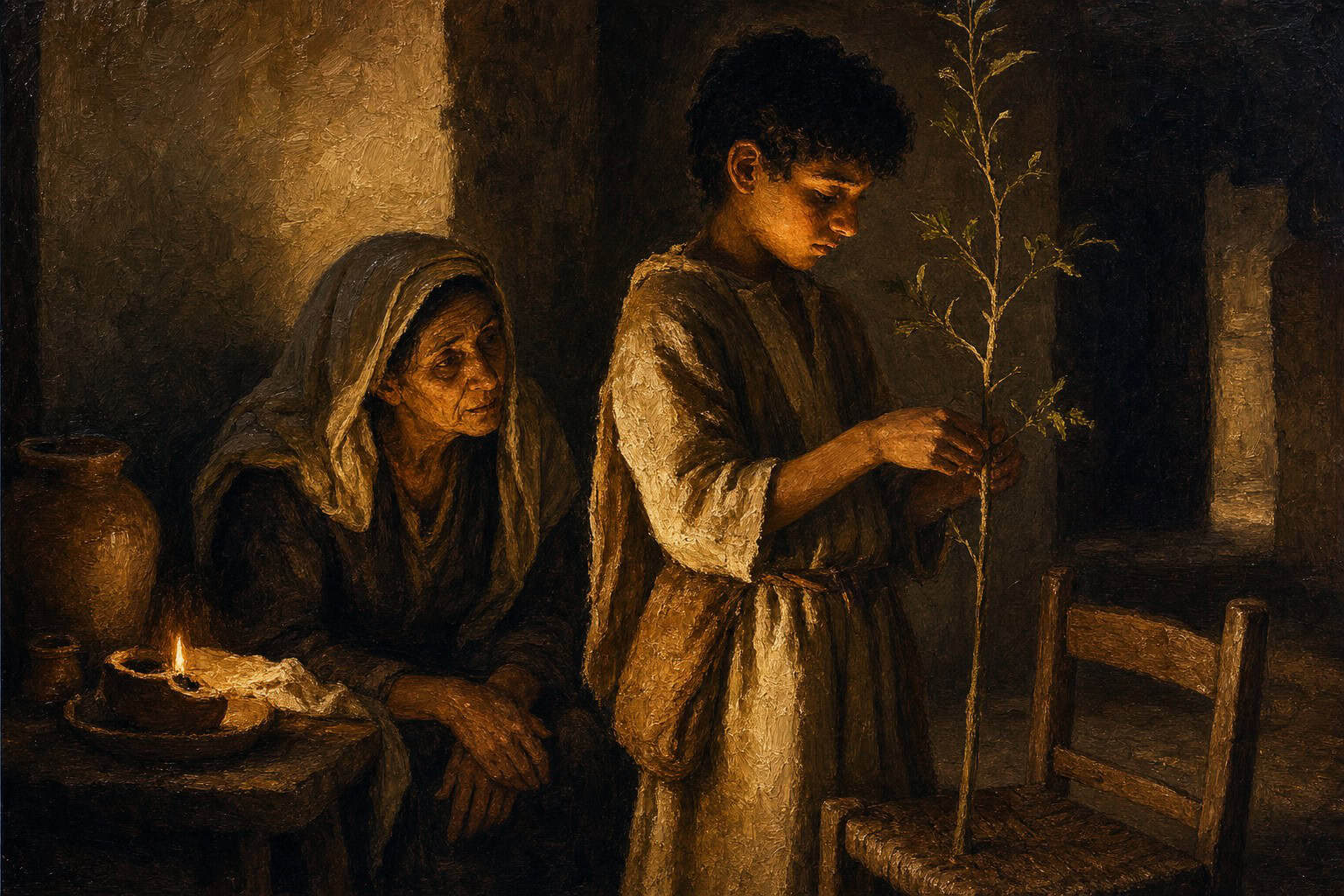
So you carry two ages at once, and you will go on carrying them. The years on the calendar and the year the freezing happened do not reconcile under a single insight, and this book is too honest to pretend they do. What shifts is not the gap but the meaning you hang on it. You have been treating your youthfulness as evidence against yourself — proof of some cowardice, some failure to become a man the way the others seemed to become men without effort. Read through the world of Confessions to the Empty Chair, it looks different in the hand. It looks like green wood. Green wood is not defective wood. It is wood that has not yet met the fire that seasons it. And there is a kind of wood that is kept green on purpose — held back from a heat that would have split it too soon and left it useless. The narrator forged his first book in a kiln, hardening language against the danger between men and women until it could bear weight. But he could not forge himself the same way, and that failure — that stubborn, unfinished greenness — turns out to be the very place he was still salvageable. Seasoned wood cracks in a fire it was rushed into. Green wood waits, and the waiting is not weakness. What the older man sees now, reading his younger self with clearer eyes, is that the boy who could not grow up on schedule was not being punished for it. He was being spared a hardening that would have cost him far more than the waiting ever did. This is where it points, and it refuses to point cheaply. You will not walk out of your own history healed and whole and finally the right age. The wound stays. The stranger inside you does not turn into a settled man overnight, and the flesh that flinches will flinch again in the next room where you might be wanted. But you can stop reading your slowness as a sentence. You can begin to suspect that the silence held you instead of dropping you, that the season is not late but slow, and that the One who kept you green has been beside the unfinished thing the whole while — quiet in the dark, patient, waiting with you for a fire gentle enough not to split you down the grain. That suspicion is enough to make you want the whole of it. Enough to follow this man deeper into his empty chair and hear how a soul learns to grow up without betraying the boy it once was. The map was never the country. But you are still standing at its edge, green and alive and unburned, and the season has not passed you by. It is only waiting for you to consent to be crossed.