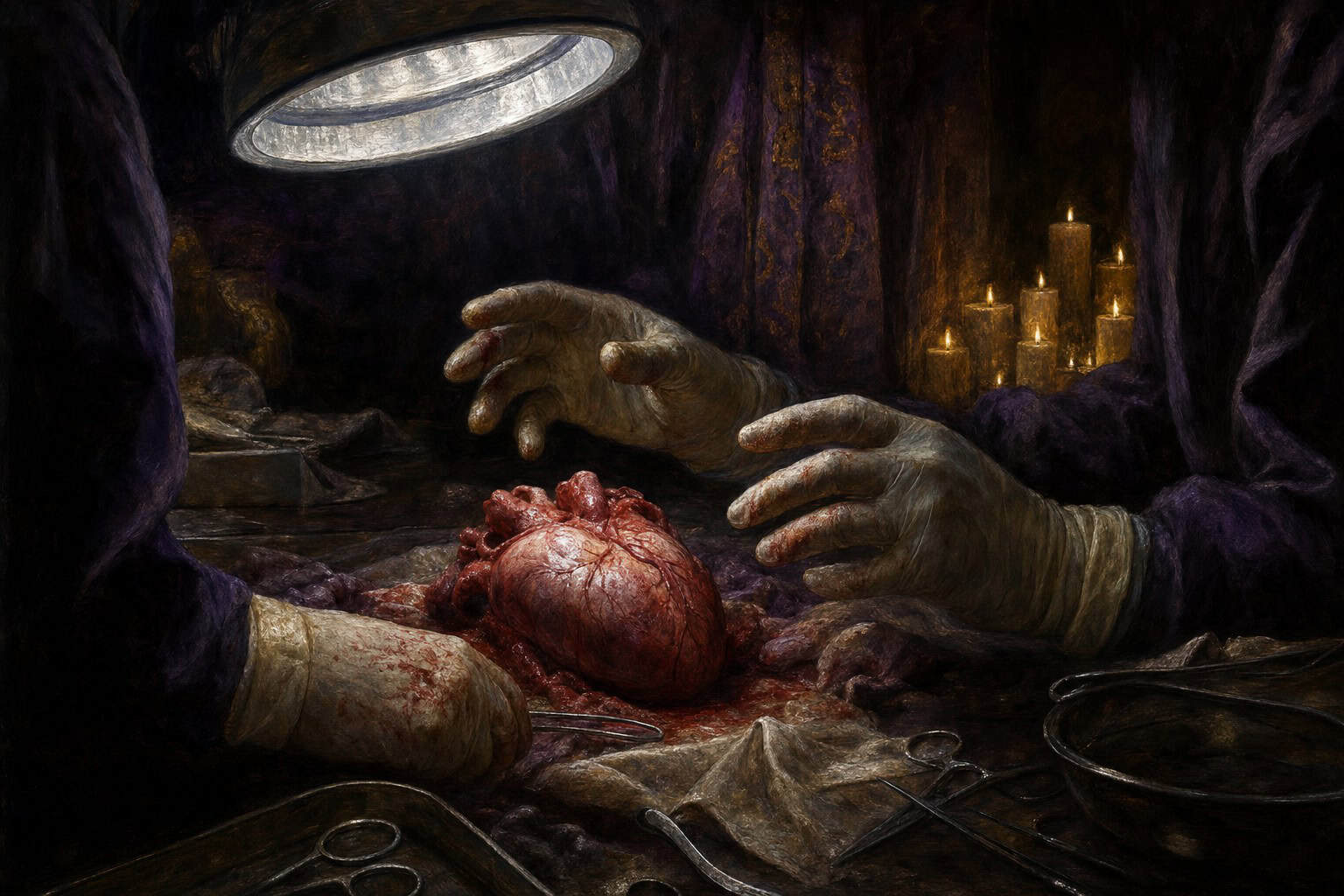
He does not weep over what betrayal killed in him; he leans in under a hard light and dissects it, naming each severed feeling without letting himself feel one.
Fluorescent Light on an Open Chest
A harsh, humming light bears down on the scene as if feeling itself were an exposed organ under its glare. In this passage, the narrator does not collapse in grief; he leans over his own history like a specialist, chest of memory split, ribs held apart by willpower. Where a boy once reached with bare hands toward warmth, a man now peers in with the trained eye of someone who has seen too much. The beloved’s indifference doesn’t just hurt; it gives him permission to switch on that light and stand back from the table, to name every impulse instead of inhabiting it. He traces when he first learned to step outside himself and watch, how the child’s raw need slowly hardened into adult procedure. The operating field is his own capacity to attach, his own tenderness pinned back for study. What looks from the outside like insight is, inside this moment, a tight refusal to be caught off guard again.
Notes Scribbled in the Margin of a Heart
Here the reckoning is not with the beloved so much as with the narrator’s chosen stance toward love itself. He catches himself using the language of analysis as if it were a shield, recording motives and patterns the way a clinician charts symptoms. Every gesture, every silence, becomes another line in a mental file, another proof that closeness cannot be trusted. He remembers when this habit first grew teeth, how childhood’s sharp lessons taught him to step back from the ache instead of letting it move through him. The passage lingers on that split-second before feeling, where he now inserts commentary instead of consent. Underneath all the careful notes lies a single, blunt admission: this distance is not neutral. It is a decision. The reckoning pressed here is whether he will keep treating his own heart as a case study or admit that each new encounter with affection asks for something riskier than explanation.
The Familiar Weight of a Scalpel in the Hand
The pressure in this scene builds around an awful recognition: the tool he now trusts most was first wielded against him. As he describes his cool detachment, there is a flicker of memory—earlier hands, older voices, cutting close to the quick of his young desire. What was once done to him in the name of control, he now does to himself in the name of maturity. The scalpel of distance fits his grip because it has been pressed there for years, guided by the very betrayals he swore he would never repeat. Each time he feels a tremor of longing, that blade appears, and he rehearses the same clean cut between himself and what he wants. The passage does not let this pass as clever coping. It presses on the question of complicity: at what point does inherited defense become chosen cruelty toward one’s own heart? The tension rises as he hovers over that living tissue, steadying his hand, not yet deciding whether to cut again.
Betrayal can turn a lover into a coroner, dissecting what once moved him and cataloguing every sensation without feeling a single one.
Standing Over Your Own Life with Gloves On
For an ordinary reader, this moment names a posture many secretly know: the habit of staying suited up, even in the presence of tenderness. You might recognize the ease with which you explain your patterns, present tidy histories of why you do not trust, why you do not stay. You can detail childhood fractures and past betrayals with calm clarity, and people praise your self-awareness. Yet beneath the narrative, there may be a quiet fact: the gloves never come off. This passage exposes how knowledge can become latex between you and your own experience, how you can stand over your life rather than inside it. It shows the loneliness of always being the commentator, never the participant, the one who can map every contour of desire while refusing to be changed by contact. The stakes are not academic. They are as close as the next person who reaches for you and meets only the cool surface of your understanding.
A Beating Heart Mistaken for a Specimen
The final image in this passage gathers around something pulsing that has been treated as if it were already on the slab. The narrator realizes that what he has been cutting into, measuring, and naming is not a corpse but a living capacity to be met. Divine love, in this context, does not appear as a soft haze but as a gaze unwilling to accept his report that everything worth feeling is dead. Yet he still stands by the tray, tempted to seal the jar, to suspend his own heart in explanation so it will never surprise him again. He senses that consent to God’s affection would mean stepping back from the glass, allowing that stubborn rhythm to dictate its own beat rather than his scalpel’s line. The passage leaves him there, hovering between the safety of preservation and the risk of letting that muscle keep pounding against its constraints, like a fist against the inside of a wall not yet broken.