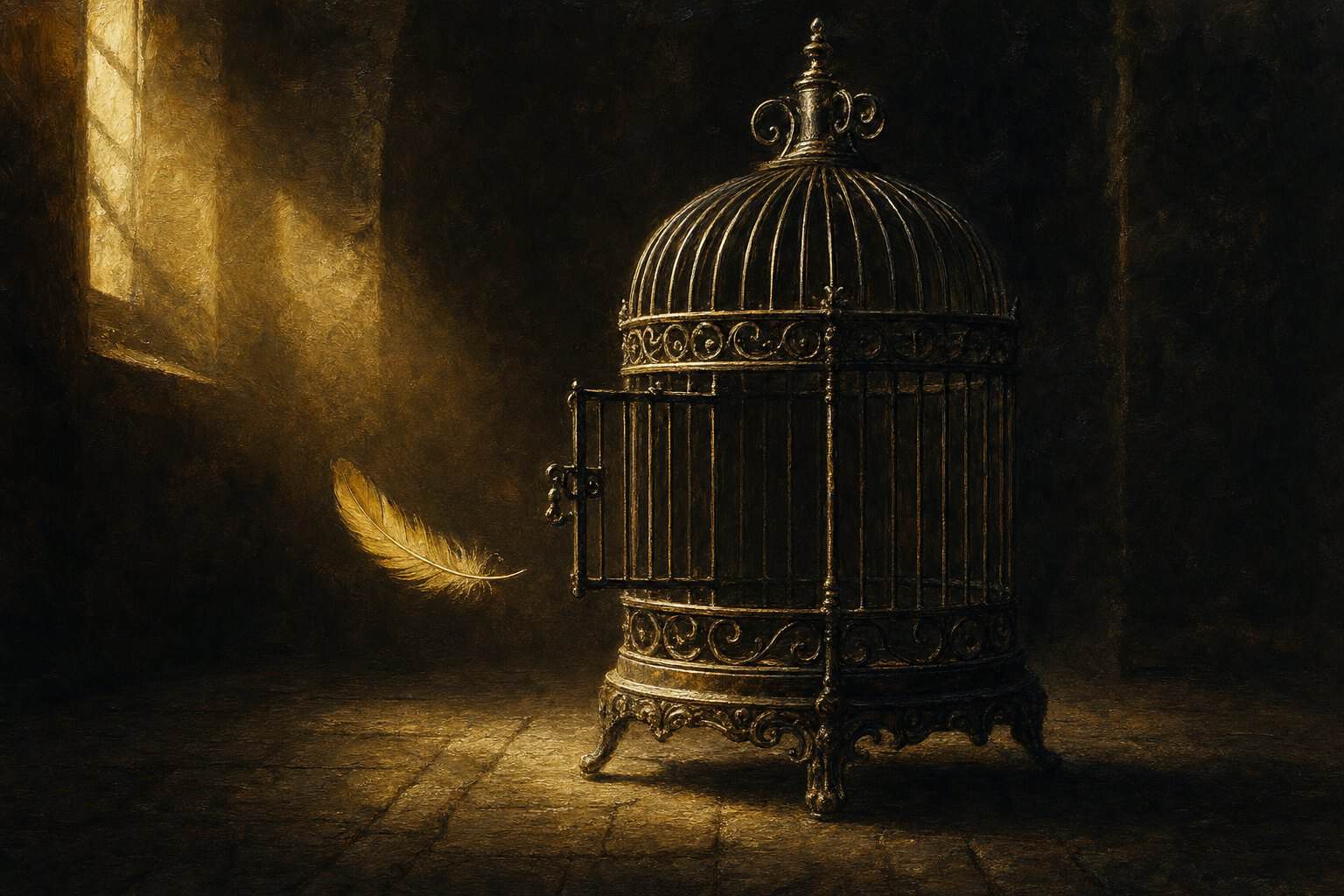
To cage desire is not to master it but to flee from it; Fromm names the sterile prison as the last refuge of the fear of freedom.
The Transparent Prison
There is a certain lover who does not lock the beloved away in a dungeon but in a room of glass. He can see her always; he can be seen loving her; nothing is hidden, and precisely because nothing is hidden, nothing is free. This is what Confessions to the Empty Chair names, in one of its most unsparing passages, as the sterile cage of controlled intimacy – the transparent prison some lovers build around desire itself, mistaking surveillance for closeness and containment for care. Erich Fromm would recognize this architecture at once. For Fromm, the terror at the root of modern love is not the fear of losing the other but the fear of freedom – the vertigo of standing separate, thrown into aloneness, and being asked to bridge that distance not by possession but by act. The glass room is the answer of the man who cannot bear the vertigo. He removes the risk of the other’s freedom by removing the freedom, and calls the resulting stillness peace.
Falling Versus Standing
Fromm’s whole quarrel is with a single preposition. We say we fall into love, as if it were an accident of gravity, a collapse of the barrier between two strangers – the explosive intimacy, the sudden nakedness, the intoxication of being, for once, not alone. But the collapse of a barrier is not the same as the making of a bond. Fromm insists that mature love is not a falling but a standing in – an active power, a discipline requiring ‘courage, faith, and discipline rather than passive sentiment.’ The sterile cage is what happens when a man has felt the thrill of falling and, terrified it will not last, tries to make it permanent by force. He cannot generate the ongoing act, so he manufactures its appearance. He confuses the vigilance of the jailer with the attention of the lover. Both watch constantly; only one of them is free while watching, and only one of them lets the watched be free.
Having a Person, Being With One
Beneath this lies Fromm’s oldest distinction: the difference between having and being. In a society that has learned to exchange ‘personality packages’ as commodities, to stroll before the shop windows of other selves appraising their exchange value, the lover comes to treat the beloved as an acquired object – a possession whose worth is protected, insured, guarded against theft. To have a person is to hold a still image of her, curated and controlled; to be with a person is to consent to her movement, her opacity, her capacity to surprise and even to leave. The glass room is the perfected form of having. It renders the beloved wholly available and wholly unfree, a portrait rather than a presence. And here Fromm’s diagnosis turns pastoral: the man who must have cannot be, because being requires the productive orientation, the aliveness that gives rather than grasps. Giving, for Fromm, is the highest expression of potency – and the sterile cage is built precisely by those who experience giving as loss, and so hoard the beloved as they would hoard any other diminishing resource.
The lover who cages the beloved to make love permanent has only made it stone; freedom is not what threatens love but what love is made of.
The Symbiosis That Wears Love’s Face
What makes controlled intimacy so difficult to renounce is that it counterfeits union. Fromm distinguishes the mature love in which ‘two beings become one and yet remain two’ from symbiotic union, which achieves oneness only by destroying twoness – through masochistic submission, in which one dissolves into the other to escape the unbearable aloneness, or sadistic domination, in which one absorbs the other as an extension of the self. The cage-builder is the sadistic pole of this pattern, though he would never name it so; he would call it devotion, protectiveness, the intensity of a love that cannot bear separation. But the tell is in the fruit. Symbiotic union feels like fusion and produces suffocation. The reader of Anthony’s confessions will recognize the pattern – never the person, always the pattern – in which closeness is measured by the elimination of the other’s separateness, and every act of the beloved’s independence registers as a wound. This is the post-Edenic signature: the self so afraid of its own thrownness that it would rather imprison another than stand, alone and free, before the empty chair.
The Discipline of Release
The way out of the glass room is not a warmer feeling but a harder practice. Fromm is austere here, and rightly: love as an art demands the development of one’s total personality – humility, courage, faith, and above all discipline. To love is to relinquish the guarantee. It is to let the beloved be a thou who might turn away, and to build the bond not from bars but from the daily, unglamorous act of attention that must be renewed and cannot be stored. This is where Fromm and the Catholic imagination of Confessions to the Empty Chair meet: for both, love is a giving that makes the giver more alive, a standing that requires courage precisely because it forfeits control. You are asked to trade the counterfeit peace of the still image for the real peace that only free things can give one another. And you learn, slowly, that the transparent prison was never protecting the love – it was protecting you from the freedom that love, if it is love at all, requires you to bear.