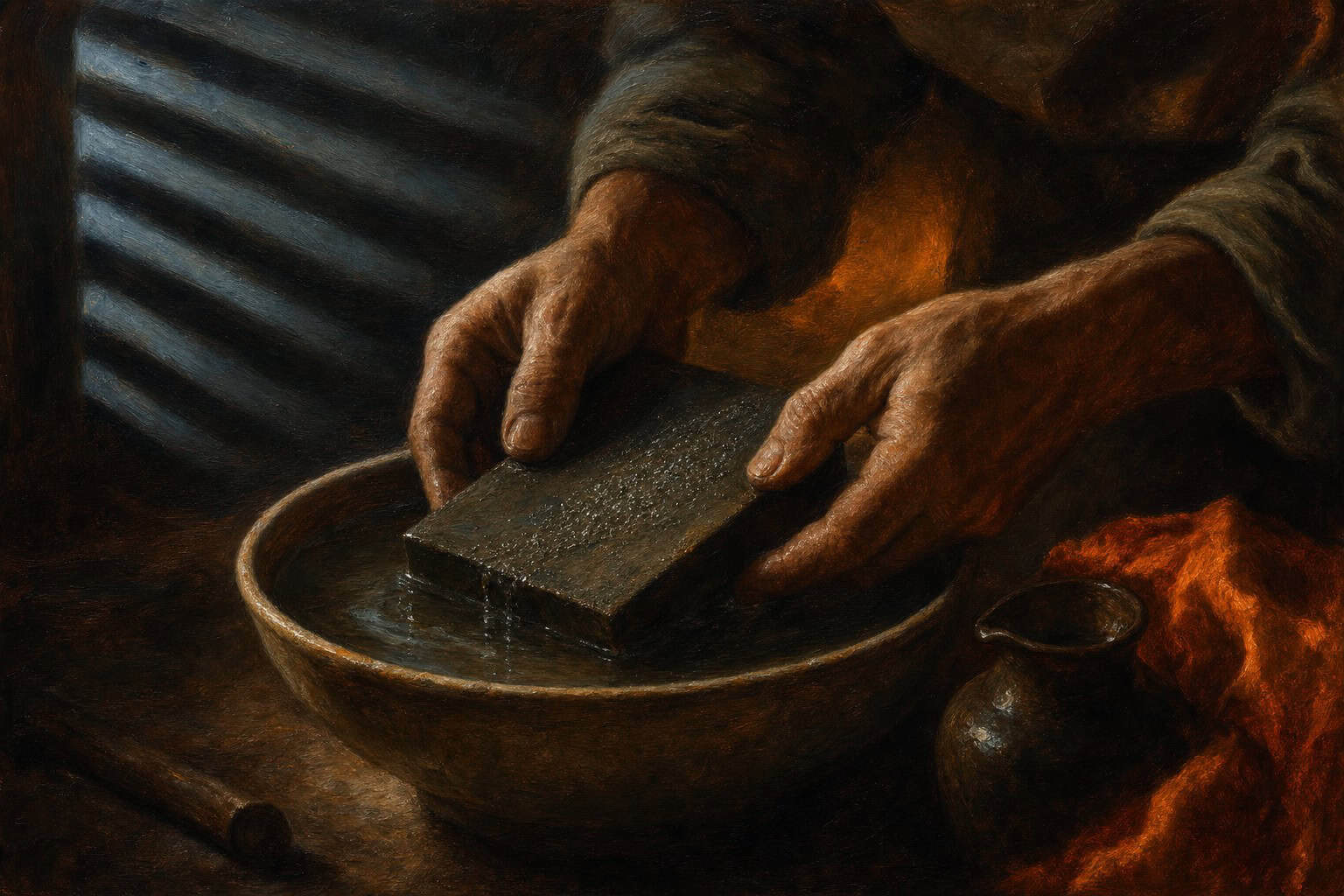
He rinses the stone and watches the silver filings swirl down, the residue of every edge he has honed, and no hand anywhere reaching to sharpen him in return.
Metal Filings in the Sink
Water runs cloudy in the kitchen sink as he rinses the whetstone, tiny silver filings swirling like a slow storm. His hand remembers the rhythm before his mind names it: blade against stone, angle held, pressure steady. Each pass pulls something invisible from the knife, and something just as invisible from the stone itself. He watches the murky water and feels a strange recognition, as if his own years of listening, advising, absorbing others’ crises have settled there in that shallow basin. People come to him, lay their dullness on his surface, leave carrying a new edge. They do not see what is scraped away from him in the exchange, what private fatigue hides under his practiced steadiness. In that small domestic act—sharpening a knife between errands—he sees the shape of his vocation: to be worn down in order that others might cut cleanly through their own confusion.
The Counselor with No Confessional
As the water clears, another knowledge refuses to be rinsed away: there is no one left to whom he can hand the weight he carries. Friends still come with tangled stories, and he can read their knots with almost frightening ease. Their motives, their patterns, their self-deceptions stand out to him as clearly as the edge of the knife under kitchen light. Yet when he reaches for someone who could see him with that same clarity, there is no one. Not from pride, not from disdain—just a stark awareness that the questions burning in him have outrun the usual frameworks. That realization does not crown him; it isolates him. Spiritual authority arrives here not as a title or victory, but as the unnerving sense that only God now stands tall enough to meet his gaze and not flinch from what lives there.
Hearts Parked in Several Driveways
While the whetstone dries on the counter, another pressure pushes forward: the scattered state of his own affections. There are faces, names, possible lives orbiting his phone and his memory—women who could, in theory, become the one. Each represents a different script, a different city, a different version of himself. He has kept every road unblocked, every future theoretically reachable, telling himself this is prudence. Yet he can feel how this keeping-everything-open has hollowed each encounter. In never saying a full yes, he has never given any person the mercy of being his actual chosen. The image of burning bridges shifts in his mind from melodrama to necessity. To love truly might mean torching every alternate route, accepting that to become one person with one other is to let whole universes of possibility die on purpose. The thought does not comfort him; it presses like a weight on his chest.
To become the one who sharpens everyone and find no one able to sharpen you is a loneliness that takes on almost divine proportions.
The Body That Cannot Heal All at Once
Underneath the loneliness and the scattered desire runs a quieter fatigue, the kind that sits in muscle and marrow. Continual self-scrutiny, constant spiritual surgery, has left him tender. He knows how to name dynamics in others, how to invite them into harder honesty, how to risk saying what might cut in order to cure. But he is starting to sense that his own soul cannot keep enduring incision after incision without rest. The image of the knife returns: there is a point beyond which more sharpening begins to eat the blade itself. In this passage he begins to suspect that endless improvement, endless relational analysis, might be its own sort of cowardice—a refusal to sit, for a season, with one chosen person, one chosen path, one given level of healing. For anyone who has become the strong friend, the perpetual advisor, this is where the text presses: your limits are not failures; they are the edge of your creaturehood.
A Blade Waiting on the Cutting Board
By the end of the scene, the knife lies ready on the cutting board, its edge restored, its purpose obvious: it will soon meet food, resistance, heat. The stone, by contrast, simply sits there, edges softened, surface subtly altered, bearing the invisible cost of every stroke. Nothing dramatic happens in that kitchen—no revelation shouted, no vow made aloud—yet the air feels heavier for what has been admitted. He cannot unknow that his life has become that stone for others, nor that his divided heart cannot stay scattered without consequence. How he will answer these recognitions remains deliberately unwritten here. What he will choose—to keep collecting admirers or to choose a single beloved, to keep operating on his soul or allow it time to scar and strengthen—stays outside the frame of this passage. On the counter, stone and blade wait in their separate stillness, each holding a different kind of unfinished work.