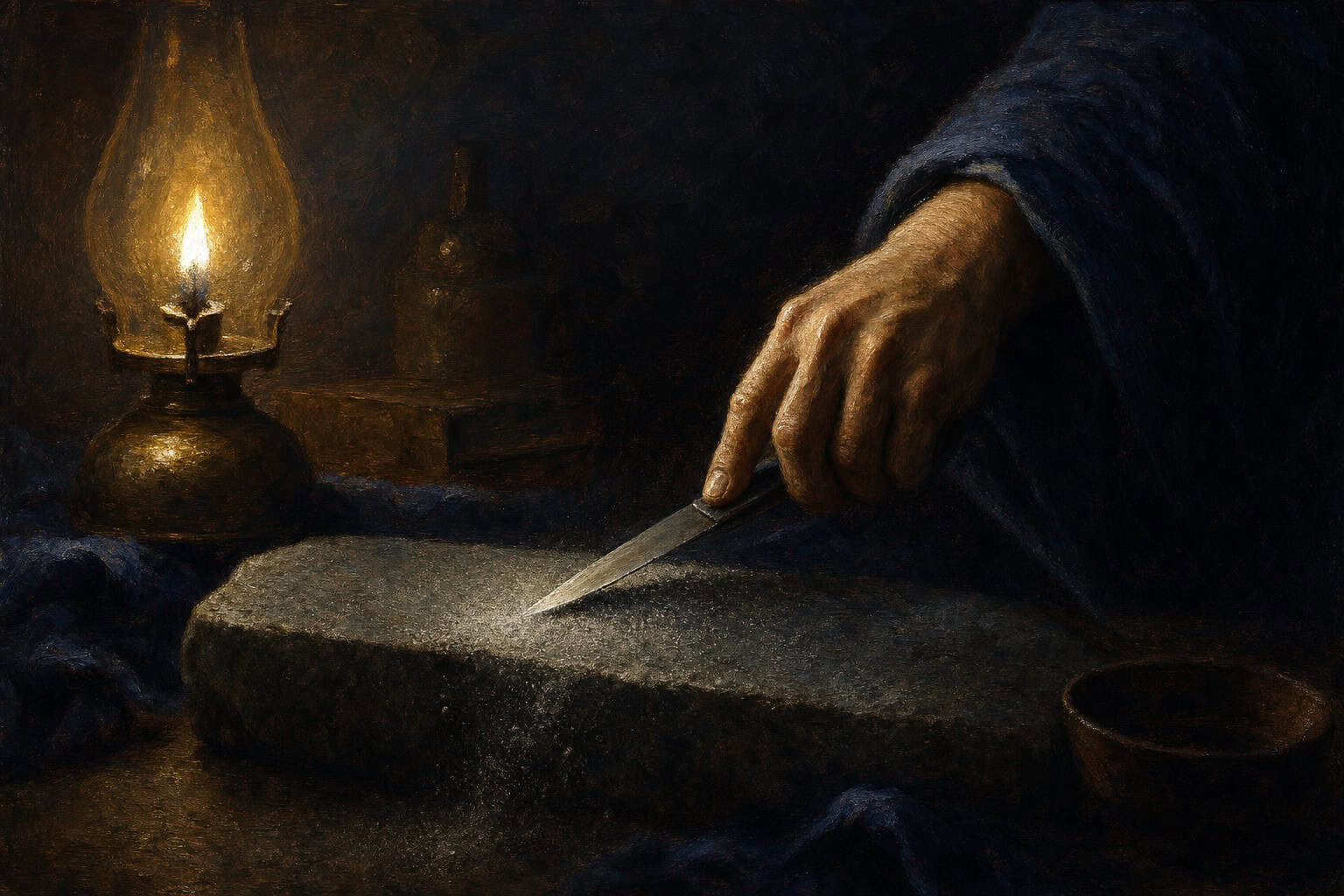
From one bright ring of metal on metal he builds a whole philosophy of usefulness, never noticing that the teacher of clear sight cannot make out his own clouded heart.
The Ringing Sound of Contact
Metal meets something harder and there is a small, bright sound—that is the territory of this chapter. From that contact, the narrator builds an entire world: people as tools and instruments, lives as edges that can be steadied or ruined depending on what they’re pressed against. He sketches a geometry of heart, mind, and spirit that must settle into some kind of workable shape before two bodies risk multiplying themselves into a child. In his telling, nothing in love is casual; even a date, even a conversation, is already part of a training ground for war. The language is not soft: he speaks of discipline, of preparation, of a God who expects souls to be sharpened before they dare to reproduce themselves. All of this unfolds not in a workshop but in the human field—bedrooms, dinner tables, pews—where every touch, every choice of partner, becomes part of a long apprenticeship in how to carry an edge without cutting everything in sight.
The Man Holding the Flashlight
Underneath the teaching runs a single reckoning: who has the right to declare himself a true grinder of souls, and how can anyone tell? The narrator turns his beam outward, offering a method for women to inspect the men who approach them. He lists marks to watch for: the way a man works, suffers, thinks, controls his urges, shoulders or dodges responsibility. Each item is concrete, almost like a mechanic checking a used engine—looking for leaks, listening for rattles, asking where this machine has been driven and how hard. At the same time, every test-point reveals the tester’s own ideal: a man whose discipline proves his love of truth more than comfort. The reckoning is not just, “Are there imposters out there?” but, unspoken, “Does my own life bear enough weight to cast light on anyone else’s?” That is the silent pressure humming behind his careful flashlight beam.
The Scratch That Masquerades as a Grind
From that reckoning the chapter walks into a sharper ache: most people calling themselves whetstones are only sand in the hand. The narrator names them by their patterns. They confuse touch with transformation, busy calendars with depth, flattering words with real courage. He describes evenings that look full—a meal, a bed, easy talk—but leave metal unchanged, no shavings on the table, no sting, no new clarity. His tone is not only angry but weary; you can feel how many such nights he has seen, how many men and women orbit the same small pleasures and call it growth. He draws a hard line between those who accept the pain of being changed and those who will only offer distraction, and he does it with physical detail: sweat, effort, the burn in the arm that keeps stroking the blade. As the chapter moves, the category of “false whetstone” swells, and the reader feels the weight of a world where real grinding is rare and costly.
We are never so blind as when explaining the very sight we claim to offer others; the teacher of clarity often cannot see his own opaque heart.
Reading Bruises and Calluses
Midway through, the lens widens from lovers to human perception itself. God, he says, has given bodies and inner senses as a joint set of instruments: eyes and ears, but also thought, feeling, and spirit. The narrator shows how these play off each other in ordinary life. A disordered heart spills into constant conflict; a muddled mind leaves a trail of poor choices; a starved spirit bows down to its own reflection. He traces how people hide these lacks by leaning hard on their strengths—the fit body covering shallow thought, the clever mind hiding from flesh, the religious mask worn over an unyielding pride. Here the dominant image stays plainly physical: bruises, calluses, posture, tone of voice. From these, he argues, an honest observer can infer the invisible pattern underneath. The chapter gathers this material into a tense question: if our surfaces always betray us, what does it mean that so few of us really want to be read?
Standing Near Another Person’s Hum
By the end, the chapter makes a quiet, unsettling promise: it will not teach how to control others, but how risky it is to stand near anyone at all. The narrator describes the slow work of tuning in to another person’s inner rhythm—watching, listening, gathering their repeated reactions like scattered notes. At some point, he says, an observer can choose to match that hum, to let another’s pattern enter the body as empathy. That choice is never neutral. To adapt to the wrong rhythm is to let dullness seep into one’s own edge; to join the right one is to accept discomfort, friction, and change. This is how the chapter ties back to the book’s wider terror: every contact with another human carries the chance of further shattering or truer unity. It leaves us there, beside another person’s low, steady vibration, feeling in our own muscles how costly it would be to really listen.