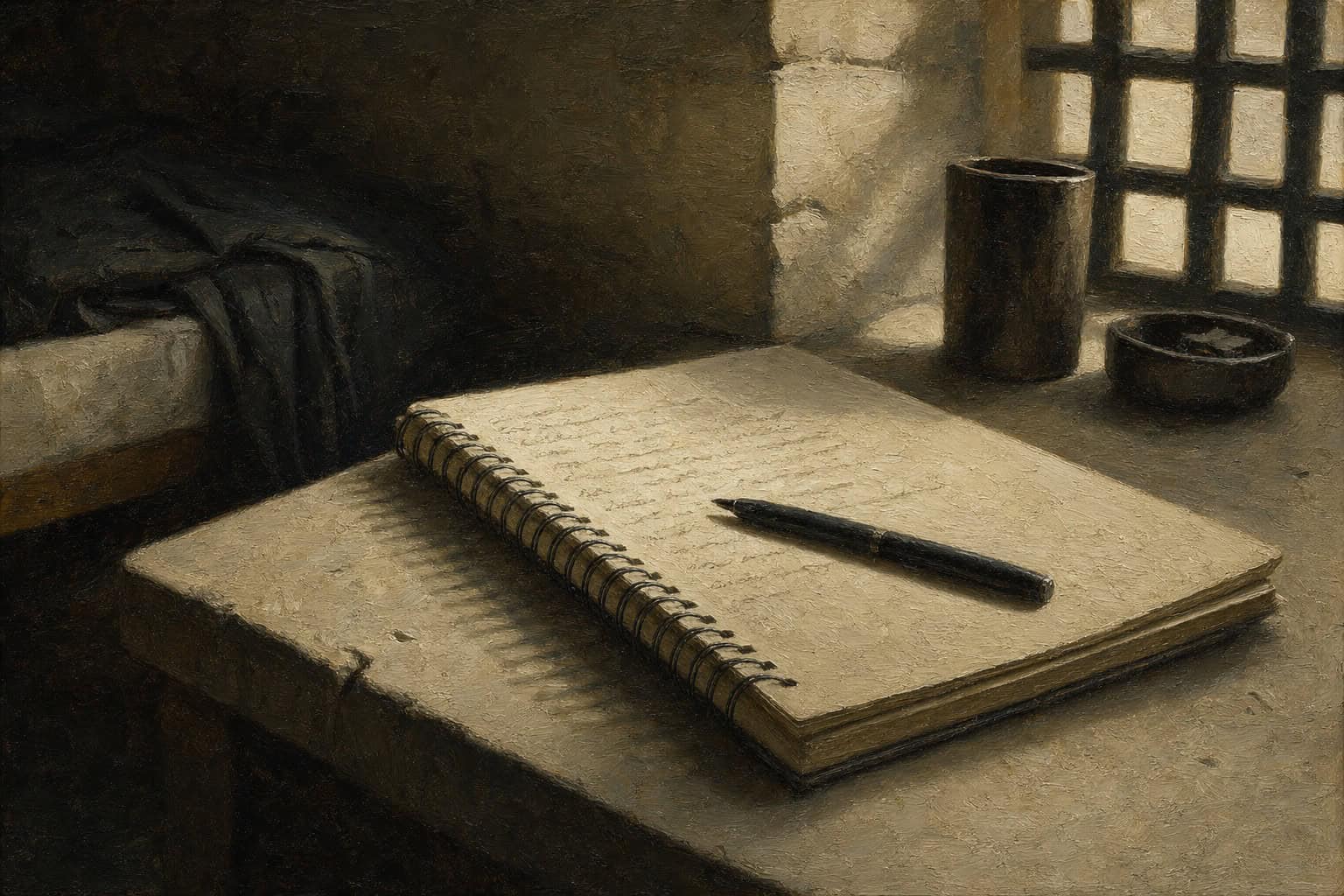
Wet ink glistens on the blue lines while a teenage hand hovers between a word and its refusal, ready to confess the wounds it can bear to name and to guard, in white space, the ones that actually made him.
The Pen Hovering Over Wide-Ruled Paper
Ink glistens wet on the blue lines while a teenage hand hesitates, the ballpoint tip hanging in the space between word and refusal. A spiral notebook lies flat on the laminate desk, edges curled from use, the week’s journal prompt written in the teacher’s looping hand on the board. She has promised privacy, promised that whatever appears on these pages will be met with care, not punishment. So something loosens: a sentence about a father who says he does not need his son, about the hollow left where a blessing should have been. The hand moves faster now, describing loneliness that feels like walking through school hallways as a ghost among solid bodies. Yet when memory shifts toward the older violations, the pen stalls, then veers away. What happened to that small body in earlier years presses hard against the skin, but it does not cross into ink. The page fills, but not with the central fire.
Lines That Hold and Lines That Cannot
To write the father’s dismissal feels almost clean, like setting down a fact that cruelly fits the world’s grammar: parents can reject, homes can fracture, children can be unwanted. The teacher can understand this kind of wound; culture has words for it, frameworks, tidy phrases. On the page, the boy can let her see how a single sentence from a parent can stain every later gaze, every invitation, every goodbye. Yet under that written grief moves another current, older than school, older than clear memory. Those earlier nights, those hands, that premature training of the body into a script it never chose—none of this fits inside a classroom promise of safety. The journal becomes a border: on one side the harm that adults will recognize and affirm, on the other side the desecration that would sound like accusation simply by being named. The pen obeys this boundary as if it were moral law.
The Ache That Refuses the Margin
Around him, twenty pens scratch in steady rhythm, a low insect hum against the classroom’s fluorescent buzz. He can hear pages turning, desks creaking, the teacher’s soft pacing at the front as she gives them time to be honest. His own heart thuds louder when the memory of earlier touch rises—how his body once became altar for someone else’s hunger, how desire and terror braided together before he could spell either word. To write that would not be simple sharing; it would be handing the teacher a live coal that might burn through both their hands. So he practices a grim arithmetic: this much can go in the journal, this much must stay lodged in muscle and nerve. Every sentence about abandonment carries, underneath, the weight of what he will not say, a pressure that makes even the written truth feel strangely thin. The unspoken sits behind his sternum, hot and watchful, refusing to step into the margin where the teacher writes her kind, small notes.
We confess most freely the wounds we can bear to name, and guard in silence the ones that made us who we are.
When Your Own Hand Censors Your Story
Anyone who has stared at a blank page, knowing there is more truth than they will allow themselves to write, can feel the burn in this scene. You may have done it with a therapist’s notebook, a chat window, a parish penance sheet—telling enough to look honest while steering carefully around the memories that still taste like poison in the mouth. There is a strange morality in this self-censoring: a fear of becoming the one who defiles by dragging certain images into shared space. So you offer the smaller catastrophe first: the breakup, the harsh comment, the parent who said they did not need you. You wait to see whether the listener flinches even at this. Their reaction becomes a quiet verdict on how much of your history the world can hold. Like this boy at his desk, you learn that even in places built for honesty, your own hand can become the gate that keeps the worst of your story locked inside your chest.
The Notebook Closed on What Still Burns
At the bell’s sharp ring, he dots the last sentence, flips the cover over, and feels the thin cardboard press briefly against his palm. The journal he hands forward contains a real sorrow: a boy marked by a father’s declaration that he is not needed, that his presence is optional in his own bloodline. The teacher will read it and grieve, will perhaps write a gentle reply in the margin, offering sympathy and some hint that he is worth more than that verdict. What she will not see is how that same page hides an older script, where his body learned to confuse violation with being wanted, and where consent became the one sacred boundary he clings to so he will not mirror the evil that touched him. Those earlier scenes remain unwritten, but they have not gone quiet; they will bloom later in fantasies of redoing the past, in a ravenous hunger to be chosen without being used. For now, they sit behind his ribs like coals banked under ash, waiting for a different kind of altar than school-lined paper can ever offer.