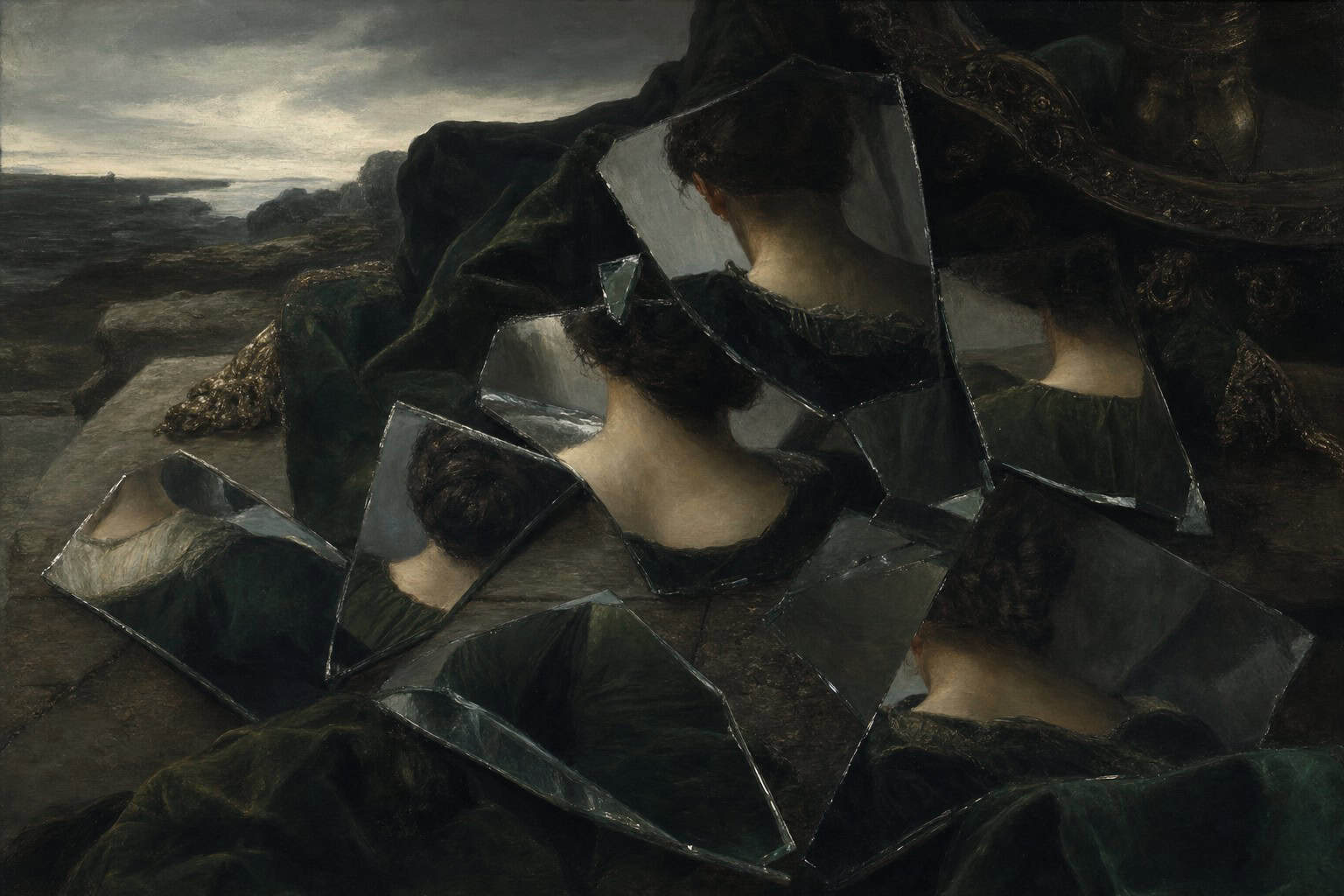
She stands in the middle of her own life already cut into sixteen neat slices, like a cake divided before the guests arrive — a piece for the church boy, a piece for each of the others, and no whole left to answer for any of it.
Sixteen Slices on One Plate
She stands in the middle of her life with herself already cut into sixteen neat pieces, like a cake sliced before the guests arrive. One slice goes to the church boy who thinks he has found a holy girl, all pious questions and trembling consent, her body on his lap while her heart kneels in another room he will never see. Another slice is dressed in clever words for the academic friend, answering his theories with lines stolen from books she skimmed at midnight, hoping he will mistake echo for understanding. A softer piece is reserved for the confidante who gets her late-night messages, the one who believes she alone carries the real story. Each portion tastes different, looks different, speaks with its own practiced tone. No one at the table is allowed to see the whole cake; they hold their narrow wedge like proof they have been chosen, never noticing their fingers are sticky with something that does not quite satisfy.
The Math of Giving Away 0.0625 Percent
Here the chapter lingers on numbers, not as statistics but as a kind of moral arithmetic. Divide one person by sixteen and each friend receives 0.0625 percent: just enough warmth to feel special, not enough weight to press for truth. Her body lies beside one man, her mind turns over phrases meant for another, her whispered prayers belong to a God she keeps at a distance even while using His name. Each relation runs on its own logic, sealed from the others like separate bank accounts with different passwords. She can cry in one set of arms on Tuesday and laugh like nothing touches her on Thursday, confident that the worlds will never collide. This is not simple confusion. It is a chosen method: plausible deniability written into flesh. If every slice carries a different story, then no single witness can ever stand up and say who she really is.
Hunger Wearing Sixteen Faces
Beneath the careful divisions, one thing refuses to split: the gnawing hunger that drives the whole operation. Each slice of herself is sent out like a tasting sample, small enough to be safe, tempting enough to draw devotion back toward the center. The church girl’s double surrender—body in one direction, soul in another—becomes a pattern for all other bonds: never let the same person touch both flesh and heart. She learns how to weaponize distance, how to let fantasy do the heavy lifting where presence would be too dangerous. The friend across town becomes an ideal lover in imagination, more vivid the less he actually sees her. The more faces she crafts, the more she feels protected, yet the appetite underneath only grows sharper. The passage tightens around this paradox: every fresh fragment promises relief, and each one returns empty, like sending sixteen hands to pick fruit from a tree that will not bear.
When a person splits into calculated fragments for each new relationship, you have to wonder what remains of the single soul that once claimed to be whole.
The Pieces You Hand Out Without Naming Them
It is hard not to feel the knife in your own hand as you watch hers. Maybe you have not counted to sixteen, but you know the smaller fractions: the version of you at work that never mentions confession; the one at home that never admits how empty the bed feels; the online self that sounds wiser than the person who forgets how to pray. You tell yourself this splitting is mercy, that others cannot handle your full weight, that you are sparing them. Yet the pattern here exposes a harsher truth: when no one gets your whole presence, no one can truly care for you, and you cannot truly care for them. To give only your opinions without your fear, only your pain without your joy, only your body without your conscience, is to keep every bond on a starvation diet. The passage presses the uncomfortable question without spelling it out: how many percent of you does anyone really meet?
The Cake No One Has Ever Seen Whole
The scene leaves her mid-performance, still moving plates, still smiling as each guest praises their narrow slice. We are not allowed to skip ahead to the dinner where all the pieces get dragged into the same light, or the day someone finally asks why they were only ever fed crumbs. The narrative holds us here, inside the uneasy success of her system: the church boy believing he has her soul, the academic convinced he has her mind, the late-night friend sure she alone knows the real story. Somewhere behind all this serving and slicing, a full, uncut self waits like a cake that never leaves the kitchen. Whether it will ever be carried to the table is left unresolved. For now we are kept with the quiet clatter of dessert forks and small, satisfied lies, and the strange ache of knowing there is more on the counter than anyone has been allowed to taste.