Why does childhood abuse still haunt adults? A raw chapter shows how early terror becomes the lens through which a whole life is read.
A Three-Year-Old Left in a Rented Duplex
Why do so many grown adults carry a fear they cannot name, a dread that seems tied to no danger in the present room? The first chapter of Confessions to the Empty Chair answers by going back further than most memories can reach. A boy of three is left in the care of a sixteen-year-old babysitter, and behind the ordinary business of being watched, something ugly is done to him. She works a ritual on him, in secret, more than once. He does not understand it. He does not choose it. That is the first hard truth the scene sets down: the youngest wounds arrive before a child can agree to anything, before he even owns the words for what is being done. The place is a plain duplex, the kind of address families rent and forget, one wall shared with strangers. But the space itself changes for him after this. Nearness stops feeling safe. The seam between where his small body lies and whatever else might be near him grows thin, worn down like a partition until the cold on the other side presses through. Here is where the searcher’s question first meets the book. When harm comes this early, it does not stay behind in the past like a shut drawer. It rewrites how the child feels every room he walks into afterward, how close is too close, how a familiar place can turn foreign between one breath and the next. The narrator does not soften any of it. He calls the ritual an intrusion, alien, unwelcome. He does not pretend he asked for it or somehow earned it. What strikes you is how small he was, and how large the thing done to him was, and how badly the two refuse to fit. That mismatch is the start of a lifelong problem: how does a person hold an experience far too big for the little body that received it? The chapter offers no easy comfort here. It will not rush to promise the boy turns out fine. It lets the duplex stay cold. It lets the fear soak into the shared wall. It asks you to sit beside a child who has been marked before he could spell his own name, in a room where the border between the seen and the unseen has already been rubbed raw. The war of this whole book begins right there, and it begins in a place that was supposed to be nothing more than ordinary, a floor, a bed, a babysitter, an evening like any other.
The Move That Packed the Fear in the Truck
The family moves. They leave the duplex, the babysitter, the whole poisoned address behind them. Any parent would trust that distance settles the matter. Get the child away from the one who hurt him, put miles between them, start clean in a new home. This is exactly what the scene tests, and it is where adults who carry old wounds will feel the floor tilt under them. Because the fear comes along. Months pass, his birthday draws near, and in the new house, at night, something crosses over to visit him. The move changed the map but not the child. This is the quiet horror the book keeps insisting on: you cannot outrun a wound that has moved into your own way of seeing. The narrator names what the ritual left in him, and he is precise about it. Not possession, not the loud takeover of a horror film, but obsession. Intrusive thoughts. Images that will not leave, that plague both his waking hours and his sleep. Thoughts that arrive uninvited and inappropriate, that a boy of nearly four has no shield against. Anyone who has lived in the wreckage of early harm knows this exact texture. The trauma does not always wear the face of a memory. It looks like a mind that will not go quiet, a picture that flashes when you least want it, a dread that grips you hard in a room where nothing is actually wrong. The scene reads this as a spiritual campaign, deliberate and patient, waged by an enemy with a plan. It names the ordinary tactics: deception first, then division, then diversion, then a crushing discouragement that grinds a person down across years. Even a reader who does not share the book’s spiritual world will know this pattern in his bones. The wound teaches the child a watchfulness he can never fully switch off. He becomes a boy who scans every room for threat, who cannot rest in a safe place because safe places have already betrayed him once. The older narrator, looking back, does not flinch from his own share in what came later. He wonders what the fear made of him, what kind of man it built, how early he learned to raise cold walls against everyone who might come close. He ties none of it off. He simply lets the tension stand there in plain sight: the fear moved into the new house first, unpacked before the family did, and sat waiting for him in the dark of a fall evening, patient as an appointment already written on a calendar he never saw.
The Small Vaporous Thing at the Foot of the Bed
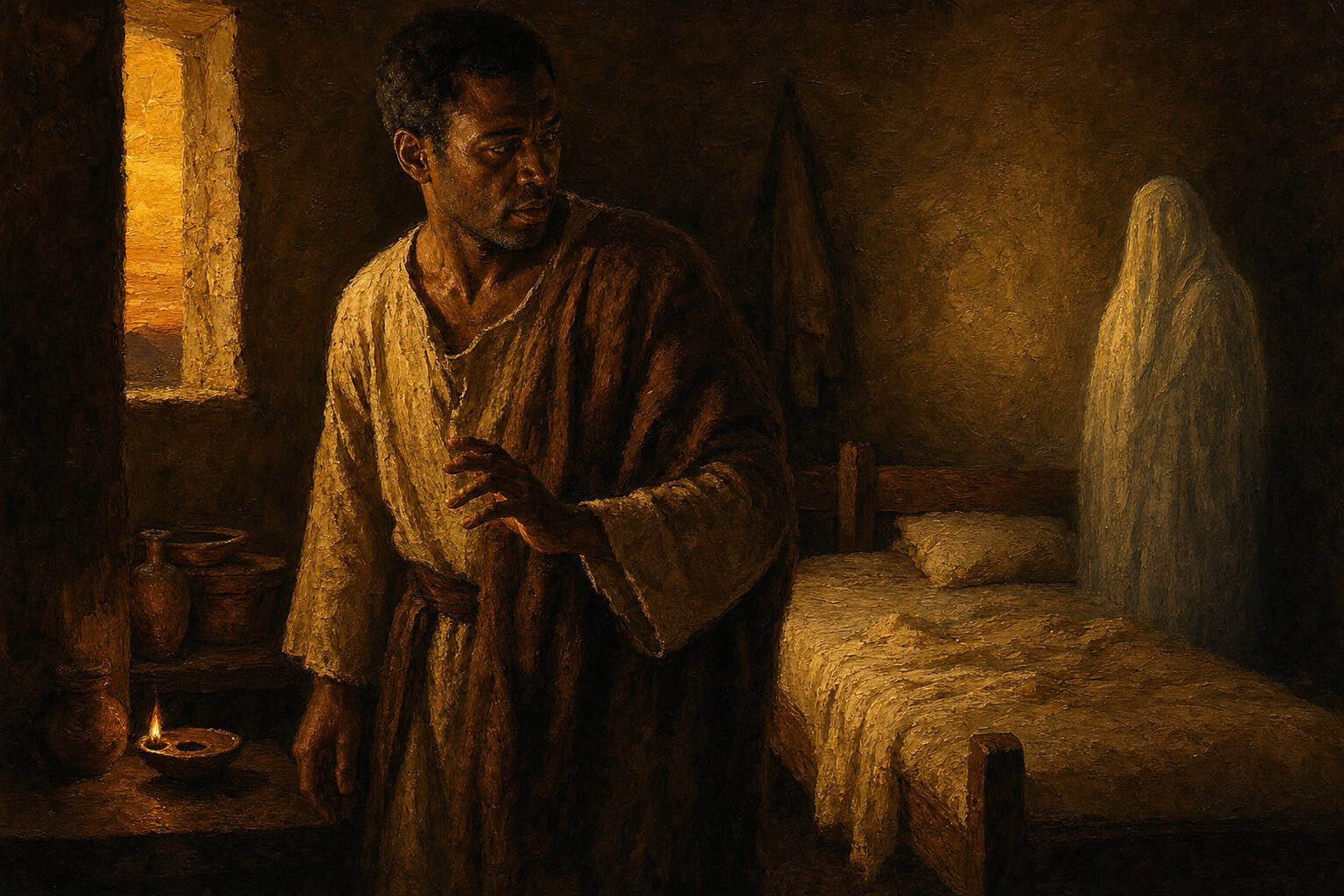
Then the visitation itself. The boy lies in bed one fall evening, and a spirit crosses over into the room. The book describes what he saw with a strange, awful exactness: a form only about twelve inches tall, vaporous and lanky, a thin humanlike shape hovering there in the dark. He never saw it again after that night. But the mark it left never washed out of him. And here the chapter turns in a way the reader does not expect. The terror is real, but it is also ridiculous. A tiny, absurd little figure. This is the sharpest thing the scene reveals about childhood abuse, and it is why so many who survive it can never speak of what was done. The worst harm often comes dressed up in mockery. It mixes real terror with something so bizarre, so shaming, that the victim cannot tell it without sounding out of his mind. The darkness does not only frighten a child; it makes his fear look silly, so that even his suffering feels like a joke played on him. That is a crueler thing than a grand and tragic horror. A grand horror could at least be spoken with some dignity. This small vaporous shape at the foot of a boy’s bed leaves him with a terror he can never get anyone to believe. The book reads it as a defilement of innocence, a deliberate humiliation stacked on top of the fear. For the searcher asking why old abuse still haunts them, this is the answer that stings: part of what keeps the wound sealed shut is shame. Not only did it happen, but it happened in a form so strange that saying it out loud risks being called crazy. The narrator names this trap plainly. And yet the whole book exists because he decided to say it anyway.
What breaks you as a child does not stay in childhood; it teaches your grown eyes how to see everything after.
That is the hinge of the chapter and the hinge of a whole life. The thing he did not want, the intrusion he never invited, became the very lens through which he learned to read joy, terror, beauty, and the heavy burden of seeing. He did not pick the eyes he was handed. But they became his only eyes, and he had to look at the world through them for the rest of his days, at every good thing and every terrible one, from that fall evening on.
What breaks you as a child does not stay in childhood; it teaches your grown eyes how to see everything after.
Eyes Trained on Every Room for the Exit
After the visitation, the boy grows, and the fear does not lift; it turns into his teacher. This is the fallout the searcher most needs to understand about surviving early harm. The wound does not stay a single event you can set on a shelf. It spreads into everything, coloring how the person feels every good and terrible thing that comes after. The narrator says the intrusion became the lens for reading joy, terror, beauty, and vision. Sit with what that means. Even his joy reaches him through a fear-trained eye. Even beauty arrives with an edge of dread, because he learned early that lovely and safe rooms can turn on a child without warning. This is the daily life behind the cold word symptoms. It is not a list on a chart. It is a man who cannot take in a good thing without bracing for the harm hidden under it, who reads a space the way a soldier reads open ground, marking the doors, the corners, the distance to the wall. The book names discouragement as one of the enemy’s slow tools, and here it lands with full force. Years of intrusive thoughts, years of dread with no cause in the present, wear a person down until hope itself starts to feel like a con. The narrator turns the hard question back on himself. What did he do with these eyes? He admits he built a fortress out of his own isolation. He grew cold and cynical. He told himself the tender people around him were only faking, that the gentle ones hid a hunger just like his, so he would not have to feel his own. He confesses that his wound did not only make him a victim; it made him someone who wounded, who shut out warmth, who could not let a hand reach for his skin without the old shadow rising up behind it. The book refuses to let him off the hook. It also refuses to pretend grace swept in and fixed the whole thing. Instead it offers something harder and truer. God is present in the dark, but not by clearing it away. The boy is led as if blind, down a road he cannot see, and the book quietly insists this blind road is somehow safer than the light he would have picked for himself. This is not comfort in the cheap sense. It is the stubborn claim that even the fear-trained eye, even the cold fortress, even the humiliating little terror at the foot of the bed, was not beyond the reach of a God walking close beside him inside it.
Saying the Thing Too Strange to Say Aloud
Where the chapter finally comes to rest is not in healing but in speech. The whole book is framed as a confession made in the presence of God, a darkness lifted up on purpose, in fulfillment of something asked of him. That is the turn that matters most for anyone carrying a childhood wound in silence. The narrator understands that his most isolating experience, the one so bizarre he feared no one would believe it, is exactly the thing he must make public. He treats it as a debt. The older self owes the younger world his darkness made clear and speakable. What was once groaned alone in a private, wordless prayer becomes medicine when it is finally said out loud with care and precision. This is the answer the searcher came for, and it is not a fix. The book does not promise the fear will vanish or the intrusive images will fall quiet. It promises something rarer and more honest: that the very wound which cut you off from everyone can become the place grace enters, once it is spoken with exactness. The narrator names his ritual violation. He names the tiny vaporous shape. He names his own coldness and cruelty and self-deception, the fortress he raised, the people he refused to see plainly. He resolves none of it into a tidy moral. He leaves the fear real, the shame real, the questions still open and unanswered. But he says them, and in the saying, the private torment turns into something he can hand across to another frightened person. For the adult who still flinches at a touch, who still counts the exits in every room, who still carries a terror too strange to put into words, the chapter offers a strange kind of company. You are not insane. What happened to you was small and absurd and enormous all at once, and that is precisely why you could never manage to say it. This book was written by a man who decided to say it anyway, in full view of the God he believes was there in the dark of that fall evening. Confessions to the Empty Chair does not hand you relief. It pulls a chair up beside you in the unlit room and speaks the unspeakable thing first, so that you might begin to find the words for your own. That is where it leaves you, sitting in the low light with someone who has already gone ahead of you into the fear, and it is enough to make you keep turning pages.