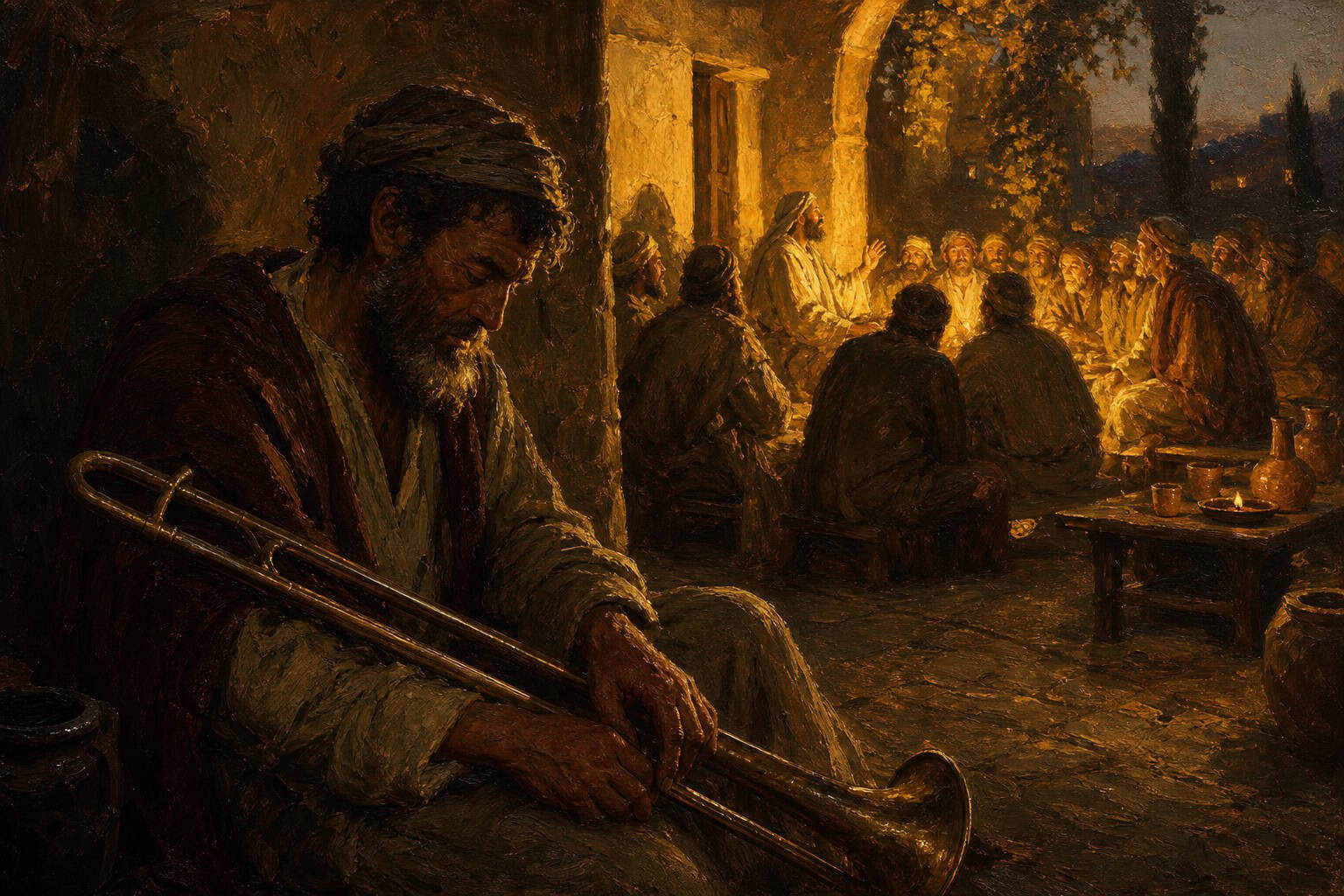
Molested as a child, then hiding in plain sight at school. How a wounded boy learns to disappear—and finds God still walking beside him in the dark.
The Slide Cold and Long Across My Palms
It began with a weight I could hold. The trombone’s slide filled my hands, cold and long, its metal warming slowly against my grip, and the sound that came out of it dropped below my own thin voice into something bigger and safer. I chose that horn the way a hunted animal chooses cover, not for love of music but for the wall it put between me and the room. Around me sat boys who spoke sarcasm like a second tongue, sharp as I once had been with Doug and Steven, and I no longer wanted to trade in that fast, cutting currency. I wanted the instrument between us. In Confessions to the Empty Chair, the third chapter drops the narrator into junior high, and this is the place where he learns a strange arithmetic—how to take up less room inside a body that had already been taken from him too early, touched by hands that had no right. A boy who has been used that way does not learn shame as a lesson he could recite; he learns it as a posture that lives in the shoulders and the eyes. The shoulders curl inward. The gaze slides to the floor. The voice goes reedy and quiet. He hunts for a lower register to hide inside, and when brass offers him one, he grabs it with both hands. What undoes me now, reading it, is how young he was to already know all of this without being taught. Nobody sat him down and explained disappearance. The flesh worked it out on its own, the way a hand jerks back from a stove before the mind has even said the word hot. He calls it survival, and it was exactly that. But survival carries a bill, and the boy signs the contract without reading a single line of it, because at that age you will pay almost anything to not be looked at closely. The lower voice granted him a different identity, he says, one less likely to be questioned—and that one phrase tells you the whole of his fear. To be questioned. To be examined. For a child who had once been examined by hands he did not invite, the plain gaze of maturing boys must have felt like a second harm crouching just ahead of him. So he reached for the horn and hid inside its heaviness, and he counted himself lucky to have it. And if God was in that band room at all, He was not yet anything a boy could call rescue. He was only the small quiet under the noise that let a frightened child keep breathing.
Counting Shoelace Knots Instead of Eyes
At lunch, he tells us, he counted the knots in other boys’ shoelaces rather than lift his face to meet anyone’s eyes. That single detail took the breath out of me. Picture it plainly: a boy in a loud cafeteria, trays banging, laughter rising up walls he cannot climb, and his whole attention drains down toward the tile floor, toward the small looped knots on the sneakers around him. It is such a precise, practiced way to stay alive. Eyes are the danger. Eyes measure and appraise and decide. Eyes carry a history for him that none of these boys will ever guess at. So he trades the human face for the ankle, the chance of recognition for the safety of a knot, and he tells himself this trade is enough to live on. He pushed himself out to the edge of every group, to what he calls the periphery, and from that far margin he became a student of a different kind—not a boy among boys but a watcher of them. He mapped the tribes with cold care: the kickers stamping around in their boots and country swagger, the jocks who carried the school’s pride into interscholastic games, the preppies fresh from the country club, the stoners drifting in their haze of smoke and worn denim. He watched each group mine popular culture for its aspirational self, borrowing attitude and style off screens and radios and glossy magazines. And underneath all of it he read the silent architecture of power—tall, athletic, older, wealthy, in roughly that order—the invisible frame that decided who spoke and who faded into the background. He was frighteningly good at seeing it. But here is the tenderness the older man now lets himself feel, and could not then. This brilliant watching was not wisdom. It was a wound wearing a lab coat. He mistook his detachment for intelligence because detachment was the only ground that felt solid under him. A boy who has been hurt learns to study a room before he dares trust it, and then he never once stops studying, and the studying slowly becomes its own locked cell. He spoke their language, he admits, faking a share in their easy familiar routines, while his inner world stayed entirely off the map. That gap—fluent on the outside, uncharted within—is the exact shape abuse leaves carved into a child. You become an expert translator of everyone else and a total stranger to yourself. I want to reach back across the years and tell that boy his gift for reading rooms was real, that his eye missed nothing—but that it grew up out of soil that should never have been poisoned. He built a whole self out of watching because being watched had once meant being harmed.
The Armor That Also Buries You
There comes a point in the passage where his invisibility stops being only a shield and shows its second face. He says invisibility had its own strange mercy—it spared him the sharper edges of scrutiny. Then, without softening it, he adds that this mercy made poor company. That is the turn, quiet as a dropped coin. Because the thing that guarded him was the very thing that starved him. He was spared the judgment, yes, but he was robbed at the same time of the warmth that recognition sometimes carries, the ordinary human heat of being noticed and wanted. He bought his safety with his own voice, and only now, decades on, can he add up what that purchase truly cost. This is the hard truth a molested child grows up into: the armor you weld in the dark does not simply lift off when the light comes. The habits that kept the boy alive—the silence, the endless watching, the shrinking, the flat refusal to be known—harden into the walls of the cell the man goes on living inside. He was not merely dodging the loud boys at the lunch table. He was hiding from being touched, from being seen, from being wanted, because in his history every one of those things had once come attached to a blade. So he chose exile and named it peace. He chose the periphery and named it wisdom. And the God of this book does not come swooping down to smash those walls to rubble. That is not how grace moves here, and the plainness of that is exactly what makes it bearable. There is no clean rescue out of the flesh, only a companion who stays inside it—someone quieter and nearer than the boy could ever feel, closer to him than his own held breath, present in the clattering cafeteria and the counted knots and the heavy cold horn across his knees. He does not lift the child out of the loud room. He sits down on the bench in it with him.
We train the body to disappear long before we can name the thing it is fleeing.
Fluent in Everyone, Mute in Himself
After the turn, the fallout settles slowly, the way cold seeps into a room through the long hours after everyone has gone. The boy grew into a young man still fluent in the language of everyone around him and still mute in the language of himself. He could recite the code of every tribe, the currency of every group, who ranked above whom and exactly why. What he could not do was walk into any of it and simply be one body among bodies, unafraid, unarmored. That way in had been shut early—by hands, and by the shame those hands pressed into him afterward. Reading his own past, the narrator turns the lens back on himself with a severity that never sours into cruelty. He puts to himself the questions I would want him to ask. Did I really see those boys, or did I only weaponize my seeing so I would not have to feel? Was my detachment a kind of superiority I crouched behind, a pride I dressed up as insight so I would never have to confess how badly I ached to be let in? He wanted out of their orbit more than he ever wanted in, he claims—and he does not fully believe himself, so neither should we. Beneath the wish to flee sat a hungrier, near-unbearable wish to be chosen, and he could not let himself feel the size of it, because to want recognition is to risk being seen, and being seen had once meant being used. So he told himself he preferred the margin. He told himself the analyst’s cold seat beat the crowded bleachers. And maybe, for a wounded boy with no better option, it did. But he knows now what the seat cost him. He knows the watching was another form of dying, a slow one, a whole boyhood spent with his face turned toward a world he never believed he had permission to enter. The molestation did not stay inside the moment it happened. It kept happening in every cafeteria, every crowded hallway, every choice to count shoelaces instead of eyes. It taught him that the safest human being is an invisible one, then billed him his entire youth for the lesson. What the older man extends to that boy now is not correction. It is mercy—the real kind this time, not the poor company he settled for then. He does not despise the child who hid behind a horn. He grieves for him. And slowly, unevenly, against the grain of everything he was taught, he begins to love him.
He Blesses the Boy Behind the Horn
Where it settles is not a triumph, and Confessions to the Empty Chair is far too honest to fake one. The boy does not stride into the cafeteria remade. He does not shed the armor in one bright cinematic instant and claim his rightful seat among the tribes. That is not the shape of this healing, and if you have carried what he carried, you already know it never is. What shifts is smaller and far truer. Reading his own past on the page, the man discovers he can finally look at the boy on the periphery without contempt—the boy who was trained by an early wrong to despise the very need in him to be held. Tenderness arrives late, but it does arrive. And it brings a stranger recognition trailing behind it: that the God he could not sense in that roaring room was never actually absent from it. He was there inside the hiding itself. He was nearer to that shrinking child than the shame was, nearer than the counted knots, more inward than the boy’s most inward part. Not fixing him. Not hauling him out of the dark into some easy floodlight. Just present, walking the margin alongside him, a companion in the exile the boy had mistaken for safety. That is the medicine this book stores up in memory—not that the suffering got erased, but that it was accompanied the whole way through. For anyone hurt as a child who learned to vanish before they could name what they fled, this chapter hands over no quick cure and no cheap comfort. It offers something harder and much better: the sight of a man who at last stops hating the child he was for surviving in the only way that child knew. In memory he lifts that heavy horn again, and this time he does not sneer at the boy for hiding behind it. He lays his hand on him. He blesses him. If you have spent your years reading rooms you never once felt safe enough to walk into, this is a hand reached out across that same cold distance—not to yank you into the light, but to lower itself down into the dark beside you and stay there. What the boy learned to call peace was only loneliness he had gotten used to. The rest of the book is where that hard, patient staying gets tested. And it holds.