When do people feel old? Not in the mirror, but the day love turns into obligation. A hard, tender look at freedom, silence, and the tired heart.
The Hands That Learned to Pay Instead of Give
When did you first feel old? I know you thought it would arrive the way weather arrives, some visible fact you could point to, a gray hair in the sink, a knee that complains on the stairs. But listen to me now, from the far side of it: you felt old the first evening love stopped feeling like a gift and started feeling like a bill. You were young in years then, boy, still lean, still able to take the steps two at a time, your breath easy in your chest. And yet your heart had already begun to stoop. Somewhere back in the smallest rooms of your childhood you had learned to earn affection the way a laborer earns wages, hour by hour, chore by chore, keeping a running sum in your head, hoping the numbers would come out right by nightfall. You carried love the way a frightened man carries water in cupped hands, arms rigid, eyes down, terrified of the spill. That rigidity is what aged you. Not the years. The constant flinch of a soul convinced it must perform to be kept. I watch you now across the distance and I see it in your body: the shoulders drawn up near your ears, the way you tallied your own usefulness before you slept, the way you asked yourself whether you had done enough today to be worth staying for tomorrow. You called this devotion. It was fear dressed in devotion’s clothes, and fear is the fastest thing there is for turning a young man old. It hollows the face from the inside out. It makes the mouth careful. It teaches the hands to pay instead of give, and hands that only pay forget the whole shape of opening. You did not notice the change because it came so quietly, one small compliance at a time, one swallowed word, one bent knee that was appeasement rather than prayer. If you could hear me I would tell you: the ache under your ribs was not weakness. It was the true weight of a real thing carried the wrong way. Love was never meant to be gripped like that. It was meant to be received with the hands loose and low. But no one had shown you the difference, and so you aged in secret, inside a body that still looked young to everyone who passed you, while within it a tired man bent over a ledger he would never balance. You mistook the ache of that wrong carrying for the ordinary cost of loving. It was not ordinary. It was the slow theft of your youth by an accounting no one had ever asked of you but yourself.
The Silence That Pressed You Flat Against the Chair
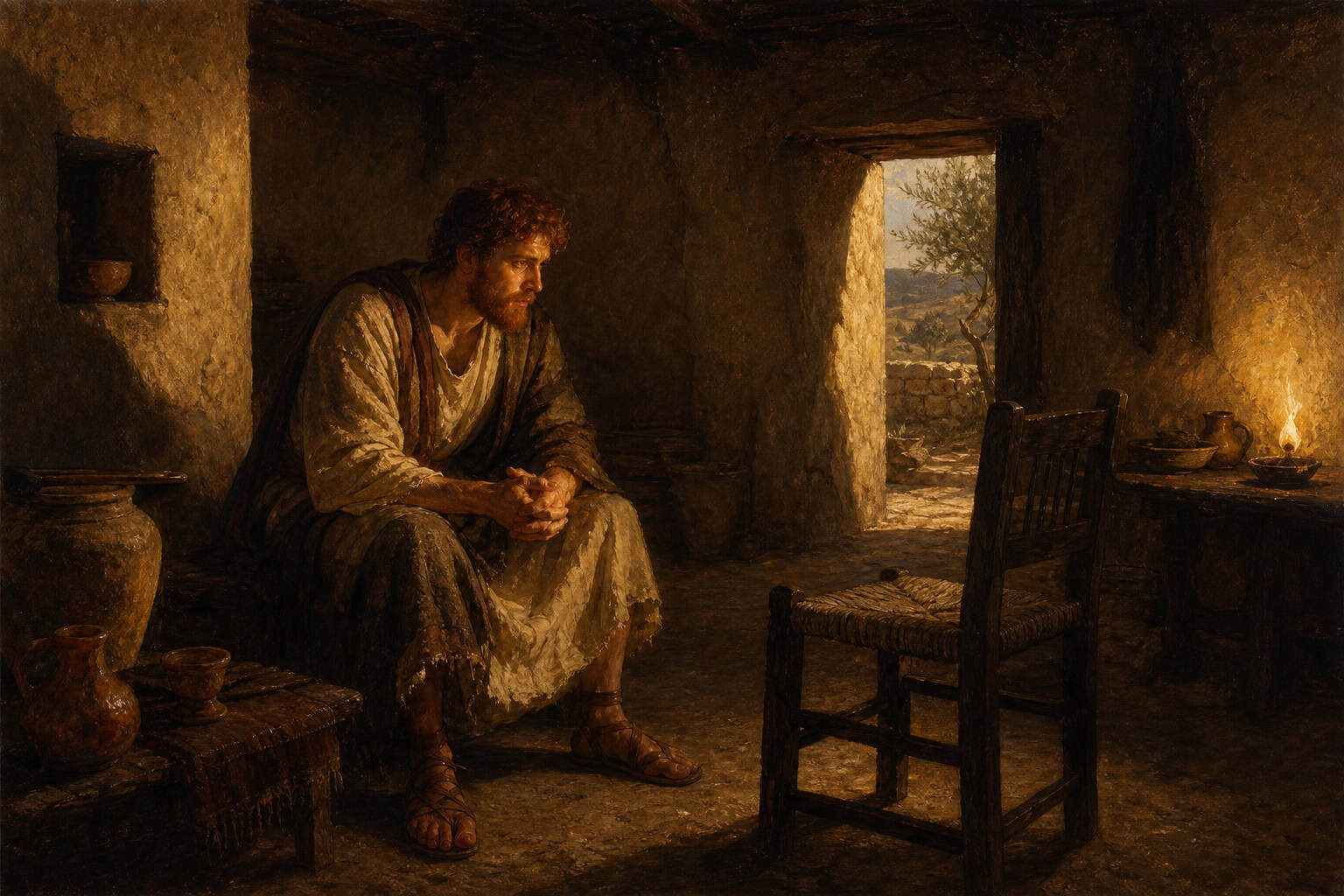
There were nights you sat in that room and strained your whole face toward Heaven and heard nothing come back. You called it abandonment, and you were sure of the word. The quiet gave you no comfort; it pressed you flat against your own refusal, each breath meeting only the unmoving surface of an empty chair. In that pressing you did what tired hearts always do. You began to bargain. If I am good enough, He will speak. If I pray hard enough, hold my body still enough, confess with enough precision, the silence will crack and an answer will fall through. You tried to purchase His voice with your compliance, coin after coin, and when no voice came you decided the fault was yours, the debt still open, that you were unworthy even of a whisper. This is the exact machinery of feeling old, and I need you to see it plainly. The aging of a soul is the belief that love, human or divine, must be manipulated into arriving. It is the slow exhaustion of trying to secure what can only ever be handed to you freely. You read God’s silence as a verdict on your performance. You had not yet learned that His silence is many things at once, distinguished and multifaceted, and that not all of it is absence. Sometimes it is hard grace, prying you off the couch of your assumptions and driving you out to seek. Sometimes it is sacred space He clears on purpose, so your own spirit can find its voice and speak. Sometimes it is the inexplicable quiet in which His whisper can finally be told apart from the noise of your own bargaining. But you could catch none of that, because your ears were tuned to a reward and not to a Person. You were young and you felt ancient, ground down by an accounting with no last page. The most sincere part is what breaks me: you truly believed the price would work, that if you simply kept paying, the transaction would clear. You did not know that the very act of pricing love was the thing wearing the grooves into your face, teaching your prayers to sound like invoices read aloud in the dark. I sat where you are sitting. I pressed my own body against that same refusal until my back ached with it. And I want to hand you this from the far side: the silence was not empty of Him. He was inside it. He was in the salt on your cheeks. He was walking beside you within the very fear that made you old, matching your step in a dark you were sure He had left.
Love Arrives as a Gift or It Does Not Arrive
Here is the truth I would carry back into that room and press into your open hands if I could reach across the years: love is free. Free to be accepted and free to be refused. It cannot be coerced, cannot be manipulated, cannot be purchased through your endless compliance or held upright by the obligation you kept stacking on your own bent back. It arrives as a gift, or it does not arrive at all. And this is not only how human hearts are built. This is how Heaven itself moves. God does not want a machine that obeys because it has no choice. He seeks a willing heart, a real yes offered from a free soul, and He honors that freedom so completely that He holds His own sovereignty in check to wait on your consent. Sit with the size of that. The One who could compel you refuses to. The One who holds every power will not force the latch. Consent is not some courtesy He extends around the edges of His will; consent is the very way He chooses to come. Any love that tramples this freedom, however noble the reasons it recites, becomes a gilded cage, and you had built yourself a fine one and hung the word faithfulness over its bars. This is the turn I needed and could not find alone in the dark. You do not feel old because the body is failing you. You feel old because you have been living inside the cage, paying rent on a love that was never for sale, never on any market you could reach. The moment this lands, something in the chest unclenches. The knuckles go loose. You see that you were never meant to grip the thing so hard, because it was never yours to forfeit by loosening your hold. It was given. It is still being given, this very hour. The exhaustion you dragged everywhere was the exhaustion of a debt that did not exist, dreamed up by a frightened boy who mistook worthiness for a wage. And the God you strained toward across that silence was not withholding Himself until the balance cleared. He was standing in the dark at your shoulder, so tender with your freedom that He waited to be wanted rather than force His way in. That is the intimate life He was inviting you into, love moving freely and without coercion between the Persons who are its home, and He held the door of it open by never once forcing yours. You wore yourself old trying to earn what He was already holding out, palm up, in the quiet.
You do not age when the body slows; you age the hour love becomes a debt you pay instead of a gift you give.
What the Loosened Grip Cost and Gave
I will not lie to you and call the loosening a relief. It was not, not at first. When you finally set the ledger down on the floor, you did not feel light; you felt strangely emptied, alone, weak in a way you had not braced for. This is the part the comfortable voices leave out of their bright sermons. When the fire of your striving stops assailing the soul, the heat goes out of it too, and for a long while the room feels colder rather than warmer, the way a hearth does the hour after it dies. You had organized your entire self around the paying. Pull that away and you do not float free; you feel exposed, purposeless, like a laborer told the work is finished and given no reason left to stay. I remember the hollowness of it. I remember believing I had lost the only manner of loving I knew, that without the accounting I would not know how to hold anyone at all. But this emptiness is the stripping, and the stripping is not cruelty. It is the purging of a palate grown sick on the wrong food. You had been feeding your spirit on performance, on the dense material weight of good deeds counted twice, trying to fill with effort a hunger only free love could ever fill. When that was taken from your mouth you tasted, for the first honest time, how starved you had let yourself become. The silence did not console you in the middle of the stripping. It pressed you down until every argument and every image you had built to buy God collapsed under their own weight, until there was nothing left in your hands to purchase Him with, until the empty palms simply stayed empty and stayed open. And here is what I could not have believed while I lived it: the open empty hands were the beginning of everything. Forgiveness, I would slowly learn, releases the false claims we lay on another’s will and returns our own consent to God, ours to give freely again as the gift it always was. The test was never whether you had paid enough into the account. The test was quieter and harder: does freedom draw you closer, or does fear hold you in place? You had been held in place by fear so long that mere stillness felt like dying. But the flesh remembers what it was made for. The same body that learned to flinch can be taught to rest. The shoulders that stooped under the ledger can come down and open, not because the burden was finally earned away, but because it was never yours to carry. I watch you sitting there, spent and thin and old before your time, and I ache for how long you kept paying into the dark.
The Young Man Who Was Never Meant to Grow Old That Way
So when do people feel old? Not the morning the mirror surprises them with a stranger’s face. They feel old the day they forget that love is a gift and begin treating it as a wage they must keep earning or watch vanish. And they grow young again, in the only sense that matters, the day they finally let it be free. You, boy, sitting in that dim room with your open accounts and your straining ears, you were never meant to grow old that way. The aging was not written into your bones. It was the residue of a lie about love that you swallowed young and never once questioned, the lie that whispered staying loved demands ceaseless payment. I cannot tell you here how the rest of it unfolds. That belongs to the walking, to days I have not yet set down on this page for you. But I can point you in the direction, and the direction runs away from the ledger and toward the empty open hand. The mother’s love that is a blessing of peace can never be produced or controlled or bought at any price; it either rests upon a life like light or it does not, and where it is absent the world goes strangely without beauty. You knew that absence in your own marrow. You tried to manufacture by effort what only ever arrives freely, and you wore yourself old in the trying. There is no fixing this in one evening, no tidy resolution I can hand you across the years to close the wound cleanly. The exile is real; you were cast out of a home and you felt it. The silence is often long. God did not haul you up out of the dark and set you somewhere bright; He came down into it and stayed, present in every tear on the back of your hand, walking beside you inside the very fear that had made you old. That nearness is the astonishing thing, not the erasure of the pain, which He did not perform. If you want the whole account of how a heart learns to lay its ledger on the floor, of how the empty chair slowly became something other than a judge, you will have to sit longer than these lines allow. That story lives in Confessions to the Empty Chair, written for the tired ones who have grown old paying for what was always meant to be given. Hold this single truth in the meantime, and weigh your own bonds against it honestly: does the love you are gripping so hard make you free, or does fear pin you where you sit? Answer it without flinching. The honest answer is the first breath of the younger self coming home, the first unlocking of the hands that forgot the shape of opening, the first slow taste of a table you were never once billed to sit down at.