How childhood trauma hides in small choices—the boy who joined band to escape the showers, and the slow work of being seen again.
The Slide Heavy in Your Small Hands
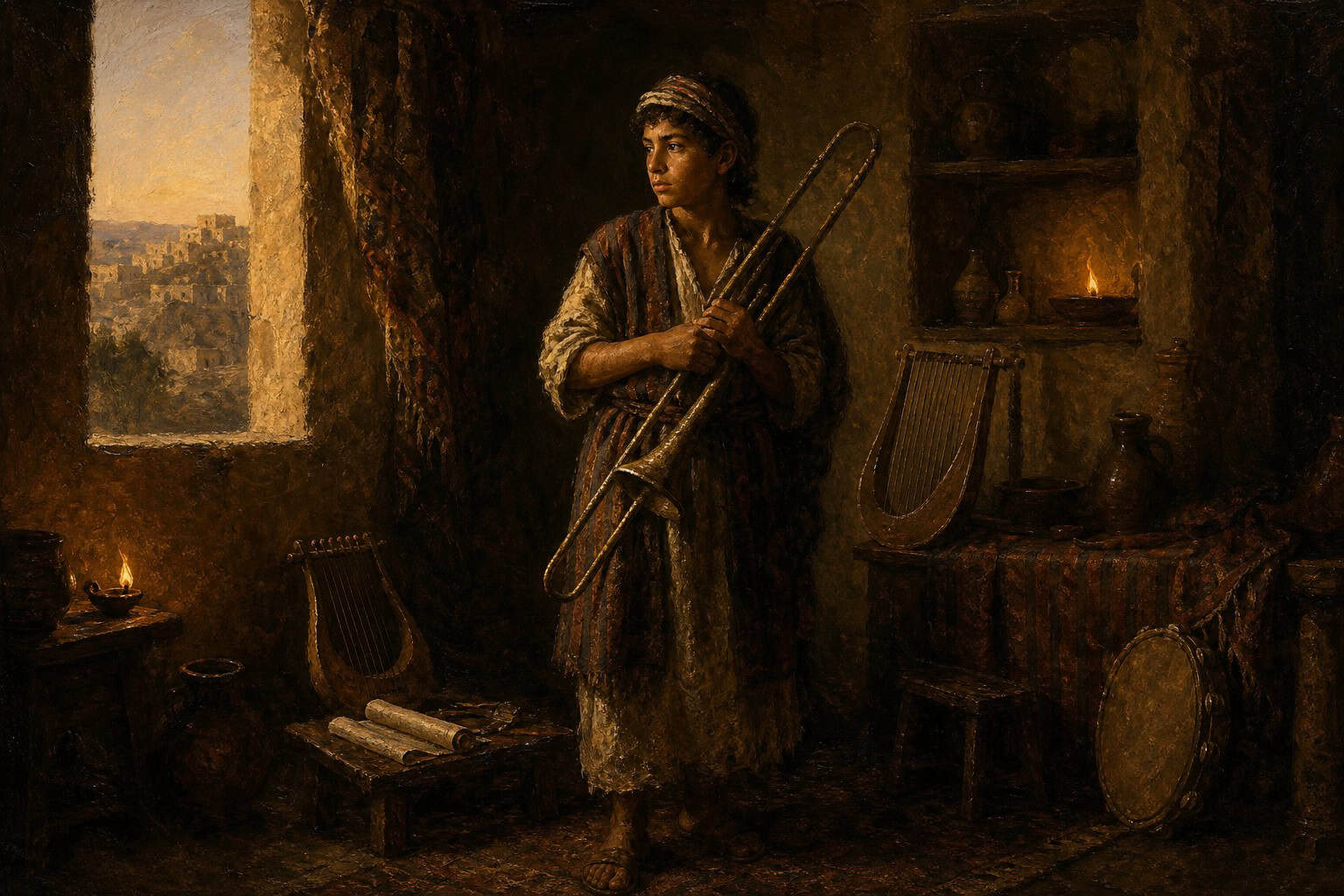
Can a wound handed to you at twelve ever loosen its grip? You have carried that question a long time, so let me speak to the boy you were, the one holding the trombone across his chest like a shield beaten out of brass. You told everyone you loved music. You told yourself a softer version of the same story, and after a while you half believed it. But the truth sat lower than any note that horn could reach: you joined the band to escape the showers after gym. You could not bear the thought of standing bare among the other boys, your changing body offered up for their appraisal, weighed and ranked while the water ran and the tile went cold under your feet. That was the whole reason, and you knew it even as you signed the form. The slide felt heavy in your hands, and you liked the weight, because it gave you something solid to hold and somewhere to put your eyes when eyes were the very thing you feared. Its voice came out low and sure, more commanding than your own thin voice, and for a moment it lent you a borrowed self, one less likely to be picked at. I want you to know I see the deal you struck at that music stand. You traded an hour of terror for an hour of practice, and you walked away certain you had come out ahead. You had learned, without any words for it, that your own flesh could betray you—that simply being looked at, undressed, was enough to expose everything you spent your days trying to bury. So you found a room where you could stand clothed and useful and mostly unnoticed. The band hall smelled of valve oil and old carpet and the sour brass of a hundred mouthpieces. The music stands leaned at their crooked angles like tired men. You fit yourself into the second row and let the sound rise up and cover you like a blanket you could hide beneath. I do not scold you for this, small one. A frightened child finds the exit within his reach and takes it, and there is no shame in reaching. But I will not pretend the exit was free of charge. You bought your safety with your own body’s shame, and the price kept collecting interest for years you could not yet imagine. What you did not know, could not have known, was that God was already there in that shabby hall with you—not as a rescuer come to pull you out of the fear, not as a hand yanking you free, but as a presence sitting in the empty chair beside your own, quiet and unhurried, watching you learn to hide and loving you inside the learning.
Counting Shoelace Knots at the Long Table
From the edge of things you became a student of a different kind, and you were proud of the schooling. You kept your head down and your mouth shut, and you taught yourself to read the room you were far too afraid to enter. The cafeteria became your laboratory. The hallways, the crowded bleachers—you studied them all, not as a boy among boys but as a cold and careful analyst, cataloging what you could not join. At lunch you counted the knots in other boys’ shoelaces instead of meeting anyone’s eyes. Do you remember that habit, the way you bowed your head over the tray and watched feet and floor, because a shoelace could not look back and find you lacking? You mapped the tribes with a precision that impressed you. The kickers with their boots and country swagger. The jocks, worshipped for their wins on the interscholastic field, the school’s own spirit warriors. The preppies fresh from the country club, the elite’s children with their easy money. The stoners in their haze of smoke and worn denim and studied indifference. Every group kept its saints, its enforcers, its exiles. Every group mined the movies and the radio and the magazines for a face to wear, plundering the world around them for an aspirational self they could pull on each morning. You saw the silent architecture of power that decided who spoke and who faded into the beige of the walls. And at the top of the whole structure, in rough order of worth: the tall, the athletic, the older, the wealthy. You held yourself against that scale and came up short in every single column, and the tally became a kind of daily liturgy. Here is what you could not have believed then. Your observing was not wisdom, however much it felt like wisdom. It felt like you had climbed above the childish game and could see its rules from a great and lonely height. But it was only another way of disappearing. You mistook your safe distance for insight when it was really a slow, quiet dying—the anthropologist who studies the human community because he has stopped believing he belongs inside it. You told yourself the tribes were beneath you, that the recognition they hungered for was a cheap and borrowed thing. And there was some truth folded into that judgment. But beneath the truth lay a hunger you would not name: you wanted to be seen and kept and counted, and because you were sure that being seen would end in ruin, you decided you would rather not be seen at all. So you counted knots. You practiced your absence until you were expert at it. And the warmth that recognition sometimes carries in its hands—you starved yourself of it deliberately, and you called the starving strength.
The Verdict You Passed on Your Own Body
Here is the turn I would carry back to you if the years would let me. The showers were never really about the showers. What you feared standing there on the cold tile was the verdict. You believed with your whole trembling body that if the other boys saw you, they would judge you and find you wanting, and that their judgment would settle the question of your worth for good, past appeal. So you slipped out of the courtroom before the sentence could be spoken. But listen closely, because this is the thing: in fleeing the verdict, you delivered it yourself. You looked at your own flesh through their imagined eyes and pronounced it guilty—not enough, not right, not fit to be seen. That was the real transgression in that scene, and no other boy committed it. You did. The moment you accepted their gaze as the true measure of you, you handed a pack of frightened children a power God never granted them. Your body, which was made to be a dwelling place, a spot of ground where something of the divine could be reflected back, you turned into a defendant in a trial you rigged against yourself. Desire bent; survival chose. And survival taught you to vanish before you had any words for what you were vanishing from. This is the sharpest thing I know now, looking down at your bowed and careful head: you did not choose music; you chose disappearance, and called it a hobby so no one would ask what you feared. The tragedy is not that you were afraid. Every changing body is afraid, every one, and the fear is no sin. The tragedy is that you believed the fear over the truth. You believed you were a heap of vulnerabilities waiting for a sentence to be read, rather than a soul God had already looked upon and called good before a single boy in that locker room drew breath. And here is the part that undoes me still, decades on: God did not spare you the dread. He did not empty the showers or quiet the boys or hand you a body that felt safe to inhabit. He let you walk straight into the fear, and He walked into it beside you—present in the trembling, present in the shame that pinked your neck, present in the empty chair you kept setting, year after year, for someone who might finally see all of you and refuse to leave. He was not the rescue you kept begging for. He was the company. And company, in that particular dark, was the one thing no boy and no verdict could take from you.
You did not choose music; you chose disappearance, and called it a hobby so no one would ask what you feared.
The Armor That Learned to Weigh a Ton
So you survived, and you want to know whether surviving is the same as healing. I have to tell you honestly what came after the escape. The armor worked. That is the terrible part, the part that fooled you longest. Invisibility carried its own strange mercy—it spared you the sharpest edges of scrutiny, the pointing and the laughter. No one mocked what no one could see. You slipped through those junior high years mostly untouched, and you were quietly proud of it, the way a soldier is proud of a scar he thinks he earned. But mercy, you learned, makes poor company. The same armor that shielded you from judgment sealed you off from ever being known, and you could not keep the one without losing the other. The silence you spent to buy your safety was the very silence that walled up your voice. And the cool detachment, the superiority of the boy who watches the tribes and will not stoop to join them—that hardened over the years into a heavy garment of the mind, a distance you wore like importance and mistook for maturity. You told yourself you had outgrown the need for their warmth. You had only buried it alive. What you did with the fear was the real damage, far more than the fear itself. A frightened boy is not to blame for his fright. But you took the fear and built an entire self upon it, a self defined by not being seen, and then you defended that self as though it were a hard-won virtue. So I put to you the question I could not ask you then: who did you refuse to see, because you were so busy vanishing? The other boys in that band hall spoke sarcasm as fluently as you did. Most of them were frightened too, tucked into their own rows, guarding their own tender accounts. You could have known them, could have let one of them know you. You chose the periphery instead, and from that periphery you judged them exactly the way you dreaded being judged. The appraising eye cut both directions, and you wielded it as harshly as you feared it turned on you. That is what isolation does in the end. It does not leave you innocent. It leaves you a watcher who has forgotten he was ever meant to be held. And the body you worked so hard to erase kept the whole ledger—every flinch, every bowed head, every hour you spent making yourself smaller—stored deep in the muscle and the caught breath, waiting for a far-off day when someone would ask you, gently, to stand up straight and be seen.
A Path on the Sea With No Footprints
Does the grip ever loosen? Yes—but not the way you kept praying it would. You wanted the fear lifted clean, the body made painless, the verdict struck from the record in one merciful stroke. That is not how it came, and I will not lie to you and pretend it should have. The healing arrived the way the old desert souls described the dark passage—like a road across open water, a path whose footprints cannot be found, where you cannot tell you are moving at all until you turn and see you have somehow reached shore you never chose. The purging was slow and often felt like nothing but loss. Most days it felt like being shut up behind the bars of your own imperfections, the very failings that kept you from any sweetness. But the trembling of the ground beneath you was not God stepping away; it was the earth of your soul being broken open so something might finally take root there. Hear this, small one clutching your brass shield in the second row: the aim was never to make you invulnerable. The aim was to walk you, tender and afraid, the whole way through the becoming. God did not want you to stop having a body. He wanted you to stop hating the one He gave you. And that took years, and it took Him staying—quiet, patient, unmoving—in every single room where you tried to disappear. The shower you fled. The band hall thick with valve oil. The long lunch table where you bent your head and counted knots. He was there in the starving and there in the pride and there, at last, in the slow undoing of both. He never once pulled you out of the flesh. He accompanied you through it, step by unmarked step, until your body stopped being a defendant and slowly, warily, began to be a home again. If you are the one reading this now, searching for some way past a wound you were handed far too young, I cannot promise the fear will burn off like morning fog. But I can promise you are not standing before a merciless court. You are being walked with. The whole long account of the boy who chose to disappear—every counted knot, every fled shower, every hour of it—is set down and kept in the pages of Confessions to the Empty Chair, not to shame him but to show that even the child who trained himself to go unseen was seen the entire time, and was never, for one breath of it, turned away from.