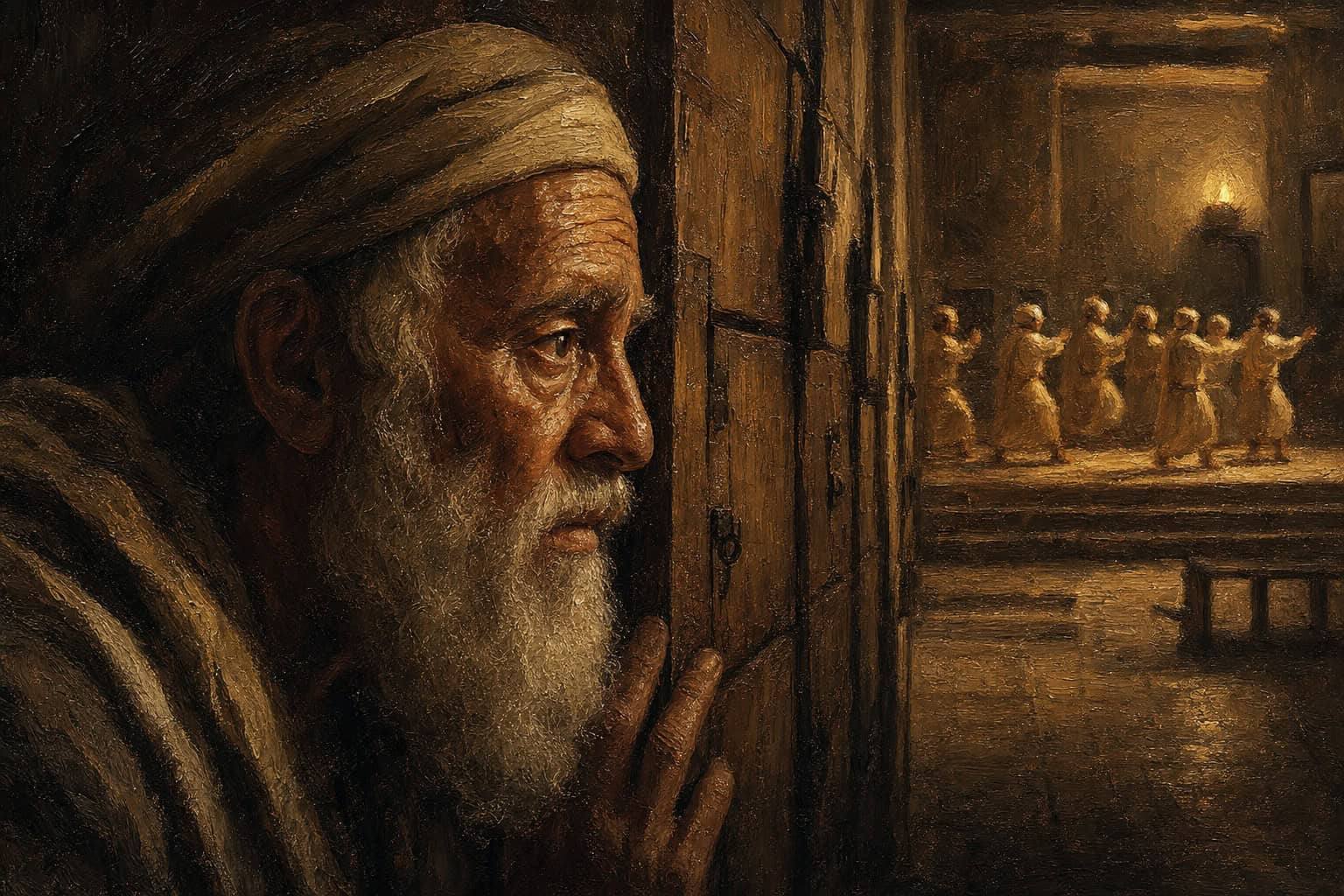
What happens when you hate someone? A memoir reads the cruelty of country-club kids through the movies that mirrored it – and names the prison both sides share.
Sixth Grade Girls Singing the Same Song
What happens inside you when you hate someone – not a passing dislike, but a hatred earned by their hands on you? The narrator of Confessions to the Empty Chair carries this question back into a school hallway in 1988, where the answer began to grow in him like a bruise under the skin. He remembers a talent show, and how nearly every sixth-grade girl walked onto that stage to perform the very same song. They moved their arms the same way. They tilted their heads the same way. They wore the same practiced smiles, taught by the same unseen hand. He watched from the edge of things, one of the disposable boys, and something in him hardened at the sight. It was not that the song was cruel. It was that the sameness itself felt like a wall raised against him and the others – against Stephen, against Samir, against every awkward, science-loving, arcade-haunted boy the school had quietly filed under afterthought. He recalls the country-club boys who ruled that world, molded in the arrogant image of the movie villains he had absorbed as a child. He had learned their type from a screen before he ever met them in the flesh. Now the screen and the hallway matched with a fidelity that unsettled him. The satire he had laughed at as a boy was not satire at all. It was documentary. The mocked archetypes on film and the smooth cruel faces in the corridor were the same faces, and knowing this early did not protect him. It only made the trap feel scripted, as if his humiliation had been written before he arrived. Looking back, the older man does not simply catalog their cruelty. He turns the lens on the hatred it planted in him. He asks what that hatred cost, what it became, whether it ever fully left. There is tenderness in how he reaches for the boy he was – a boy taught to despise himself, who learned to despise them back as a kind of survival. The place matters here. The hallway had its own geography of nearness and farness, of who stood at the warm center and who pressed against the cold metal lockers. He was always at the wall. From the wall he learned to watch, and from watching he learned to hate, and from hating he learned something about his own soul he would spend decades unlearning. The hardest question he cannot yet answer is simple and terrible: whether the hatred protected him from that stage, or slowly hollowed him out while he thought it was keeping him whole.
Predators Need Their Prey to Stay Prey
The tension gathers as he studies what the tormentors were actually doing, and it is stranger than simple meanness. They performed dominance. That is the word he keeps returning to – performed, as if for an audience that had to be kept convinced night after night. He sees now that they needed him. They needed Stephen and Samir. Their power was not a thing they carried inside themselves. It was borrowed, drawn out of the contrast between their smoothness and his awkwardness, their prestigious last names and his invisible one. Predators, he understands, find their purpose in the presence of prey. Remove the prey and the predator is just a boy standing in a hallway with nothing to prove and no one to prove it to. This is the first turn of the knife: the ones who seemed strongest were the most dependent. Their clothing matched. Their music matched. Their language matched, boys and girls bonded by a shared temperament that made them indistinguishable in substance. Uniformity had eaten their personalities and left a smiling shell. He saw a closed loop of mutual affirmation, each face reflecting the next in an endless corridor of mirrors, sanctioned by their parents’ status and the teachers’ willing blindness. And the teachers – this is where his anger sharpens to a fine point – did not merely tolerate the cruelty. They institutionalized it. They excused it with a smile. They called it a rite of passage for boys with the right surnames. They could not imagine that elite children were capable of what they were plainly doing in the open. They were blind to his withdrawn posture. They were deaf to the threats spoken in the hall between classes. The rule book became meaningless paper in a drawer. But here the older man refuses to let himself off easily. He asks what the hatred was doing to him while the tormentors polished their masks of civility. Was he not also studying them, memorizing their faces, feeding on the contrast in reverse? A hatred that watches this closely begins to resemble the thing it watches. He wonders, honestly and without comfort, whether his contempt was purer than their cruelty or only quieter, only better hidden behind his glasses and his silence. The body remembers humiliation faster than the mind can forgive it, and his body was learning a posture it would keep for years – the flinch, the pressed spine, the eyes that read every approaching person as a possible blow. He does not pretend this made him noble. It made him vigilant. And vigilance, he confesses plainly, is its own kind of cage, one you build from the inside and forget you can leave.
The Standard That Could Not See Us
The revelation lands not in a single dramatic scene but in a slow, cold recognition that arrives when he stops looking at the bullies and looks instead at the empty space between him and them. There was a violence worse than being struck. There was a violence worse than being mocked in front of the class. It was not appearing at all – being so far outside their reality that he could not enter their field of vision. The cruelty, at least, confirmed he existed. Invisibility annihilated him more completely, without leaving a mark anyone could point to. He understands now that the deepest wound was not being seen and rejected. It was being unseeable. He was not a person to them, and not even a rival worth defeating. He was an afterthought, and to be an afterthought is to be barely there at all. This is the moment the hatred reveals its true shape to him. He had hated them because they saw him only as contrast, as fuel, as a chorus of the weak. But he had also needed them to name himself against, exactly as they needed him. The mirror ran both ways down that corridor. Hatred, he sees now, is not the opposite of their game. It is the same game played from the wall, with the same hunger underneath. He had built his identity on standing against the standard, on being the authentic ones while they performed a hollow civility. And there is real truth in that. Defiance did give him and his friends something the popular ones had surrendered – a self that was not stitched together from everyone else’s approval. Yet the older man will not let the young rebel keep his clean conscience. Hatred needs a mirror; the one who hates cannot stop looking at the face he pretends to despise. He had spent his contempt studying them so closely that they came to live inside him, rent-free, for decades after the last bell rang. The tormentors moved on, forgot him, grew up, married, aged into ordinary lives. He carried them. That is what hatred does when you hate someone: it does not punish them, it houses them. It gives them a room in you, warms it, and lets them stay past every welcome. And in that crowded room, he found he could no longer tell where their cruelty ended and his own hardening began – the walls had run together, and the boy at the center could not find his way back out.
Hatred needs a mirror; the one who hates cannot stop looking at the face he pretends to despise.
The Room Where They Kept Living
The fallout is quiet and long, measured not in incidents but in habits. He describes how the boy who learned to hate on that hallway wall grew into a man who read all nearness as danger. When kindness came from anyone socially near his old tormentors, his body braced before his mind could catch up to the mercy. He could not tell the hand that struck from the hand that reached toward him. This is the true cost he traces now – not the years of exclusion, though those were real and left their scars, but the way the exclusion rewired how he stood in every room afterward. He entered spaces sideways, gauging exits. He kept his back to the wall out of habit long after the hallway was gone and its actors scattered. The hatred that had felt like armor turned out to be a wound that healed crooked, so that even tenderness stung when it pressed against the misshapen place. He interrogates himself without mercy here. Did he hate them, or did he hate the self they taught him to see in their eyes? He suspects the hatred aimed outward was always partly aimed inward – contempt for his own awkwardness, his fascination with the wrong things, his failure to be smooth and blank and beloved like the boys on the stage. He had swallowed their verdict whole and then hated them for delivering it. That is the trap folded inside hating someone who holds power over you: you take their measurement of you as true, and then you spend your rage defending a self you secretly agree is worthless. The tenderness that finally enters is not aimed at the tormentors at all. It is aimed at that boy on the wall, arms crossed, eyes down, learning to survive by hating. The older man reaches back toward him with something like the gentleness no teacher offered and no parent noticed. He does not tell the boy the hatred was wrong. He tells him it was understandable, and that it was also a prison, and that both things stay true at once without canceling. God, in this memoir, does not arrive to erase the humiliation or to strike the bullies down in the corridor. He is present in the crowded room, walking with the narrator among the very faces he could not stop hating, near him in the middle of his sin of contempt. Not lifting him out of the dark – abiding there beside him in it. That nearness does not fix the boy or empty the room. It sits with him on the cold floor. And somehow that sitting, that stubborn company in the dark, is where the slow, unfinished work of release finally begins to stir.
Learning to Set the Faces Down
Where it settles is not resolution, because this memoir refuses tidy resolution, and the wound of hatred does not close on command like a book. But it points somewhere honest. He arrives at the understanding that hating someone is finally a way of keeping them – of refusing to let them go by chaining yourself to the injury they caused. The tormentors are prisoners of their own performed sameness, trapped in the endless mirror of mutual affirmation, needing victims to know who they are. And the hater is a prisoner too, needing enemies to know who he is, carrying their faces in his chest like relics he cannot stop pressing to his lips and cannot bring himself to bury in the ground. Both sides inhabit the cage, though only one of them notices the bars. He sees now that authenticity in defiance saved something real in him – it kept him from becoming indistinguishable, from surrendering his soul to the loop of approval. That was genuine grace, and he honors it without irony. But defiance is not the same as freedom, and hatred is not the same as strength, however alike they feel at fourteen. The comedians he and his friends loved, the unfiltered voices that felt like truth spoken against the polished lie, gave them a way to laugh at the standard rather than only to fear it. That laughter was a small, saving mercy in a world that offered few. Still, laughter aimed at those you hate keeps them near, keeps the room full and the fire lit. The older man’s honest, unsettled question is whether he has actually forgiven them or only grown tired of carrying them upstairs each morning – and he does not pretend to know. He suspects forgiveness and exhaustion sometimes wear the same worn clothes and answer to the same name. What he can say is that setting the faces down, one by one, off the shelf and into the ground, is the only way out of the crowded room. And God waits there not to hand him an easy pardon stamped and sealed, but to help him loosen his cramped grip finger by finger. This is what Confessions to the Empty Chair keeps circling – the slow, embodied labor of unlearning the postures our earliest cruelties taught our bodies. If you have ever hated someone who deserved it and found the hatred still living in you years later, still furnishing a room, still watching a face that has long forgotten yours, this book will name what you carry. It will not tell you the hatred was wrong. It will show you, with severe tenderness, what it costs to keep it, and it will sit with you in the dark while your hands slowly work out whether they are ready to open.