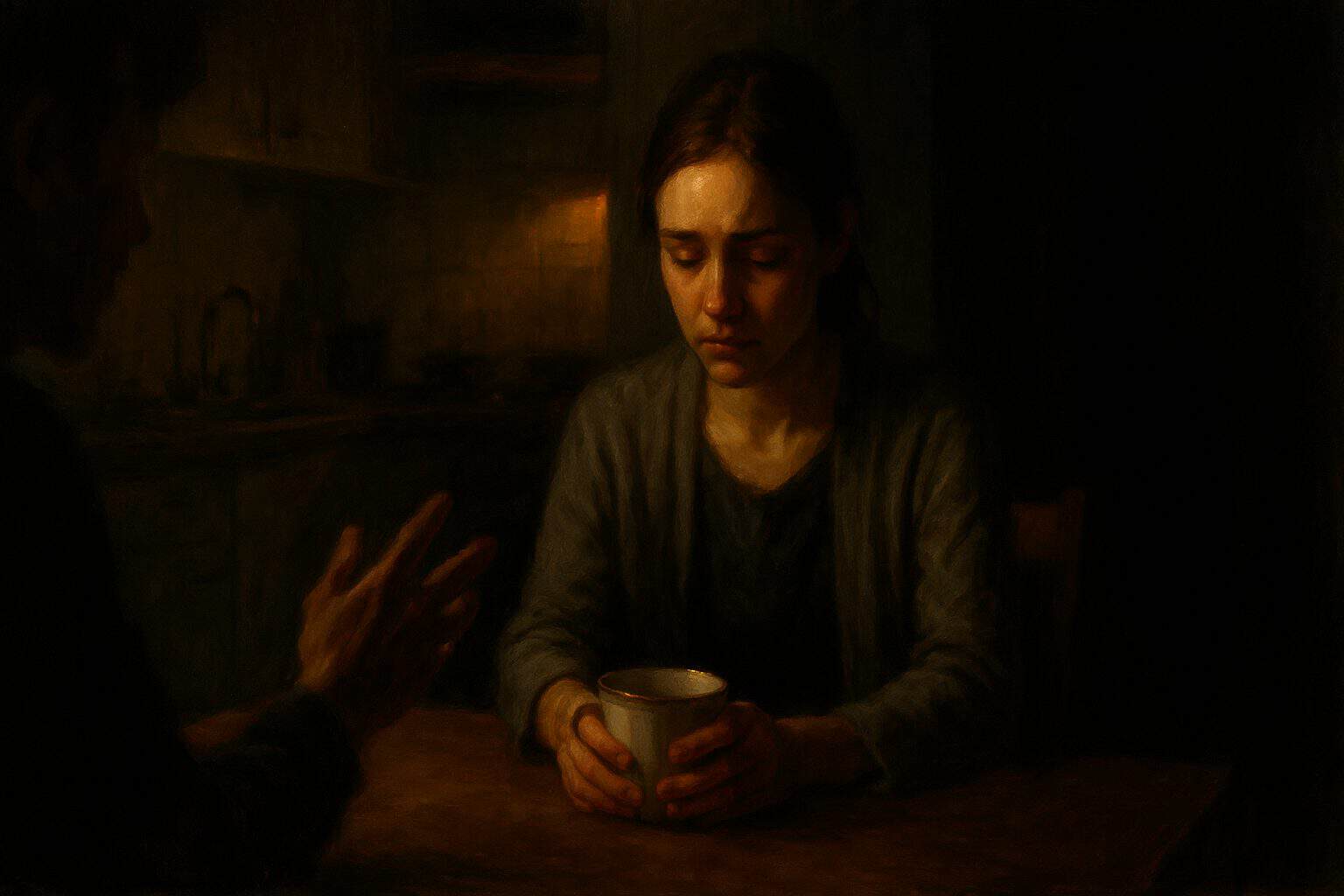
Where words dissolve at the threshold of utterance, and the soul speaks into an absence that somehow listens
The phenomenon begins in the throat—that constriction when words gather but cannot cross into sound. You sit across from someone who should hear this, who needs to hear this, yet the confession remains lodged beneath the larynx like a stone. The dining table stretches between you, ordinary in its wood grain and water rings, extraordinary in the chasm it suddenly represents. Your fingers trace the rim of a coffee cup grown cold. The other continues speaking about tomorrow’s errands, unaware that you carry news that would shatter this domestic choreography. The confession pulses against your teeth: I’m leaving. I’ve already decided. The apartment lease ends in three months and I won’t renew. But their voice fills the space with plans that assume your presence, and you nod, complicit in a future you’ve already abandoned.
This is how it begins—not with dramatic withholding but with the simple recognition that some truths cannot find their passage into shared air. The confession no one hears is not merely the secret kept; it is the word that discovers, in the very moment of its forming, that no ear exists capable of receiving it.
The Architecture of Unspoken Truth
In the phenomenology of confession, we encounter first the weight. Truth held back does not simply rest in consciousness like information filed away. It presses. Anthony Adoré writes of “the silence after my confession was heavier than the words themselves,” but before that voiced confession comes this other density—the gravitational pull of what remains unspoken. You carry it through your days like a second skeleton, an infrastructure of withheld revelation that shapes your posture, your gait, the way you hold your shoulders when the almost-confessor enters the room.
The weight distributes itself unevenly. In solitude, it settles into the chest, a dull ache that becomes almost companionable. But in the presence of the one who should know—the beloved who plans a future you’ve already left, the parent whose approval you’ve ceased seeking, the God whose existence you’ve begun to doubt—the weight shifts, sharpens, becomes a blade between the ribs. The body knows what the mind attempts to rationalize: that withholding transforms both the withholder and the relationship itself. “Both he and she existed per se, in a physical sense, but they did not yet exist for each other.” The unspoken confession creates this strange doubling—you exist simultaneously as the one they see and the one who has already departed, already betrayed, already chosen otherwise.
Watch how the confession structures time itself. The present moment splits: there is the manifest present where you smile and nod and participate in the fiction of continuity, and the hidden present where you count days until revelation becomes unnecessary because absence will speak what words could not. Adoré captures this temporal fracture with surgical precision: “I never would have told Leigh I was moving in a few months. I would have kept my plans to attend Duquesne University a secret, said all the right things, taken her pleasure as often as she would grant it, and then simply disappeared from her life when the time came.”
“An unspoken truth hung in the cab between us during those drives: our time was also running out.”
The future, too, divides. There is the false future you help construct through your silence—vacation plans, shared investments, the slow accumulation of domestic ritual—and the real future you guard like contraband, checking it occasionally when alone to ensure it hasn’t dissolved. This double-living exhausts. Every conversation becomes a careful navigation between truth and performance. You learn to speak in the subjunctive mood, all your commitments hedged with an invisible “perhaps” that only you can hear.
The Varieties of Silence
Not all unspoken confessions emerge from the same source. Consider first the strategic silence, calculated and cold. “This was my Kobayashi Maru—the unwinnable scenario. If I remained silent, Angela’s narrative would win. If I spoke, I would hand Jane the very tools to crucify me.” Here, the confession remains unspoken not from inability but from a careful weighing of outcomes. The truth would arm your enemies, validate their suspicions, provide ammunition for your own destruction. So you hold it, this confession that could explain everything, justify your actions, reveal the fuller context—you hold it because speaking would be a kind of suicide.
But there exists another species of silence, more mysterious and more devastating: the confession that cannot be heard because no adequate listener exists. “I begged for a word and met only the throb of my pulse. I learned how loud silence can roar.” This is the prayer that finds no ear in heaven, the love that discovers its object has vanished, the apology offered to one already dead. The confession forms perfectly in consciousness, each word chosen and arranged, but it dissipates against an absence. You speak to God and hear only your own breathing. You whisper to the photograph, the gravestone, the empty chair where they once sat, and the words fall into a void that neither accepts nor rejects them.
Between these poles lies the most common and perhaps most tragic form: the confession that remains unspoken because we lack the language to give it form. “All the things you say,” she told Adoré, “I’ve thought about them my entire life, but I’ve never put them into words.” We carry these wordless knowings—that we no longer love, that we never believed, that we are not who we have pretended to be—but they remain trapped below language, felt but not articulated, known but not speakable. The confession exists as pure Stimmung, mood without content, a color that has no name.
The Presence of the Absent Listener
Even unspoken, the confession requires its addressee. In consciousness, we compose our words toward someone—the parent we will never tell about our loss of faith, the spouse we cannot inform of our departure, the friend we dare not burden with our diagnosis. They exist in a strange half-presence, these phantom listeners. We rehearse the conversation endlessly, refining our phrasing, anticipating their responses, watching their imagined faces crumble or harden or turn away.
Augustine knew this peculiar dialogue with absence. His Confessions address a God who already knows what will be confessed, yet the speaking remains necessary. But what of the confession that addresses human absence? “Why did you wait so long to speak your passion to the grass and dirt when you had the opportunity to do so eye to eye, mouth to mouth, and chest to chest?” The dead become our most patient listeners, receiving all our unspoken words without judgment, without response, without the terrible possibility of misunderstanding.
Yet even the living can become these absent presences. In the same room, sharing the same air, they remain unreachable. “The silence of that empty apartment was another forge. In the wreckage of the realization—that I was a placeholder—I abandoned the hope of love.” The other is there, physically present, but the confession cannot bridge the distance between two subjectivities that have ceased to overlap. You could speak the words, but they would arrive as sound without meaning, information without import. The confession remains unspoken not from cowardice but from a terrible clarity: there is no one there to hear it.
The Weight of Withholding
The unconfessed does not simply vanish; it accumulates. Each withheld truth adds its weight to the next, creating a geology of silence, layer upon compressed layer. “For the next week, while scrambling to figure out my next step… I went silent.” The silence begins as strategy but becomes habitat. We grow accustomed to the weight, even dependent on it. The unspoken confessions become a kind of companion, more reliable than any human presence.
But this accumulated silence exacts its price. “Part of me died; love – now pretend. / She who knew me best… my friend… stayed not. / The end.” The withholding transforms the withholder. We become actors in our own lives, performing a self that grows increasingly distant from whatever authentic core we might once have claimed. Each unspoken truth creates a small death, a part of the self that cannot be expressed and therefore cannot fully exist.
The phenomenology of the unspoken confession reveals itself most clearly in the body. The shoulders that unconsciously rise when the almost-confession nears the surface. The sudden need to leave the room when the conversation veers too close to the hidden truth. The exhaustion that follows an evening of careful navigation around the unspeakable. The body keeps the score of what the mouth withholds.
The Sacred and the Silent
“I learned that His silence is multifaceted. Sometimes it is hard grace that forces us to seek; other times it is sacred space He provides.” In the theological register, the unspoken confession takes on additional complexity. Here we encounter not just human inability or unwillingness to speak, but the possibility that silence itself carries sacred meaning. The confession that cannot be spoken to God—because He does not answer, because He already knows, because He might not exist—becomes a peculiar form of prayer.
“Faith is something that cannot be proven; it is something that either one has or one does not have.”
Consider the inverse confession, the one that speaks precisely through its absence. “And so began my secret quest, driven by this hidden desire to relive that moment—launching my pursuit of deeper holiness…” The inability to confess doubt becomes itself a confession of faith. The words we cannot speak to God outline, in negative space, the shape of our belief or unbelief. Every unspoken prayer is also a spoken silence.
“The Idol of Solitude broke when I finally realized the silence I fled to was, in fact, the one Presence I had been seeking all along.” This suggests another possibility: that some confessions remain unspoken because they have already been heard, received by a Presence that requires no words. The confession no one hears might be the confession everyone hears—the truth that radiates from us despite our silence, the revelation that needs no language because it speaks in the grammar of being itself.
The Theater of the Abandoned
“They become the book that no one will read, the song that no one will hear, and the film playing in an abandoned theater.” This image captures something essential about the unspoken confession—it continues its performance even without an audience. In consciousness, we remain perpetually in confession, perpetually composing the words we will never speak, addressing listeners who will never hear.
But perhaps this is not tragedy but simply the human condition. We are all films playing in abandoned theaters, our deepest truths projected onto screens no one watches. “Finitude begins and ends with solitude. We are born alone. We die alone. During the time in between, we either embrace solitude and loneliness or we run…” The unspoken confession might be the most honest acknowledgment of this fundamental aloneness—the recognition that some truths cannot be shared because sharing itself is an impossibility, a beautiful fiction we maintain against the essential privacy of consciousness.
Yet even in this abandonment, something persists. “Even though the dead cannot speak for themselves, our voice can unite with theirs and they can speak through our interpretations.” The unspoken confession creates its own form of communion—not between speaker and listener, but between all who carry similar unspoken truths. We recognize each other by what we don’t say, by the careful spaces in our conversation, by the weight we see in each other’s shoulders.
The Moment of Almost-Speaking
Return to that table, that coffee cup grown cold, that ordinary moment where the extraordinary presses against your teeth. The confession gathers itself, ready to leap into language. You draw breath. The other looks up, perhaps sensing something in your posture, your expression. This is the moment of maximum possibility—when the unspoken might yet be spoken, when the weight might yet be shared, when the separation might yet be bridged.
But then—a car passes outside. A phone buzzes. The cat demands attention. The moment passes, and with it the possibility. The confession retreats back into its hiding place, not defeated but patient. It knows there will be other moments, other almost-speakings. It has time. It has nothing but time.
“A fragment of the thirteen-year-old boy I once was surfaced… But now, in this oppressive dark hour, years later, Heaven’s silence deafened.” We carry all our unspoken confessions with us, from every age we’ve been. The child who couldn’t tell his parents about the terror in the night. The adolescent who couldn’t admit to desire. The adult who cannot speak of failure, of doubt, of the terrible suspicion that life has been misspent. They accumulate in us, these unspoken truths, creating a chorus that only we can hear.
The Ethics of Withholding
“Would you be happy knowing that you lived a life out of focus, bereft of passion and imagination, that you drifted with no plan, no agenda?” This question cuts to the heart of the unspoken confession. Is withholding always a form of cowardice, a failure of authenticity? Or might there be an ethics to silence, a recognition that some truths serve no purpose in their speaking?
The phenomenology resists easy moral categorization. Each unspoken confession emerges from its own necessity, its own impossibility. The spouse who doesn’t confess the affair that ended years ago—is this cowardice or kindness? The child who doesn’t tell the dying parent about their loss of faith—is this betrayal or mercy? The friend who carries another’s secret to their grave—is this loyalty or complicity?
“To live life, death must be ignored. But to live abundantly, death must be confronted.” Perhaps the same might be said of the unspoken confession. To live life, some truths must remain unspoken. But to live abundantly, we must confront what we withhold, understand why we withhold it, and choose our silences as deliberately as we choose our words.
The Redemption of the Unheard
“But death halts the effort of all observers and silences everything there is about a person and obliterates their future.” Or does it? The unspoken confession suggests another possibility—that what is never spoken somehow persists, continues its work in the world through its very absence. The words we don’t say shape reality as surely as the words we do. The confession no one hears might be heard in ways we cannot imagine, by listeners we cannot perceive.
In the end, every confession—spoken or unspoken—is an attempt to bridge the unbridgeable gap between consciousnesses. We speak or don’t speak, confess or withhold, but always with the same impossible hope: that another might know us as we know ourselves, might receive the full weight of our truth and not turn away. The confession no one hears is perhaps the most honest acknowledgment of this impossibility—and yet also, paradoxically, its most profound attempt at connection.
For in our silence, we join the great communion of the unconfessed. All who have loved without speaking it, all who have doubted without admitting it, all who have chosen without explaining it—we recognize each other across the silence. The confession no one hears becomes the confession everyone hears, written in the negative space between words, in the weight we carry, in the careful choreography of our withholding.
“I laid out the data points: dates missed; calls ignored; the long, silent hours of her absence.” But perhaps the most important data points are the ones we don’t lay out, the evidence we don’t present, the case we don’t make. These absences, these silences, these unspoken confessions—they might be our truest testimony, the most accurate map of who we are. Not what we say, but what we cannot say. Not what we reveal, but what we guard. Not the confession everyone hears, but the confession no one hears—except, perhaps, the One who hears everything, even silence, especially silence, and receives it all as prayer.