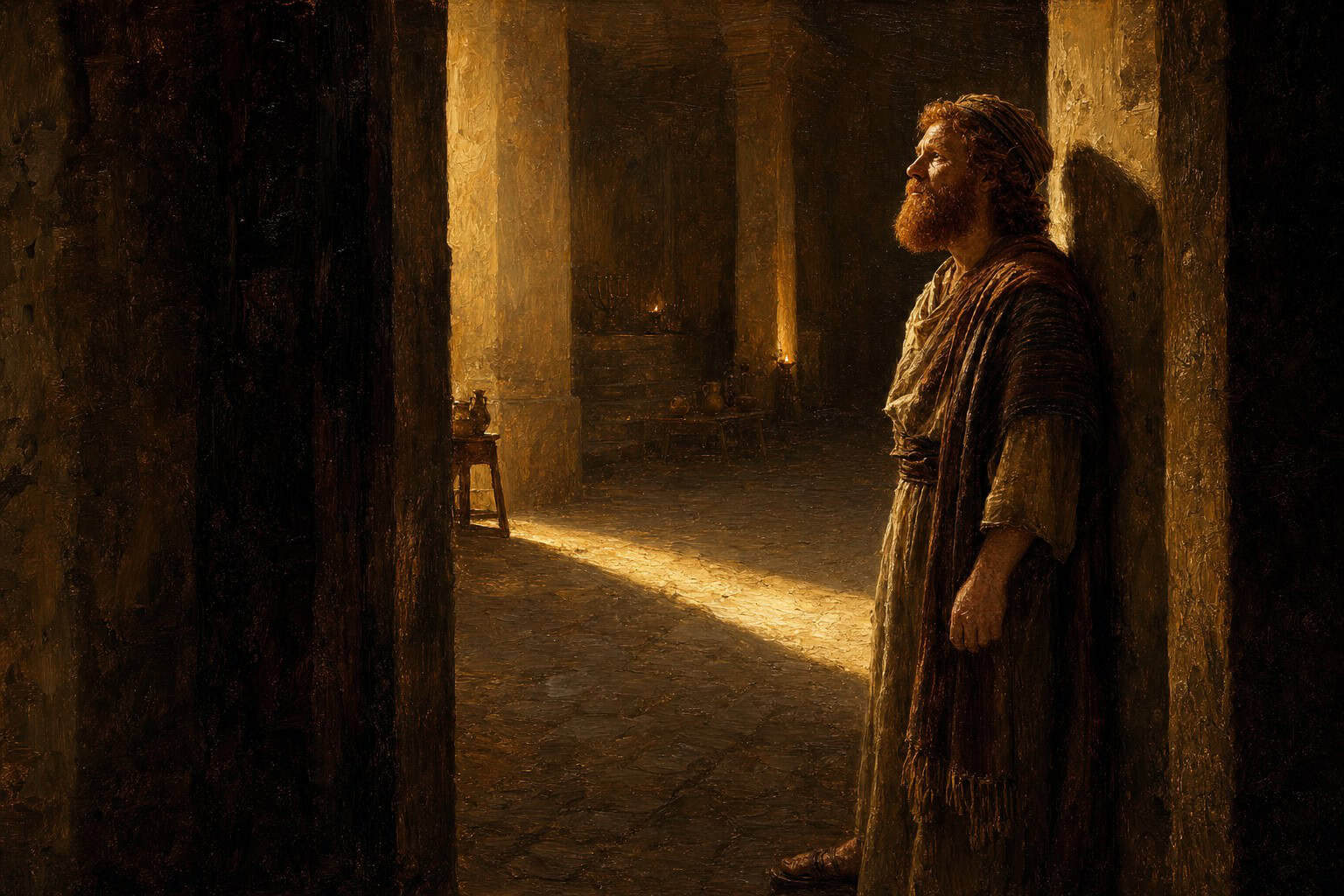
You belong where you feel free—but what if that place is only a sliver you mistook for the whole? A raw reflection on the little light we call home.
The Corner Where the Light Fell Just Right
Where do I belong, if not the one place I can breathe? That was the question under my question for years, and I answered it the way you might answer it now. I found a corner of my life where the light came in at a narrow angle and lay across the floor in a single warm band. No one there asked for more of me than I wanted to give. I sat inside that band of light and called it home. It was small. I did not notice how small, because from the inside a small brightness fills the whole eye and pretends to be the sun. That is the strange trick of a narrow view: press your face close enough to one opening and the fragment on the other side becomes, in your mind, the total. You count the fragment and believe you have counted everything. I want to be honest about how good this felt, because I will not earn your trust by pretending it was misery. There was a real satisfaction in it, even a quiet sense of accomplishment, as though I had solved the problem of my one life by trimming the room down until I could manage every inch of it. I told myself this was simplicity. I told myself I had made peace. But peace and shrinkage can wear the same plain clothes, and for a long stretch I could not tell which one had moved in with me. The reflection that carries the last miles of Fractions of the Soul names this without mercy: most people believe their limited view reflects the whole, and most people never learn otherwise. I was most people. I had looked through one small gap and thought I had walked the entire house, room by room, and written down what was in it. What I never once asked was who had cut the gap that size, and why it happened to frame only the parts of my life that flattered me. The freedom I felt was not the freedom of open ground under a wide sky. It was the freedom of a man who has quietly stopped expecting anyone to look at all of him at once. If no one sees the whole of you, no one can find the whole of you wanting. So I stayed in the warm band, comfortable, and I gave that comfort the sacred name of belonging. The older man writing this now can see the deception in a way the younger man could not afford to. A place where you feel free only because you have narrowed yourself to fit it is not a home at all. It is a hiding place with good lighting, and the light is the thing that keeps you from seeing the walls.
The Cold That Kept Testing the Edges
The tension came in the way cold comes into a house after dark—not all at once, but leaking through the seams while you tell yourself the room is still warm. I would be sitting in my narrow freedom, content, and then something would press against the edge of the frame. A question from someone who wanted more of me than the band of light allowed. A memory of a wider life I had once nearly lived. A hunger that had no name and no manners, that rose in the chest without asking. I pushed each of these away, one after another. I told myself the sliver was enough, that a smaller life was a wiser life. But the pushing itself was the evidence I refused to read. You do not have to keep defending a thing that is truly enough. You only stand guard, night after night, over the thing you half-suspect is a lie. The book calls this the prison of the familiar, and that phrase lodged in me like a splinter under a nail, because the familiar had never once felt like a prison. It felt like the single room where my lungs worked. That was the whole horror of it. My cell had comfortable furniture and a good view of the one thing I wanted to see. I had wrapped myself in the old threads of the past, in the worn ways of looking, and I had mistaken the wrapping for warmth when it was closer to a binding around the arms. The cost to the people near me was the part I would not turn and face. When you make yourself small to feel free, everyone who loves you can only meet the small version. They reach for you and their hands close on a fragment. They speak to the man framed in the little opening and never once touch the man crouched behind it in the dark. And in time they stop reaching—not from cruelty, but from plain exhaustion. There is no loneliness quite like being loved for the sliver and never for the room. I did this to myself with my own two hands, and then I grieved it as though it had fallen on me from outside. That is the self-deception I have to say out loud. I built the narrowness and then I wept that the world was narrow. The demon in the passage does not wait for the end of a life to speak. He steals in during the middle of it, in the loneliest loneliness, and he asks the one thing I could not survive being asked: would you consent to live this exact life again, this sliver, this evasion, this careful smallness, countless times, without changing a single microscopic detail? I gnashed my teeth at the picture of it. And the gnashing told me everything the comfort had hidden. A man truly free in his life does not flinch from repeating it. Only a man who knows, somewhere under the furniture, that he has been living wrongly dreads the endless return of his own ordinary days.
Standing Inside It, Learning How Small It Was
The turn, when it came, was not a rescue and did not feel like one. It was a widening of the eye, and it happened in the dark, which is the only place these things have ever happened to me. I was not lifted out of my smallness and set down in a better room. I was shown, from inside the smallness, exactly how small it had always been. The revelation was not some new bright chamber. It was the harder mercy of understanding that there had always been a whole room around me, full and shadowed and real, and that I had spent years describing the frame of the opening and calling my description the truth. The passage says everything in a life leads to this—to the moment of reading these words and knowing there is more than the sliver. I felt the floor of my certainty tilt and slide. If the little light was not the total, then the freedom I had built upon it was never freedom. It was the ease of a man who has struck a private bargain never to look past the frame. And here is the hardest thing, the thing only the older self can finally hold still long enough to say.
The place where I felt most free was only the place where I had stopped expecting to be seen whole.
Belonging is not the same as fitting. You can fit into a keyhole; a fragment fits anywhere. But you cannot belong in one, because belonging asks that all of you be present and known, and a narrow opening admits only the flattering slice and turns the rest away at the sill. God did not meet me by tearing the wall down and flooding the room with a sudden blaze. He met me in the sliver itself, in the dark, standing beside me in the very narrowness I had built with such care. He did not scold the smallness or shame the hiding. He simply stayed there in it with me, unhurried, until I could bear to look past the band of light without my whole body seizing. That nearness was the entire event—not the lifting of my blindness, but a companion inside it, quiet, patient, present in the very evasion I was most ashamed of. His majesty came in the concealment, where no accusation could reach me first. And in that steady presence the question I had been living by turned over in my hands. It was no longer whether the sliver felt free enough to stay. It was whether I would consent to be seen in the full room, at every unflattering angle, and learn to call that far harder thing my home.
The place where I felt most free was only the place where I had stopped expecting to be seen whole.
Mourning the Small Life I Had Loved
Seeing the whole room did not arrive as a gift. It arrived as exposure, the way a lamp switched on in a dim place makes you cover your eyes before it makes you grateful. The fallout of that widening was plain and cruel: everything I had proudly called peace showed itself to be management, and everything I had called freedom showed itself to be hiding under a nicer name. I had to grieve the sliver, and that grief caught me off guard. I had expected to celebrate the larger life. Instead I mourned the small one, because the small one had kept me safe, and safety is a hard companion to bury even when you know it has been slowly draining you. The people came back into focus, and that was the sharpest cut of all. I saw that inside the narrowness I had let myself feel erased—unseen, not enough to be kept—and I had laid the blame on the ones who finally stopped reaching for the fragment I kept offering them. But the erasure was never only done to me. I helped it along. I put out so little of myself that there was almost nothing for a loving hand to hold, and then I grieved not being held. The older man reading this cannot let the younger one off. What did you do, I have to ask him, with the ones who tried to see the whole of you? You flinched from their reaching. You dressed up their care as demand so you could refuse it with a clear face. You called your withdrawal humility when its true name was fear. And the mood over all of it—that heavy, colorless tone that had settled on every hour like ash on a windowsill—was not the weather of some meaningless universe. It was the fog I had made myself, breath by breath, by refusing to look at more than a sliver at a time. The consciousness the passage keeps pointing toward, the inner horizons of the heart and mind, do not open painlessly. They open the way a cramped muscle opens when it is finally forced to stretch—the first stretch reads to the body as injury before it reads as relief. I had to accept that the wider room held things about myself I would have paid a great deal never to see: the long compliance, the fondness for comfort, the quiet lifelong agreement to be less so that I would have to risk less. There is no version of belonging that lets you skip this room. To belong in the whole house, I had to let the whole of me stand in the light, including the parts that had been softly rotting in the dark behind the frame. That is not a comfort I can offer you. It is a cost. But I have learned to trust the costs more than the comforts, because the comforts kept me pressed to the small opening for years, and only the costs ever moved my feet.
A Life I Would Consent to Live Again
Where all of this settles, for me, is not in arrival but in a question I now carry the way I once carried that band of light across the floor. The demon’s true gift is not the dread he brings. It is the possibility folded inside the dread—that if I cannot bear the thought of repeating this life, then I am still free to build a different one, a life I would consent to live over again and again without wincing at the seams. That is where belonging lives for me now. Not in the corner where I feel free because I have shrunk to fit it, but in the life I would say yes to living twice, whole, seen, nothing tucked out of sight. You said you belong where you feel free, and in a way you answered your own question before you finished asking it. I only want to trouble that answer, the way mine was troubled, without pretending to hand you a clean replacement. Look hard at what your freedom is made of. Is it the freedom of open ground, where all of you can stand in view and still be wanted and kept? Or is it the freedom of the small opening, warm and manageable, where you feel free because you have quietly agreed to be a fragment and to expect nothing wider than the fragment allows? I lived by the second kind for a very long time, and I could not tell the two apart until the difference had nearly cost me the people I loved and the years I had left. The God I finally met did not shatter my small opening with a bolt of miracle. Those breakings-in are rare, and I have been given only a few in a life; I do not build my faith on them. Far more often He simply stood in the narrowness beside me, in the dark, in the middle of my own evasion, and let His steady nearness make the smallness unbearable enough that I chose at last to leave it. That is the strange shape of the grace. He did not switch on the lights. He kept me company in the dark until I could tell which light was still burning when everything else went out. Fractions of the Soul will not hand you a wider room and send you home. It presses your eye back to the opening you have been calling home and asks, without blinking, whether you truly believe the sliver is all there is. If you have ever felt your life grow small and never once suspected you were the hand doing the shrinking, this is the book that will sit beside you in the dark and refuse to let you look away. I cannot tell you what waits in the room past your own small opening. I can only tell you the room is there, that you cut the frame yourself, and that tonight, in your own loneliest loneliness, your hand is still your own to knock somewhere new.