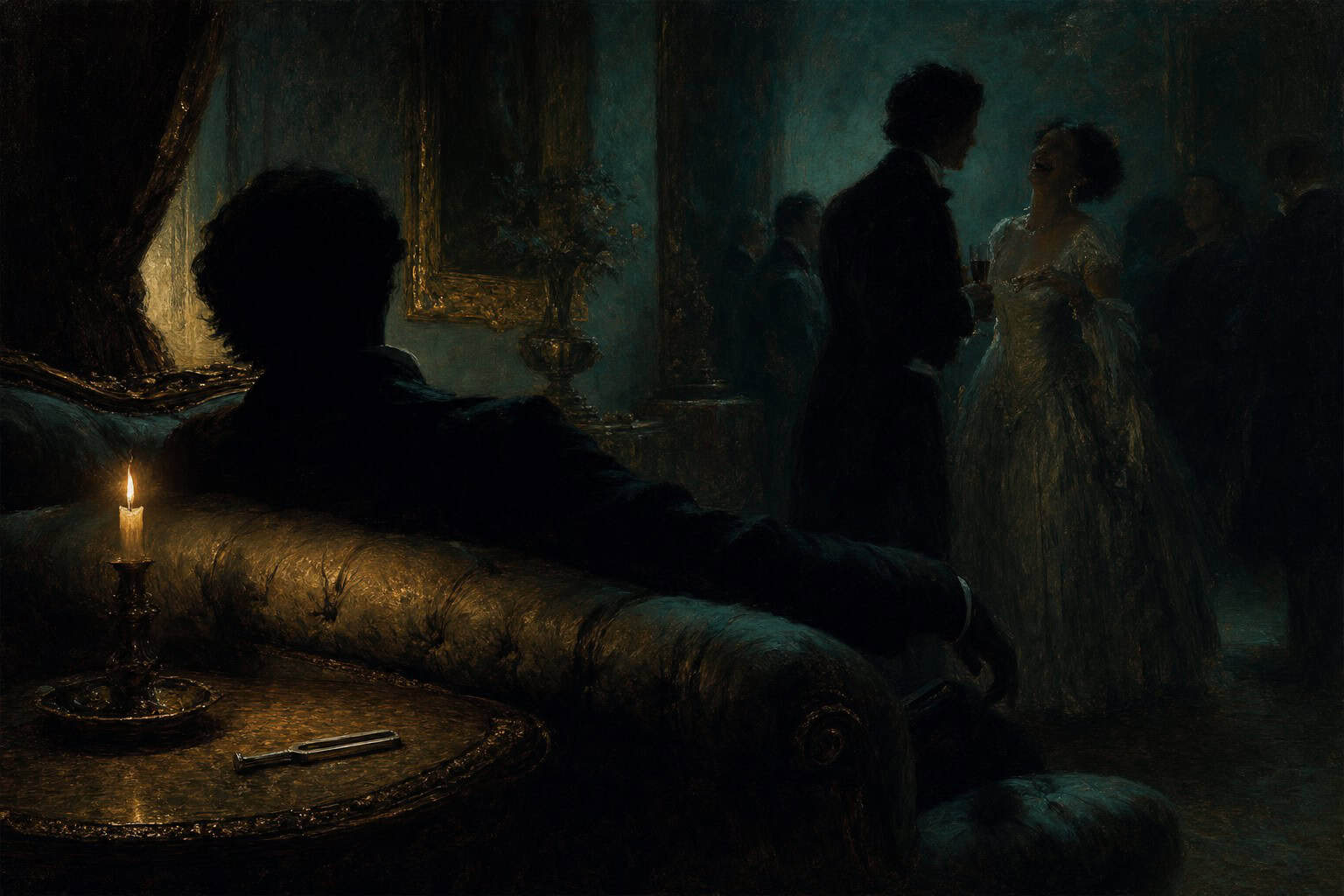
One struck bar wakes another it never touches, and he glimpses the terror of moving a soul across the distance without dissolving into it.
Metal Prongs Singing Across Air
A thin bar of steel is struck and begins to sing, its high note sharp in the classroom air. A second bar, several feet away, stands untouched on the lab table, yet its own legs begin to quiver, sound rising from it like a voice waking in its sleep. Nothing visible bridges them—only air, only vibration—but the younger self watches the invisible path traced between both pieces of metal. This small demonstration, buried deep in the chapter, becomes a harsh catechism on how one heart reaches another. Move the forks farther apart and the borrowed song fades; slide them closer and their separate tones blur until you cannot tell which one was struck first. Inside that gap of air lives the passage’s question: how near must two lives come for truth to pass between them, and at what point does nearness stop being knowledge and start becoming erasure?
The Velvet Trap of the Party Couch
Later, the lesson is no longer chalk and diagrams but a body half-sunk into a party couch, fabric warm beneath sweating thighs. Across the room, the beloved leans in toward strangers, mouth open in laughter the watcher cannot hear. The distance between them is filled not with clean air but with guesses: that touch on the forearm meant too much, that shared grin ran too long. The couch seems to soften on purpose, pulling the hidden observer lower, inviting them to become part of the furniture rather than part of the conversation. Here the passage presses its reckoning: from this safe vantage point, the heart claims objectivity while feverishly inventing scenes of being replaced. The physics lesson returns in darker form—this distance does not protect; it distorts, turning every missing word into proof that love is already leaving.
Jawbones, Eye-Muscles, and the Unshared Dictionary
In the same crowded room, another kind of experiment unfolds, this time not with metal but with flesh. The younger self watches the beloved’s face mid-conversation: the slight tightening around one eye when a joke lands wrong, the quick press of lips together before a polite laugh. A partner, standing closer, reads these shifts with terrifying fluency, adjusting tone and touch as if translating an invisible script. Every small movement is a word in a language built over years: the way his jaw tenses when he is bored, the particular angle of her head when she is bracing for hurt. From the couch, that language is unreadable; the observer sees only shadows of meaning and fills the gaps with fear. The pressure here is not only jealousy but illiteracy—knowing that the beloved’s face is speaking volumes and that you are deaf to its grammar because you chose the distance that kept you comfortable and ignorant.
Come too close and we dissolve, stand too far and we grow suspicious; real intimacy asks a costly precision the fractured heart is slow to learn.
When Your Own Skin Starts to Vibrate
The passage turns toward the reader’s ordinary life without saying so directly, because the body knows this experiment already. You have stood at the sink while someone you love spoke from a raw place, and felt your own chest tighten in answer, ribs buzzing like those metal prongs. Step too far inside their pain and your thoughts blur; you cannot tell if the anger in the room is theirs or yours. Stay on the edge, arms crossed, and you watch them fold in on themselves, your cool distance making their suffering look exaggerated, almost unreal. This is the same cruel arithmetic: every argument, every late-night confession, demands that you choose how much of your own outline to risk softening. The memoir’s scene lays bare what you already practice without naming—tuning yourself to another’s frequency and then pulling back in fear when your own skin starts to feel foreign, as if it now belongs partly to them.
That Thin Strip of Floor No One Is Crossing
Somewhere between the lab table and the couch lies a narrow strip of floor—imagined but very real—where two people could stand close enough to hear each other clearly without merging into one blurred note. The passage never delivers anyone safely to that strip; it only circles its absence. The younger self stays pressed into upholstery, the tuning forks sit on separate blocks of wood, and the beloved’s face continues its private conversation with someone else who seems to understand. For a reader, the question does not resolve into a method or a rule. It becomes a quiet dare: in the next crowded room, at the next sink, on the next sagging couch, will you cross that small piece of floor, or stay where you can keep inventing stories uncorrected? The chapter leaves that space unoccupied, like a dance step no one has yet claimed, waiting for the weight of a real human foot.