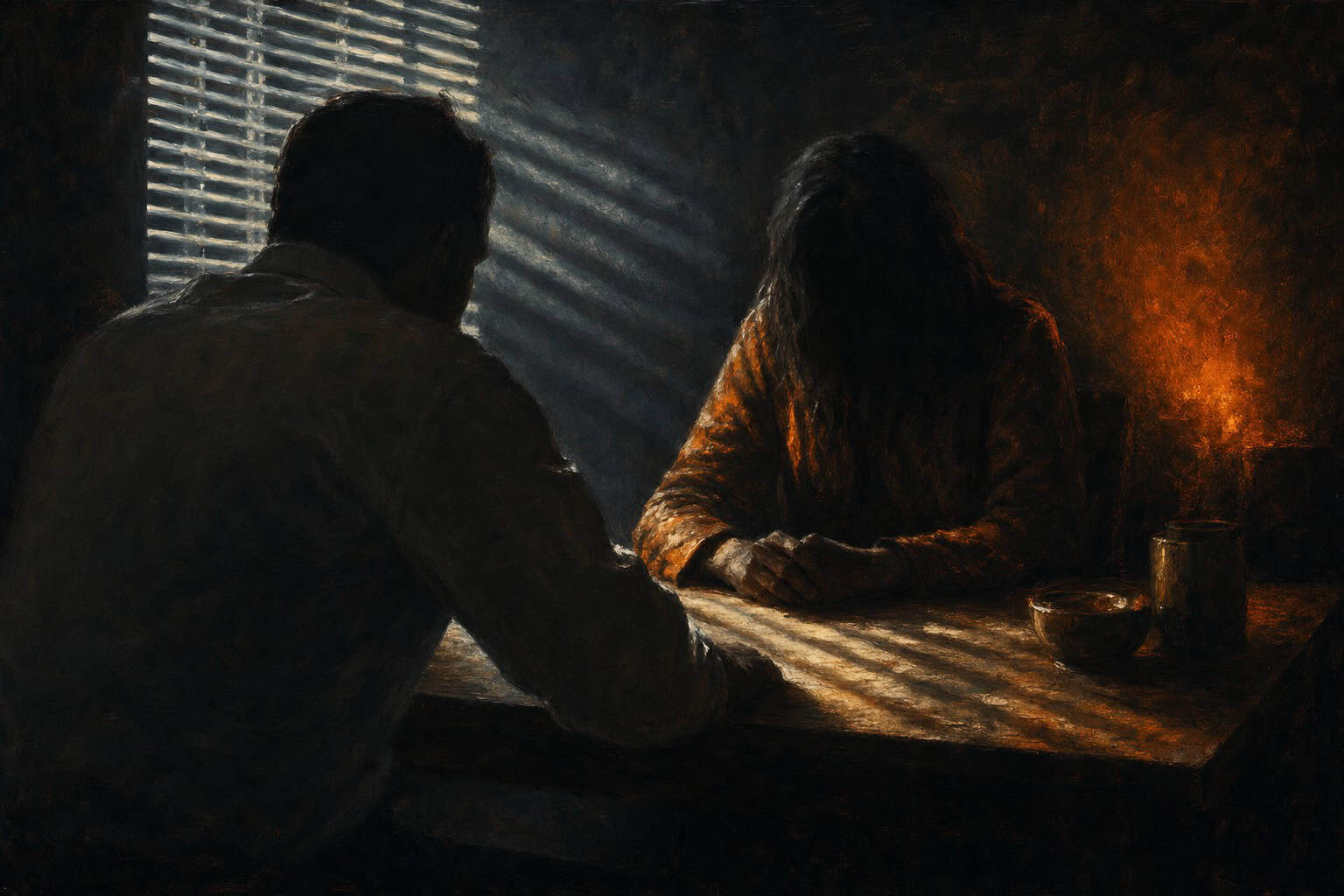
Under a hard kitchen light two men rest their hands on the table like defendants, and the son cannot yet name how he has turned every love into a trial.
Hands on the Table, Nowhere to Hide
Harsh kitchen light pools on the table, turning every scratch in the wood into a line of evidence. Father and son sit across from one another, forearms resting on the surface like they have both been told to keep their hands visible. The questions come without raised voice, but each one lands with the clean bite of a chisel into stone. The son feels it in his chest first, then in his shoulders, how they tense and try to narrow themselves, as if a smaller body might be a smaller target. The father is not watching his answers so much as his posture: the way his son leans forward at one name and pulls back at another, how his fingers find each other, knot, unclench. This is not the first hard talk they have had, but this time the subject is the son himself, the way he moves now that someone else has chosen him. The table holds all of it—the words, the pauses, the small betrayals of muscle and breath.
Tests Built from Empty Plates
Under that light, the son starts to understand the pattern he has been living like a second skin. For years he has offered people the barest version of himself, setting out an empty plate and waiting to see who will sit at the table anyway. If they stay hungry, if they keep showing up to be fed by crumbs, he takes it as proof that their love is suspect, that they do not see how little he thinks he is worth. Every slight, every delay in a reply, every human hesitation has been entered into this private ledger that always ends with the same verdict: not enough. As the father asks about this new relationship, he is not interested in the ledger. He wants to know what has changed in the son’s body, what habits have been broken without fanfare, which old defenses have gone missing. The son realizes, with a kind of slow dread, that these questions are dismantling his tests. The empty plate is no longer the only measure on the table.
Three Words Lodged Like Gristle
There is a point where the conversation narrows to the size of a single unswallowed thing. The father circles it with plain questions—Do you say it, can you say it, what do you hold back?—and the son feels those three small words rise and stop, as if caught in his throat like a piece of meat gone wrong. He can describe devotion in long, careful sentences. He can recount sacrifices, late drives, small acts of care that have bent his schedule and his sleep. But when he nears that blunt, childlike sentence that would name all of it, his jaw stays locked. This refusal looks, even to himself, like discipline, like a stern guard at the gate of his mouth. Under the father’s gaze it is stripped of its nobility and shown for what it is: a way to control the field, to keep the other always proving, always chasing a word that never arrives. The silence tastes metallic, like biting down too hard on a fork.
The soul that cannot trust love demands endless proof while offering none of itself, mistaking interrogation for intimacy.
Our Throats, Our Ledgers
Anyone who has ever swallowed back “I love you” knows the particular burn that lives behind this scene. We, too, construct exams out of breakfast conversations and text messages, watching who reaches first, who apologizes faster, who stays on the line longer. We call it caution, or standards, but under it often lies the same old fear: if we spoke plainly, if we laid our love on the table without armor, it would be judged and found wanting. So we keep the words in our mouths and ask others to prove what we refuse to name, building unpaid debts into the very structure of our days. This father’s sharp attention to movement and change exposes how thin that strategy is. Actions do speak, but they also accuse: they show what we are willing to give in secret while our tongues stay hard and holy in their refusal. The passage does not let us watch from the doorway; it drags our own ledgers into the light of that same table and waits to see what we will do with them.
The Body’s Confession Under Fluorescent Light
By the time the questions slow, the son is aware of his own body in a way that feels almost indecent. He notices how straight he sits now when speaking of this other person, how his hands move without permission, how his face must be doing something softer because his father’s gaze keeps catching on it. The father seems to be listening as much to joints and muscles as to syllables, weighing the slight new ease in his son against years of practiced guardedness. No single sentence settles anything. There is no neat blessing, no tidy condemnation. What remains is the fact that something in the son has already answered, in the way he stands, in the way he comes and goes, and that this answer cannot be unsaid even if his tongue never cooperates. When they finally push back from the table, the light is the same, but the son carries an unfamiliar sensation, as if his own shoulders have just given testimony against him and are still humming with it.