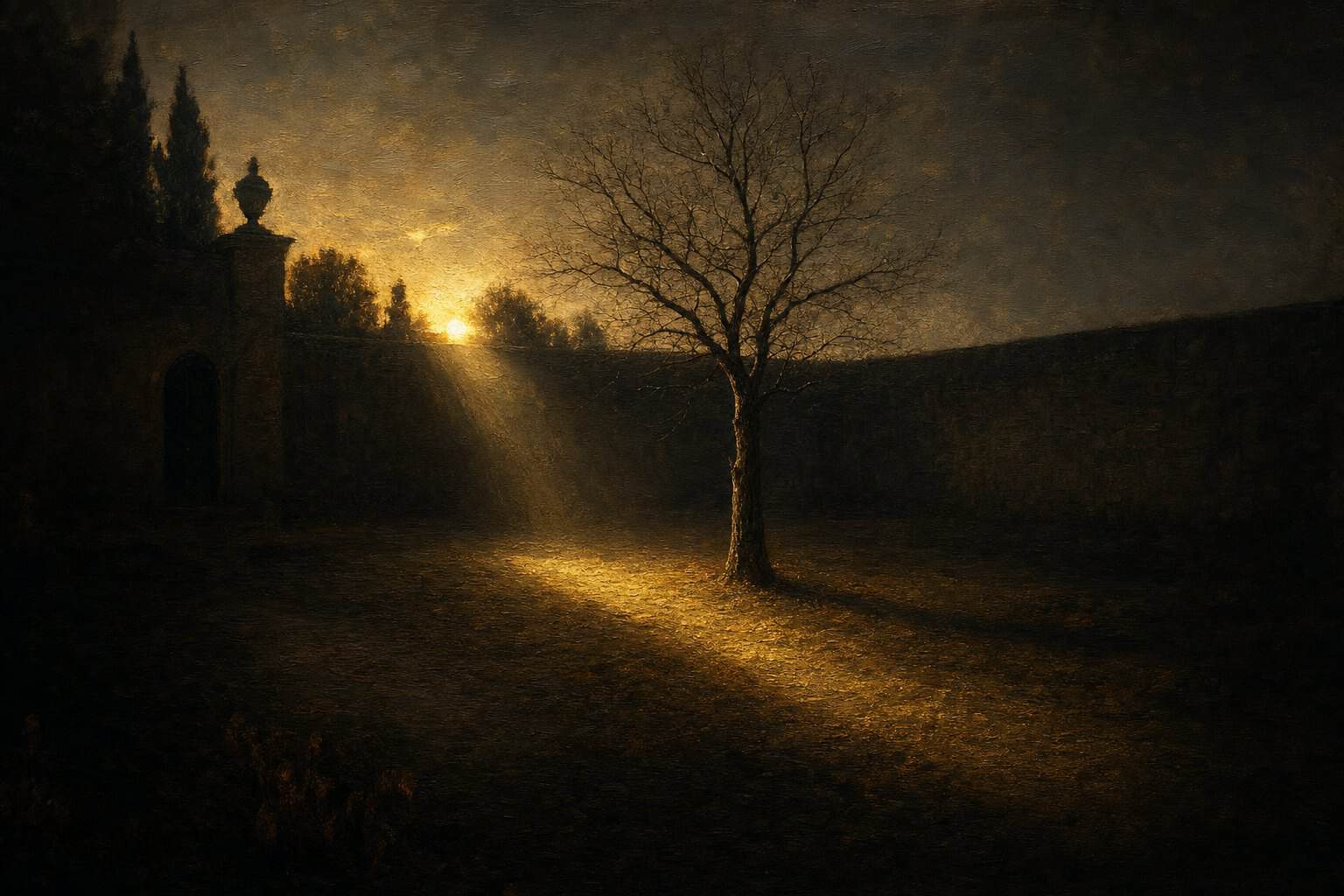
Before the wound of Eve, there was the ache of Adam alone before God: solitude not as deprivation but as the first shape of the human person.
The Ache That Precedes the Wound
We are tempted, always, to read loneliness as a symptom – a failure to be loved, a fracture in the social fabric, a thing to be cured. But the Genesis account, read slowly, refuses this. Before the woman is drawn from his side, before the fall that will teach the human being what it is to hide, Adam stands alone among the animals and finds no adiutorium simile sibi – no help like unto himself. And it is God who names this condition not good, God who has already pronounced everything else good. Here is the paradox John Paul II excavated in his catechesis on the body: the original solitude of the man is a state established within the very goodness of creation, before sin, before shame. It is not yet a wound. It is a threshold.
Anthony Adoré’s Confessions to the Empty Chair circles this threshold without ever naming it as such. The empty chair is the furniture of solitude made visible – the seat of the one who is not there, or who is there in a mode we cannot see. To sit before it is to enact something older than any particular absence: the constitutive aloneness of a being who must answer, who alone among the creatures can be addressed and can address in return. The ache is not the trace of a lost communion. It is the ground upon which communion becomes possible at all.
Dasein Is Always Already With
Heidegger’s fundamental ontology gives us the grammar to think this precisely, though he would not have named it grace. For Heidegger, Dasein – the being for whom Being is an issue – is never first an isolated subject that later ventures out toward others. The existential structure he calls Mitsein, Being-with, is woven into thrownness itself. We find ourselves already delivered over to a world that is a with-world, a Mitwelt, saturated with the presence and the equipment and the discourse of Others before we have chosen any of it. To be Dasein is to be already among.
And yet – here is the subtlety the corpus portrait insists upon – this being-with is precisely what makes possible its own privation. Heidegger’s phenomenological seeing works by attending to the everyday: how the hammer withdraws in use, how das Man, the anonymous They, absorbs us into leveled self-interpretation. Being-alone, for Heidegger, is not the negation of Mitsein but one of its own modes. The absence of the Other is legible only against the prior structure of being-with. You cannot miss what you were never ontologically ordered toward. Adam’s aloneness, then, is not the aloneness of a stone or a beast; it is the aloneness of one whose very being is a being-toward, a being-with, still awaiting its answer.
The Naming and the Distance
Scripture stages this with a strange scene: God brings the animals to the man to see what he will call them. Adam names, and in naming he exercises the understanding Heidegger calls projection – the disclosure of the ready-to-hand, the setting of each creature within a referential totality of meaning. But naming the animals reveals, precisely, that none of them can be named as a thou. Each is Zuhandenheit, equipment within the world; none is another Dasein who could turn and name him back. The very competence of naming discloses the distance. Adam’s mastery over the garden is what teaches him his solitude.
This is the deep structure of Fractions of the Soul as well: the self that perceives, that names and orders and desires, discovers in the act of ordering that it is not answered in kind. Perception opens a world and finds it, at its center, unpeopled by a like. John Paul II saw that original solitude is discovered through the body – through the man’s realization that his body sets him among the creatures yet marks him as radically other than them, alone in his self-presence before the Creator. Solitude is not sentiment. It is the epistemic consequence of being the one creature who can ask the question of Being and hear no echo from the merely present-at-hand.
The loneliness that no love fully quiets is not your flaw but your form: you were made to be met, and you remember it.
Alone Before the Empty Chair
There is a solitude that is horizontal – the missing of a neighbor, a spouse, a friend – and a solitude that is vertical, the standing of the person before the God who addresses him. John Paul II’s genius was to see that original solitude is first and most fundamentally the second: Adam is alone with God before he is alone without Eve. His partner in the naming is not the animals but the One who watches him name. The empty chair, in Adoré’s confessional architecture, is exactly this vertical seat – the place of the unseen listener, the absent confessor, the God who is addressed and who addresses.
To sit before the empty chair is therefore not a therapeutic exercise in speaking to no one. It is the enactment of original solitude as its own kind of communion – a being-alone-with that is already relational, already a call and a possible response. Read through the corpus portrait’s Heidegger, the empty chair becomes a clearing, a Lichtung, where Being can show itself beyond the chatter of everyday self-interpretation, beyond idle talk that covers over authentic discourse. What shows itself there is not first the fallen self, but the pre-fall structure that fallenness will later deform: the person constituted as one who waits to be met.
Post-Edenic Ontology and the Memory of the Ache
And here the essay must turn toward the wound, because we no longer read Adam from within the garden. We read him from east of Eden, as beings whose solitude has been complicated by shame, by the hiding that begins the moment the human learns to conceal itself from the gaze it was made to stand naked before. Anthony Adoré’s private concept of post-edenic ontology – the self as always-already fallen – names this precisely: we do not have unmediated access to original solitude. We know it only as a fracture, a homesickness, a thrownness we did not choose. Heidegger’s fallenness, his account of Dasein absorbed in the They and fleeing its ownmost possibilities, is the phenomenology of the fall’s aftermath – solitude turned anxious, being-with degraded into being-for-the-gaze.
Yet the ache remains legible as memory. This is the consolation buried in the doctrine. When you feel, in the marrow of an ordinary evening, an aloneness that no company entirely quiets, you are not merely lonely in the psychological register. You are touching the constitutive structure that predates the wound – the God-given ordering of the person toward an answer that only the Infinite can finally give. The pattern that recurs through the memoirs, the reaching toward a Jeannètte or toward any beloved who cannot be the whole answer, is the horizontal echo of a vertical solitude. To grasp this is to stop mistaking the ache for a defect. It was there in the good garden. It was there before Eve. It is the shape a soul takes when it is made to be met, and knows it, and waits.