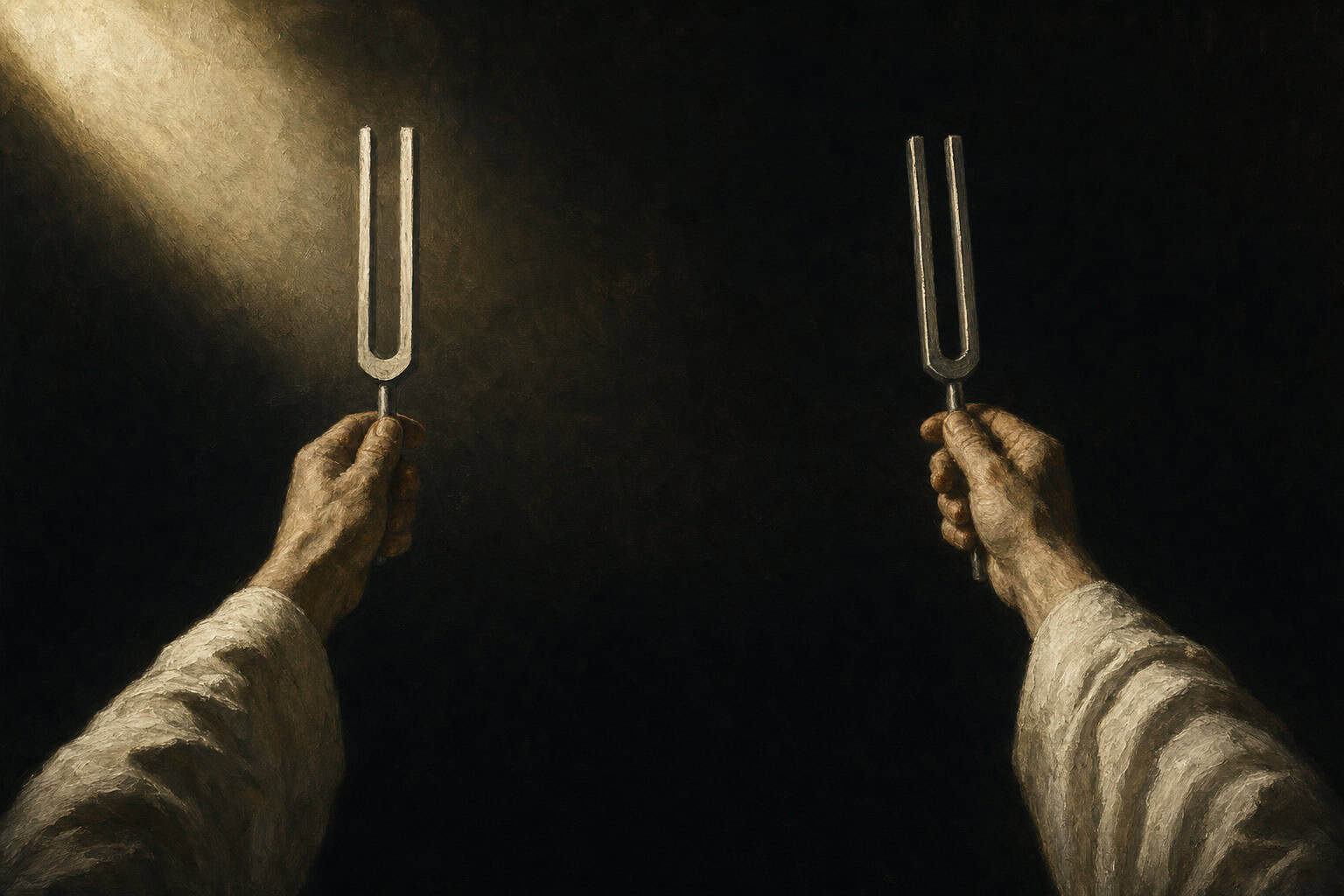
The fork rings clean between them and for a moment they share one note — and still the reaching itself seems to widen the unbridgeable air between two bodies.
Two Thin Prongs Humming in the Dark
Metal in the hand, cool and still, waits for impact. Then a wrist snaps, the tuning fork rings, and that single note floods the small space between two bodies. The sound is clean, almost sharp, a straight line of vibration you can feel in your teeth and in the soft skin of your inner ear. Across from it, another fork lies quiet on another palm, close enough to sense the air move, far enough that its own metal does not yet shiver. This passage holds there: two people, two bodies, separated by a short stretch of air that might as well be miles. The first tone hangs, searching for its partner, while each hand tightens around its fork. Neither wants to be the one whose note dies without answer. The air between them is not neutral; it is thick with memory, with past attempts at contact that slipped away. The scene watches to see whether that second piece of metal will consent to tremble.
Where the Note Finds Your Softest Metal
In that ringing air, another presence studies the hands. Not a cartoon tempter, but a cold, patient intelligence that has watched you flinch for years. It has noticed which voices make your shoulders loosen and which make your jaw lock. It has traced the exact place on your inner metal where praise slides in like a hook and where affection feels like an accusation. In this passage, temptation doesn’t arrive as a random storm; it arrives like a craftsman with calipers, measuring the distance between your longing and your trust. The attack is tuned to that gap. If you are terrified of being truly seen, the offer will be intimacy that skips honesty. If you ache to belong, the lie will sound like welcome with one small compromise folded inside. The enemy does not strike your strongest alloy. He presses on the thin, heated place where your fork already wobbles, promising relief that only deepens the shake.
Competing Notes Held to Separate Ears
As those invisible tests press against each palm, another tension rises: each person already carries their own private tone of what God sounds like. One hears command, another hears comfort, another hears correction wrapped in love. They come to the same space with different notes ringing in their chests, each convinced theirs is the proper pitch. In this passage, revelations do not arrive as grand, public pronouncements; they slip in as inner certainties, as quiet phrases that feel borrowed from heaven. Yet those phrases clash when spoken aloud. One body insists on a sharp where another swears the note is flat. The result is not open cruelty but a painful fracture: two sincere believers, two trembling forks, refusing to adjust. Each fears that softening their tone would betray the One who struck them. So they hold tighter to their fragment of sound, even as the shared air fills with a faint, piercing dissonance that neither knows how to name without wounding the other.
Two souls can strike the same note across the chasm of separate flesh and still find that even reaching for each other multiplies the distance between them.
When Your Chest Vibrates and No One Answers
For anyone standing outside this scene, the pain is familiar. You know what it is to feel your own chest ring with desire to be met, to be understood, while the person across from you seems tuned to some other frequency you can’t even hear. You try to adjust your speech, your timing, your entire manner, hoping your inner note will finally wake a response in them. But their eyes stay distant, or their replies land just off-beat, and you start to suspect you are alone even while you sit three feet apart. This passage names that ache without softening it. It shows how easily good intentions can still miss the mark when each heart clings to its private sound as if it were its whole salvation. For an ordinary life, this is where friendships sour, marriages thin, communities split: not over obvious hatred, but over that lingering sense that your deepest vibration is either unheard or misheard, again and again, until you begin to question your own pitch.
The Unstruck Fork Waiting in Your Palm
The moment does not resolve into perfect harmony. No great reconciliation drops from the ceiling. Instead, the passage lingers on the weight of the still-silent fork, resting in a sweaty hand that could, with the smallest motion, release its sound. There is fear in that pause: fear that once struck, the note will reveal just how out of tune you really are, fear that the other body will remain stubbornly still, offering no answering vibration. Yet there is also a kind of terrible longing, the wish to hear your own metal answered by something other than your inner echo. The scene ends its arc not with a chorus but with possibility held like a tool, or a weapon, or a prayer. The prongs have not yet moved. The air waits, dense and expectant, like a held breath before the first, irreversible strike.