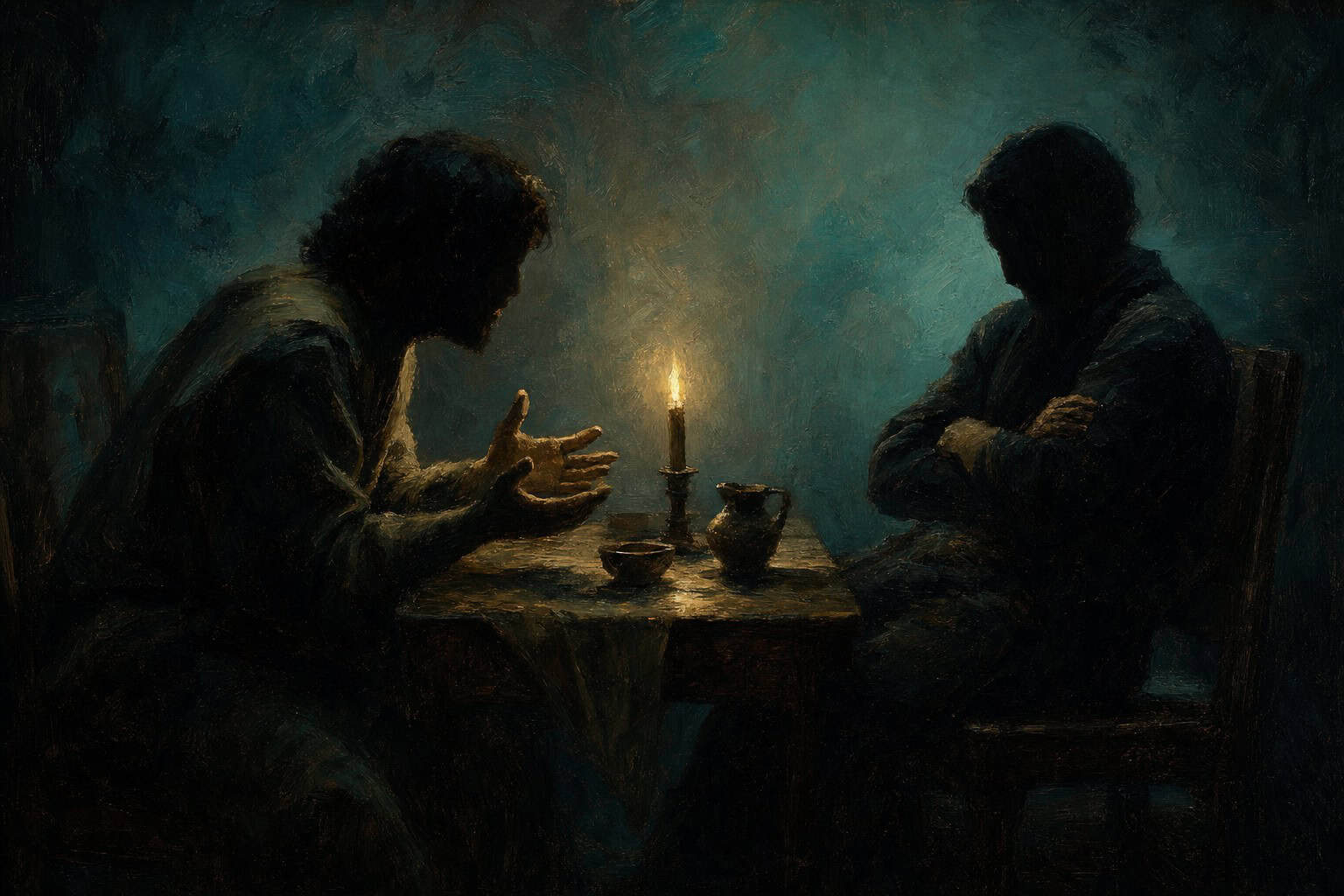
Someone has crossed the room to him, open-handed and unflinching, and he answers with a mouthful of scripture, using even holiness to keep from being reached.
A Mouth Full of Scripture and No One Touched
He sits across from a person who has already crossed the room toward him, who has already chosen not to flinch at his history. Their hands rest on their knees, their body angled open, waiting. His, by contrast, are folded tight, fingers pressed into his own palms until the knuckles pale. What leaves his mouth is not the ache lodged behind his ribs but polished lines about answering only to God, about the irrelevance of human judgment. Each citation, each cleanly framed doctrine, is laid down like another brick between them. He feels safer with these words than with his own trembling sentences. The air thickens not with reverence but with distance, a kind of holy fog he can hide inside. Here, in the middle stretch of the book, the passage slows over this one exchange: a man using divine language as a shield so that no ordinary hand will ever land on his shoulder and stay there.
Little Traps Set on the Table Between Them
Even with kindness sitting three feet away, breathing the same heavy air, he cannot stop arranging invisible tests. A delayed reply, a slightly altered tone, any hint of impatience—all are marked in his mind like evidence tags. He asks certain questions not to learn but to watch how quickly the other blinks, whether their voice wavers, whether they stumble over a promise. These are not games he names aloud; they hum under the surface like electric wire. Each trial has already been judged in advance, the verdict written by childhood nights when affection snapped without warning. In this passage, the narrative lingers over that cruel loop: the one extending grace is made to walk through a maze they never agreed to enter. If they misstep, he will say he knew it all along. If they don’t, he will quietly move the finish line. His trust bends only toward his old injuries; everything else must prove itself and fail.
A Withheld Voice That Fills the Whole Room
When life presses too hard—money tightening, memories flaring, the old shame rising like heat—his instinct is not confession but erasure. He does not storm out or slam anything; he simply stops answering. Messages sit unread. Calls ring through to nothing. In shared spaces, his body is present but his speech is gone, his eyes fixed just past the person who keeps trying to reach him. The silence feels like a cool cloth on his own skin and a burn on theirs. Inside, he tells himself he is preventing harm, that no one should have to carry the chaos in his chest. Yet the passage names the darker edge: by retreating into wordless struggle, he forces the other to live inside his absence, to pace the length of it, to guess at the crime they must have committed. Control returns to him in that guessing. He cannot command his inner storms, but he can command who is left out in the weather without a single sentence of explanation.
We can turn even God into a shield against intimacy, withdrawing behind holiness to test whether grace will chase us into the silence.
Hands That Hover Instead of Landing
Anyone who has loved a person like this will recognize the sick rhythm. One moment you are invited close by some shard of honesty, the next you are standing in a field of tests you never knew you were taking. You feel the sting of verses used as walls, the chill of days when replies do not come. Ordinary life keeps going—dishes, traffic, bills—but under it runs a second current: Did I say too much? Was it that joke? That question? The passage does not float above this in theory; it stays close to the sweat in the palms, the restless checking of a phone, the way sleep thins when you fear you have broken something you cannot see. For a reader, the recognition can be brutal. We notice how easily we hide behind noble-sounding reasons, how quickly we choose silence over the risk of saying, plainly, “I am afraid you will leave.” We also notice the faces of those who keep waiting, hands hovering in midair, unsure where they are allowed to rest.
Keeping the Dark Song Without Letting It Rule
Underneath all this strategy, the passage circles a single knot: his darkness has shaped his hearing so completely that even love sounds suspect. The jagged music from his childhood—the sudden withdrawals, the holy words used as distance, the long stretches of unanswered need—has become the only tune he trusts. To let himself be held without conditions feels like treason against that history, like calling the old vigilance a mistake. And yet, he cannot fully despise that vigilance; it kept him alive when tenderness was a trap. Here the book does not rush to decide for him. It allows the reader to stand at that inner border with him, where he wonders if there is a way for this harsh, dissonant music to be taken up rather than erased, to be met by a love that does not flinch from its rough notes. The scene ends not with a solution but with that question hanging in the shared air, as real as the two breathing bodies who must decide what to do next with their voices.