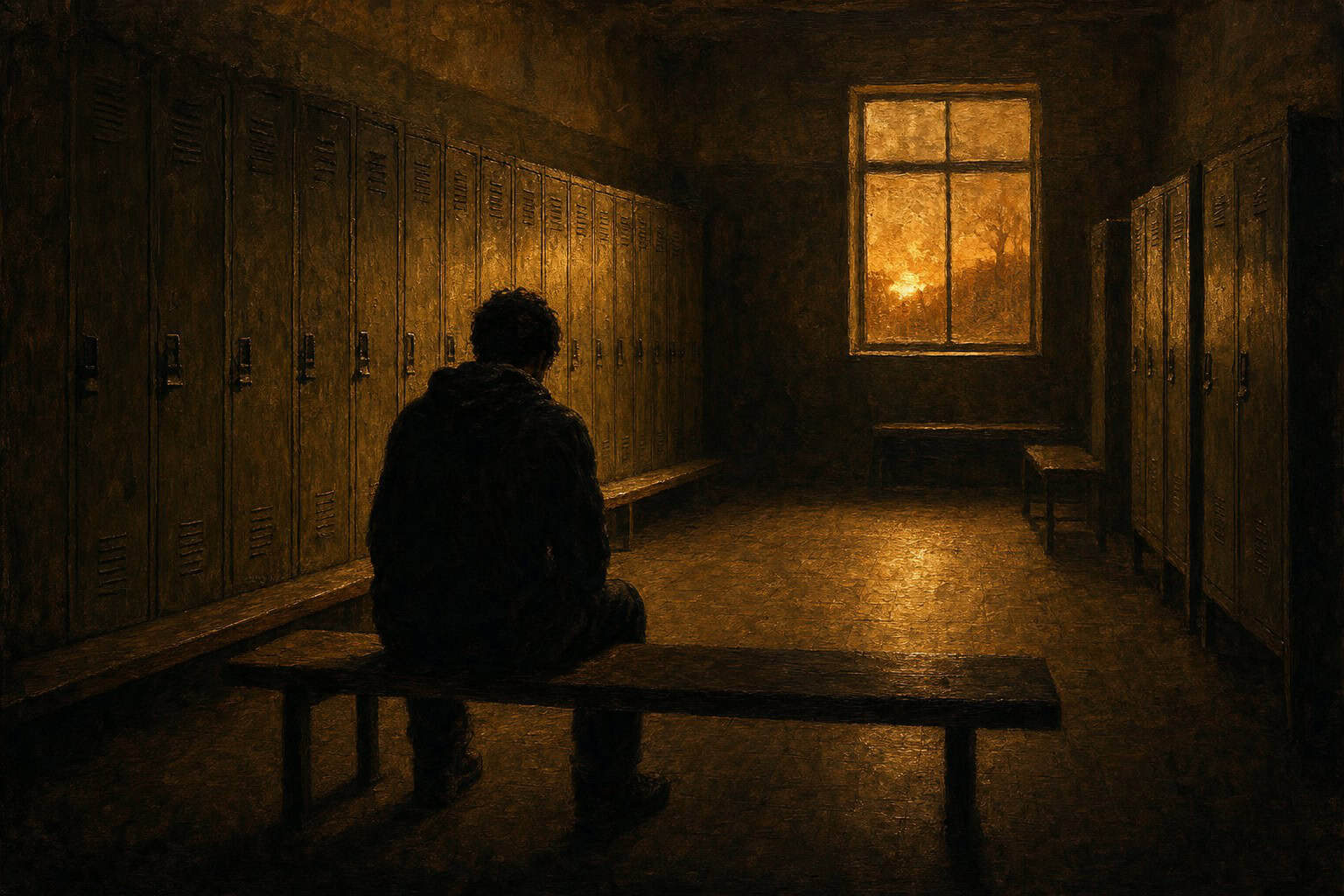
Under harsh white light on chipped tile a teenage body studies its own outline like prey studying a trap, learning to undress by fractions, forging an armor against desire that becomes, in time, its own locked cell.
Fluorescent Light On Bare Tile
Harsh white light hums above chipped tile, and a teenage body studies its own outline the way prey studies a trap. He learns to undress by fractions, turning his back just so, timing movements between glances, mapping which lockers keep him out of sight. Skin tightens before any hand can strike; muscles pull inward, ribs narrow, shoulders fold as if the skeleton itself could make less of a target. There is no shouted insult in this moment, only the low, constant threat of appraisal that burns more quietly than any bruise. Here the body becomes both sanctuary and suspect, a place where desire stirs and judgment waits. The passage lingers on this choreography of shrinking, how the boy’s flesh writes its own catechism of disappearance long before he has language for lust or shame. Each step between the benches is a small proof: survival, for now, means learning to become smaller than the gaze that would name him.
Silence Stacked Like Coins In A Locker
In that same glare, another economy runs alongside the bodies changing clothes. Speech has a price here, and the boy has learned the cost. One joke, one honest admission of what he likes or fears, could invite laughter that will follow him for years. So he hoards his words like contraband, answering teachers with the bare minimum, letting conversations slide past him like water he refuses to touch. The passage names this trade with painful clarity: quiet buys a brief immunity from open humiliation. Yet every withheld sentence hardens into a layer of distance he can no longer peel away. The locker room becomes less a place of passing torment and more a vault where his unused voice is stored, untouched, growing stale. What feels like shrewd bargaining in the moment slowly reveals itself as a long, expensive purchase of his own absence.
Notes Taken From Behind The Glass
After enough days of standing at the edge of the benches, the boy moves further back, not only in space but in posture. He begins to watch the others the way someone might study a species he’ll never join. Who throws the towel, who laughs too loud, who gets away with open cruelty—all of it goes into a quiet ledger in his head. The passage shows him reaching for theories to explain what his body feels: stories about dominance, breeding, hierarchy, as if a scientific chart could account for why his name stays off every list. This analysis feels clean compared to the sticky fear in his gut. If exclusion can be graphed, maybe it can be mastered. Yet with every new layer of understanding, he steps one pace further from the circle on the bench. The glass thickens. Observation becomes its own intoxication, safer than touch, and far colder.
The armor we forge against desire becomes its own cell; what we build to protect the heart can just as easily imprison it.
The Brain That Tries To Outrun The Flesh
What gathers in that locker room does not stay there. The same boy who made himself narrow under fluorescent hum now carries a sharpened mind like a shield through hallways and later into prayer. The passage traces how he trusts thought more than pulse—believing he can out-argue his own hunger, out-reason the ache to be seen and held. He reads, he names, he builds systems inside his skull where desire is categorized and contained. To many adults this would look like virtue, like a gifted child choosing insight over impulse. But inside, the cost is different: the body learns it cannot speak honestly without being cross-examined by its own owner. For a reader, the recognition cuts close. It is possible to know precisely why you are lonely, why lust curls through your nerves, and still be just as bound. Understanding, here, stands like a clever guard at the same locked gate.
Hands Reaching Into Someone Else’s Night
From this cramped interior, the boy finally stretches his hand toward another—a classmate pulled under by depression, a soul whose darkness feels somehow familiar. He steps into the role of comforter with the same intensity he once gave to hiding, laying down rules for himself, naming pure motives, insisting on clean lines between care and craving. He speaks about God, about hope, about not giving in, even as his own heart pounds with the thrill of being needed. The passage lets us stand at that tense edge where prayer, longing, and attraction braid together in ways he cannot yet separate. His body, trained to disappear, now leans forward; his mind, trained to rule, scrambles to keep control. Somewhere between the harsh light of the locker room and the dim glow of this attempted rescue, a different training is beginning. Whether it will become consent to real love or only a more pious disguise for the old hunger remains, for now, painfully unwritten—like a hand hovering over a phone that has not yet rung.