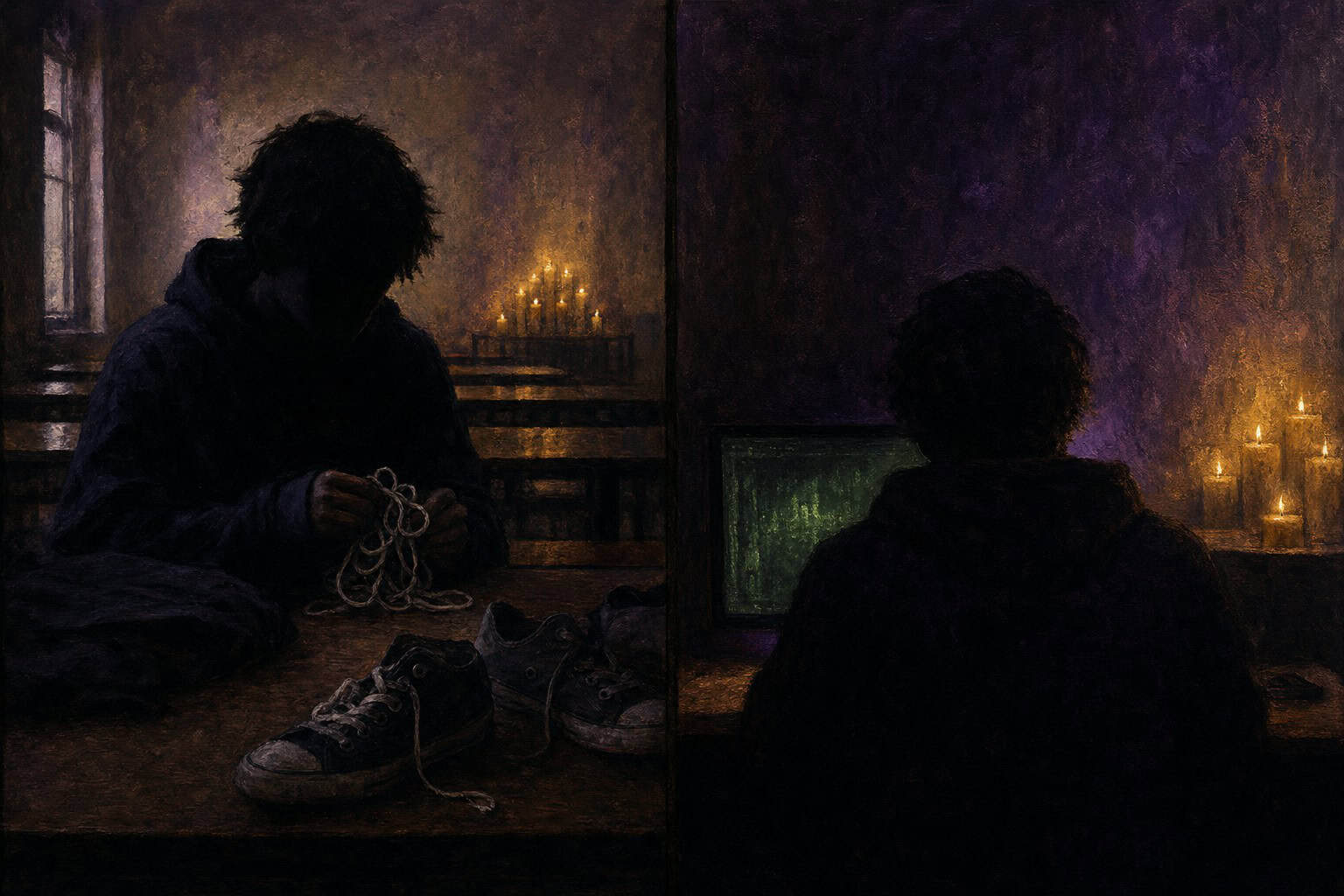
His gaze fixes on the tangled bows of his own shoes against grease-slicked tile, a boy learning that when the body becomes a liability, there is a terrible clarity in making yourself small enough to vanish.
Shoelaces Like a Private Rosary on Dirty Tile
Grease-slicked tile stretches under fluorescent hum, streaked with the faint outlines of yesterday’s spills and this morning’s rushed mopping. His gaze fixes there, on the tangled bows and frayed tips of other people’s shoes, each knot a small, safe object that doesn’t look back. To count them is to buy a brief ceasefire: if he never lifts his eyes, he never risks seeing his own nonexistence reflected in someone’s bored glance or quick dismissal. The body stays hunched over the lunch tray, shoulders rounded, fork scraping plastic, a presence so muted it barely casts a shadow. This isn’t a poetic choice; it’s a contract made under pressure, where he trades the right to be looked at for the right not to be judged. While the cafeteria roars with flirtation and mock fights and shouted names, his world narrows to laces, scuffs, stains—small facts that don’t hurt. In that narrowness, a new sense is born: the cold, sharp sight of someone who sees everything because no one is looking back.
The Roar of Want Around a Lowered Head
Above those shoelaces, chairs scrape and trays slam, and the air fills with a thick, bright noise that everyone else calls fun. Girls lean over tables, their hair swinging, their bracelets clacking against plastic as they reach toward boys who seem carved out of pure ease. Laughter flares too loud at jokes that aren’t funny, bodies tilt toward the few who carry the right clothes, the right swagger, the invisible stamp of being pre-approved. From his lowered vantage point, he hears patterns more than words: the repeated calling of the same names, the same small cluster at the center, the same nervous giggles orbiting that sun. What the room names love feels, to him, like a storm of borrowed reactions, each girl rewriting her wanting to match the group’s verdict. The reckoning this moment presses is brutal and plain: if this is what counts as desire here, then his absence from it is not an accident. He is not miscounted; he is not counted at all.
Green Text in the Dark After Cafeteria Light
Hours later, the flicker changes from cafeteria fluorescents to the soft glow of a monitor in a dim room. Fingers rest on a stiff keyboard, the plastic warm under his palms, as lines of pale green text begin to spill across a black screen. Here there are no shoelaces, no bodies, no way for anyone to glance, judge, and move on; there are only words appearing and disappearing, small blocks of thought sent and received through invisible wires. A username replaces a face, and he discovers that when no one sees the slumped shoulders or the acne or the thrift-store shirt, his sentences suddenly draw interest. Someone types back quickly. Someone laughs at a joke they cannot see the author of. The pressure builds in this split life: at school, he is a ghost among sneakers; online, he is a voice that seems to matter. The dissonance is not yet a crisis, but it thickens with every login, every new thread where the mind is welcomed while the flesh stays out of frame.
When the body becomes a liability, the exile discovers that disappearing brings its own terrible clarity.
The Habit of Looking Down That Follows You Home
Anyone who has ever survived high school by becoming a watcher knows this ache in the shoulders, this practiced curve of the spine around a book, a tray, a phone. You learn early to study the scene instead of entering it, to map who gravitates toward whom, who gets laughed with and who gets laughed at, all while keeping your own reactions carefully dull. That vigilance can feel like a strength: you read rooms quickly, spot danger fast, predict which joke is about to land like a slap. Yet the same habit that protected you hardens into a constant guard. Years later, when someone actually wants to meet your eyes, your instinct is still to check the floor, the clock, the nearest escape. The gift inside the wound—this sharp vision of how desire works, how groups move—never quite separates from the cost. You carry that cafeteria with you, even into places where no one is throwing food or ranking bodies, your neck still remembering how to bow.
Between Knotted Laces and a Blinking Cursor
In this narrow slice of his life, two worlds are taking shape at once: the tiled floor with its chorus of shoes, and the dim desk where a cursor blinks like a small, patient pulse. The girls who fold their longing into whatever the group approves do not know they are being watched by someone who is learning, painfully, what he never wants his own desire to become. Their choices, half-free and half-inherited, mark him as unnecessary in the system they uphold, and that exclusion lands like a verdict on his very flesh. Yet the same verdict frees a part of him to grow elsewhere, in text and thought, in conversations where his body cannot be dismissed because it is not even present. The open question that hangs here is not whether one world will win, but what will be left of him when they collide. For now, he moves between the knots on the floor and the keys under his fingers, carrying a hunger that neither space quite knows how to answer.