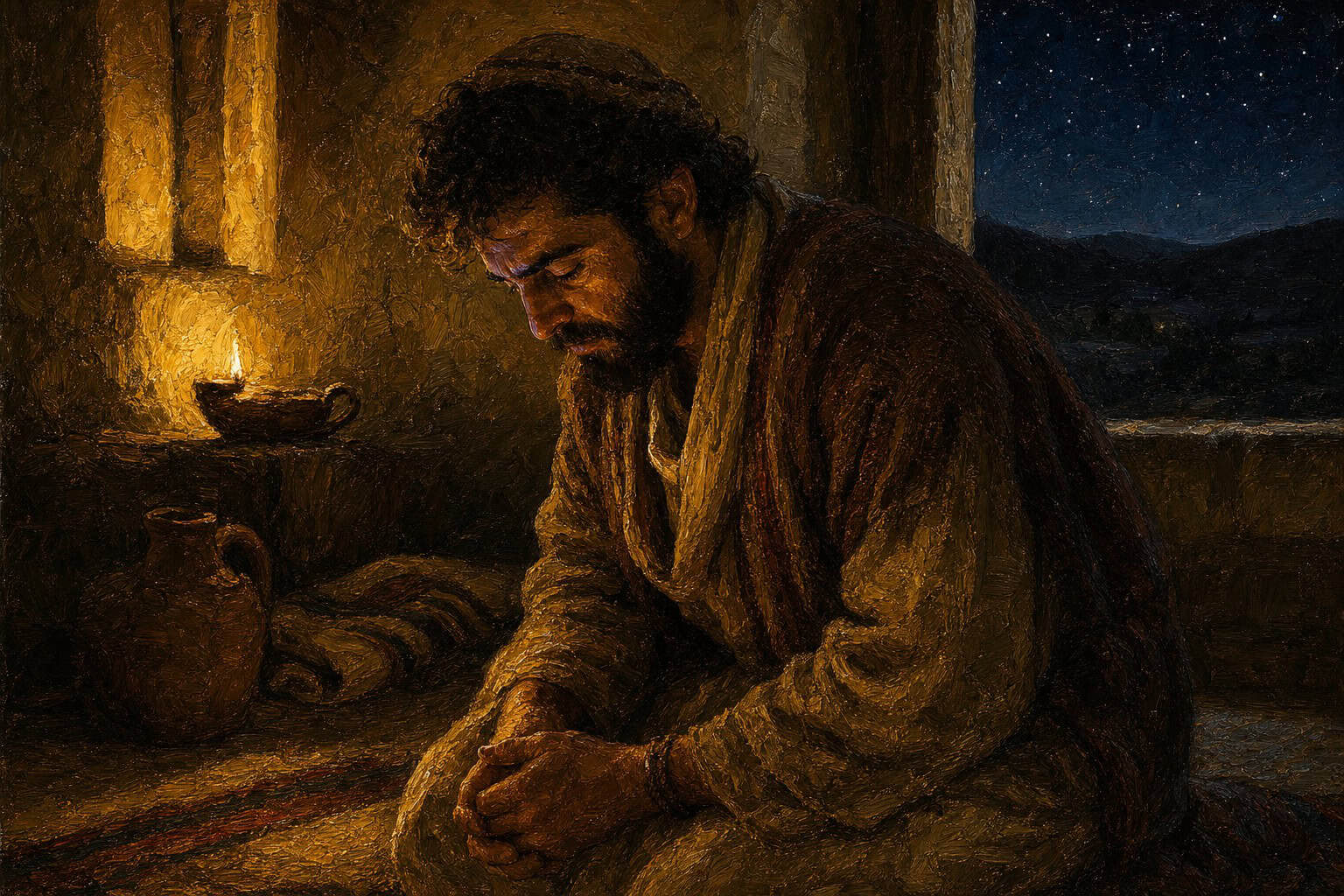
When a person hopes you will fail, the sting isn’t the risk—it’s being watched by eyes that ache for your ruin. A hard, honest reckoning.
Knees on Stone and an Ear That Bends Close
Someone can hope you will fail while smiling at you across a table. That is the first cruelty, and it is quieter than any argument. Deep in the ninth chapter of Confessions to the Empty Chair, the narrator is on his knees in a dark chapel, eyes clamped shut, rocking a little, saying the same words inside his skull until they wear smooth: just show me You are here. He is not asking to be rescued. He is asking to be seen by the one presence in the universe that does not want him to fall. Notice how small a request that is, and how enormous. He has spent years surrounded by other kinds of attention—eyes that sized him up, weighed him, waited to catch him short. When a person hopes you will fail, their looking lands on your skin like heat with no warmth in it. It is not indifference; indifference would let you walk away whole. This is closer and worse. It keeps you in view precisely so it can be there when you crack. He knows the sensation from the inside, because he has stood on both sides of it—the one tested, and the one who quietly tested others, sorting the people around him, deciding who was hungry for something real from who was only passing time. Here he sets all of that down. He begs for the one gaze that carries no bet against him. The chapel holds no other bodies, but it is not empty of watchers; memory keeps them warm in their seats. The woman who widened the hollow in him sits there in the dark of his mind, and with her sits every doubt she seemed to lay against his standing. He does not brand them as enemies, and that restraint is the harder truth. Some of the eyes that once seemed to hope for his fall belonged to people who had loved him, and love that sours does not stop being close. It only aims its closeness at your undoing. So he kneels and repeats the plea, breathing shallow, waiting in the cold. The question under the whole scene is one that anybody quietly rooted-against will know in the gut: you keep standing somehow when the person watching you is waiting to see your knees give. He does not answer with a plan or a clever posture. He answers with a plea, and the plea itself is a confession—that he cannot carry the whole weight of being wished ruined by himself, and has finally stopped pretending he can. The stone is hard under him. His hands are empty. That emptiness, it turns out, is the only offering he has left to bring.
An Intimate Who Turned the Lamp Against You
The sting is never the failure itself. The sting is who is in the room. To fall apart alone behind a locked door is grief; to fall apart in front of eyes that ache for it is humiliation, and humiliation is a wound with a face attached. The narrator carries a specific face into that chapel. A woman who once drew close now sits, in his memory, on the far side of a distance she helped open, and he suspects—cannot prove, only suspects—that some corner of her would not grieve his collapse. That is the exact shape of the ache. When someone who once chose you begins to hope you will fall, they do not turn into a stranger; that would be survivable. They become an intimate who has taken the lamp of everything they learned about you and turned it toward your ruin. They know your weak seams because you showed them yourself. You opened to be loved, and left the gaps where a hand could reach. Now the very softness you offered becomes the map by which someone traces the way to break you. See how desire itself lives inside this trap. To want another person is to hand them a lever against you. He has felt this his whole life—the plain longing of the body for union, and right beside it the dread that union means putting your standing into the hands of someone who might, someday, prefer you smaller. So a man builds walls. He goes cold on purpose. He tells himself the warm women near him are only masking a hidden appetite, that their kindness is a move in a game, that to trust is to be swallowed. There is a cold logic to this, and it is not pure invention—people do choose, people do weigh, people do sometimes want a rival brought low more than they want a friend lifted up. But the logic is also a bunker, and he half-knows it while he crouches inside it. His suspicion of anyone who might want him to fail is part clear sight and part a wall he raised so no one could see him at all. And the woman he watched through that suspicion was, from the inside of her own life, a whole world he never fully walked into. She had her own hungers, her own fears, her own reasons that had nothing to do with his downfall. The thing he does not resolve, the splinter he cannot pull, is the possibility that some of the eyes he read as hoping for his failure were only hoping to be met—and he mistook a woman’s reaching for a raised knife. That misreading cost him. It kept him armored in rooms where he might have been held. He does not know, kneeling there, how much of the coldness he blamed on others he had manufactured himself.
A Violet Burst That Breaks Him Open
Then the dark tears. A violet-blue burst punches through his clamped eyelids, sudden as a camera flash held inches from his face, and a thunderclap goes off overhead and rolls away like an earthquake pulling back into the ground. Someone heard the words he never spoke aloud. The fear that grabs him is not the fear of the demons he has met before; this is bigger, heavier, without a single word in it. Something deep inside him cracks again—the way it once cracked when he was alone in his car—and something pours out of him, out and not in, a living part of him trickling from his chest while his hands clutch at the place it leaves and his breath goes fast and ragged. This is the answer to his plea, and it does not arrive as comfort. It arrives as a force he cannot stand against. This is where the whole question turns on its hinge. He came into the chapel braced against every gaze that wanted him to fall, and now he is met by the one gaze that wants no such thing—and the meeting is anything but gentle. Grace does not show up to prop him upright in front of his watchers, to prove them wrong, to make him strong enough to win the long contest of being envied and resented and eyed for cracks. Grace shows up as rupture. It hollows him before it holds him. And in the hollowing he finally understands the difference he could never name: the eyes that hoped for his ruin were love bent the wrong way—closeness curdled into a wager on his fall. This presence lays no bet at all. He does not choose the terror; it is imposing, overwhelming, and it owns him for what feels like an eternity though it is likely mere minutes. What he receives is not a shield but an emptying, and the emptying is the mercy.
To be wished ruined is to be studied by love turned inside out—someone still holds you, only now they hold you to break you.
What Leaves the Chest When the Bet Is Refused
After the burst, the silence stays put. The pressure eases from his chest but leaves him kneeling in the dark, too afraid to open his eyes, running the sequence again and again—the flash, the thunder, the fissure inside, the pouring out. He needs to be certain he did not invent it. This is the fallout, and it is honest to the bone: the revelation does not wipe out the doubt, it lives right next to it, the two of them breathing in the same dark. But something has shifted in how he holds the eyes that used to press on him. He understands, slowly, that God is not fixing him. God is filling the empty chair—the seat of the companion he never had, the hollow the woman widened, the loneliness he has hauled since he was a boy. And here the answer to the whole searching question lands, sideways, the way true answers tend to. When a person hopes you will fail, the deep pain is that they have taken a chair inside you: the seat of the witness whose verdict you feel you need to survive. You perform toward that chair. You brace against it. You raise fortresses so whoever sits there cannot watch you buckle. His release does not come from beating the watcher. It comes from finding out the chair was never hers to sit in. The woman who seemed to hope he would fall was never his true audience. She was a ghost he had let settle into a seat that belonged to Someone else all along. So the cold suspicion that read every warm look as a threat begins to loosen its grip on him—not because the threat was never real, but because the throne it stood guard over now holds a presence that cannot be worked, cannot be gamed, and lays no wager on his fall. He does not walk out of that dark made bulletproof. He walks toward being free to let the ghost go. That is a smaller thing than triumph and a truer one. He is not standing over his enemies with the score settled. He is kneeling beside the only one who never wanted him to fall, and discovering that this one fact quietly changes what everyone else’s hoping is able to do to him. The verdict he feared has been unseated. The judge he built his whole guarded life around turns out to have been a chair he pointed at the wrong face.
A Cloudless Sky Where the Storm Should Roar
He gets to his feet and leaves the chapel, alert, half-expecting the thunder to have jolted others awake—and half-expecting, when he tips his head back, a churning sky swollen with the storm that made that noise. He looks along the ground for puddles. There are none. The night is clean and clear, the earth under his shoes dry, a few harmless clouds drifting far off along the edge of the world, the moon and the stars hanging quiet above him. Thunder and lightning with no clouds to hold them. No one else stirred inside. It is as if the whole sky staged that answer for one man on his knees and left nothing behind for anyone else to argue away. He looks up toward Heaven and nods once—a bare acknowledgment, no words, because words would only cheapen it. This is where Confessions to the Empty Chair leaves the question of being wished-against, and it refuses to tie a bow on it. He does not step out cured of all suspicion, does not stop being a man who reads other people’s eyes with his guard up, does not pretend the ones who hoped for his fall never existed or never cut him. He simply carries a new fact inside his cracked-open chest: the audience that ever mattered was never the one that wanted him broken. When you feel someone hoping you will fail, what you are feeling is the misplacement of your own hope—the way you handed the judge’s seat to a person and let their verdict become the floor you stand on. The book does not tell you the resentment isn’t real. It is real. People do sometimes prefer your diminishment, and pretending otherwise is a lie you will pay interest on. What it offers instead is the stranger discovery that you can be seen by a gaze with no stake in your ruin, and that this one witness changes the whole sum of what it costs to be watched. It is the dry ground I keep coming back to—thunder with no storm, rain that never fell, a sign cut to fit one reader in the dark and no one else. If you have ever stood in front of someone who wanted to watch you fall, and felt your footing rot under their looking, this chapter will not hand you armor to wear against them. It will do something odder and better. It will turn you, slowly, toward the one seat inside you that no rival has ever truly filled—and leave you the long, unfinished labor of learning who was always meant to sit there.