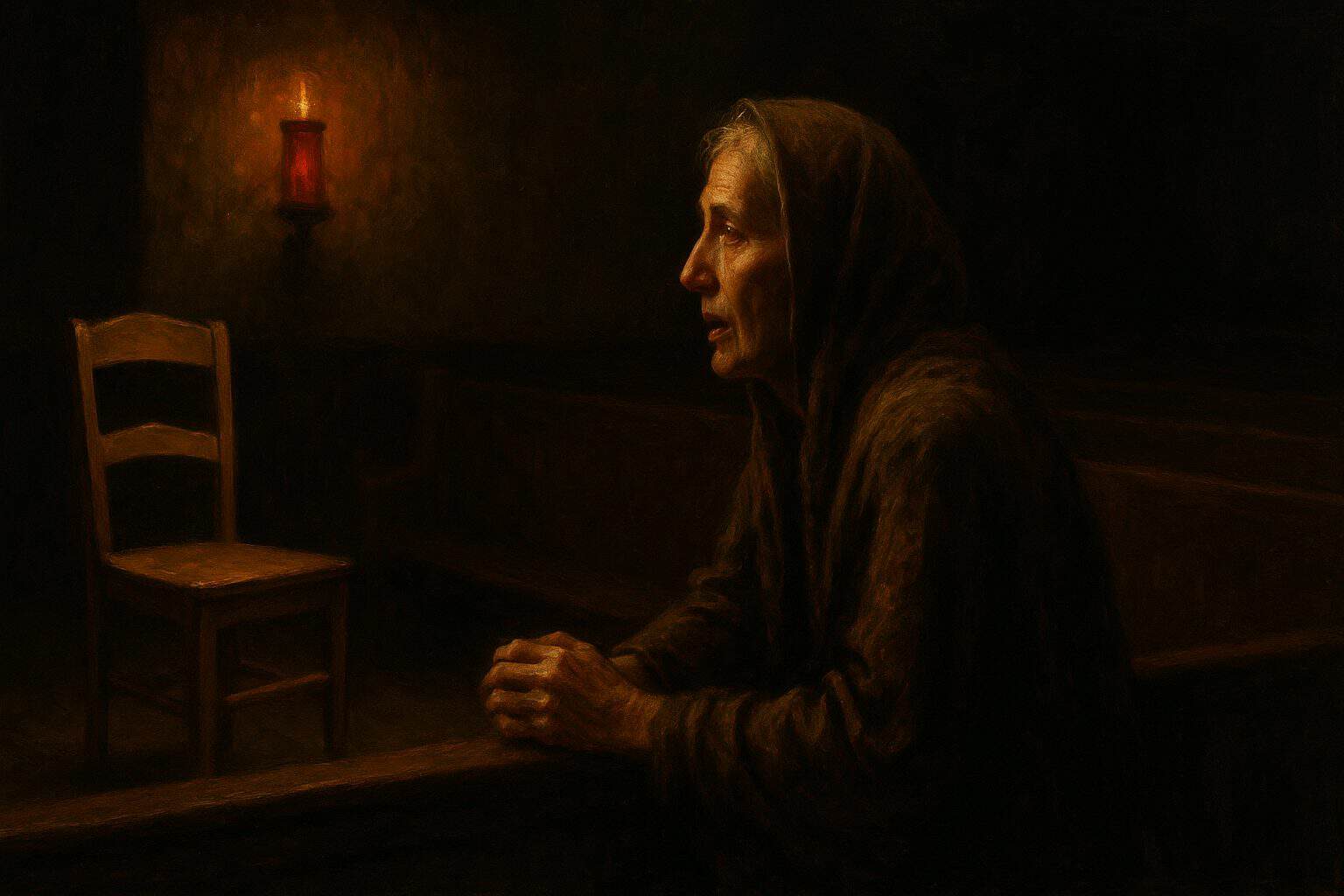
How absence becomes the most faithful presence, and silence the most articulate speech
The chapel door closes with its familiar resistance—wood swollen from decades of Texas humidity, hinges that sing their small protest before yielding. Inside, the air holds that particular density of sacred spaces after dark: cooler than the night beyond these walls, thick with the residue of incense and petition, pressing faintly against the eardrums. The sanctuary lamp flickers red in its alcove, throwing shadows that breathe across the stations of the cross. And there, third pew from the altar on the right side, the chapel holds its breath around a single vacancy. The chair across from you is empty, has always been empty, will always be empty. Yet this emptiness carries more weight than any presence could bear.
The Architecture of Absence
To speak of an empty chair is already to misunderstand it. The chair exists precisely in its not-being-there, in the space held open for what does not arrive. Watch how it manifests: the body enters the chapel and orients its posture not toward the tabernacle alone but toward this felt absence beside or before it. The genuflection happens, the sign of the cross traces its ancient pattern, and then the body settles into relation with a vacancy that somehow takes up space.
I now make public that which I once kept private, groaned in the solitude of a chapel, heard only by the moon and stars, my empty chair.
In Confessions to the Empty Chair, Anthony names what every solitary prayer already knows. The chair is first a physical thing—wood and worn velvet, perhaps, or simple pine smoothed by countless hands. But watch how quickly it transcends its materiality. It is not a metaphor. It is the lived structure of a particular mode of prayer, a way absence gives itself as presence. In the darkness of the chapel—always darkness, always that cloaking hour “when both professors and peers slept”—the one who prays discovers that solitude has a shape. It configures itself as dialogue, as address toward what withdraws even as it draws near.
The Weight of Vacant Space
There is a particular heaviness to unoccupied space that Merleau-Ponty might recognize as the body’s way of knowing what the mind cannot grasp. You feel it most acutely in places meant for gathering—churches, dining rooms, theaters. The empty pew does not simply lack bodies; it exerts its own gravitational pull. Anthony captures this precisely: Empty pews held me better than arms could.
This holding is not comfort but something more severe—the way a mold holds molten metal, giving it shape through constraint. The chapel’s emptiness forms you, presses against your edges until you discover your own outline. You become most sharply yourself in relation to what is not there. Absence, it turns out, has texture, temperature, almost taste. Anthony writes of sitting amid the shadows, his throat thick with “prayers that had turned to dust.” The prayers do not disappear; they sediment, accumulate, become part of the room’s atmosphere. Every empty chair is thick with unsaid words, uncried tears, unheld embraces.
The Multiplication of Occupants
Strange how the empty chair refuses to remain singular.
The “you” I address is not a single person; the occupants of the “empty chair” constantly shift… And always, God sits in the empty chair.
This is not confusion but precision. In one moment the chair holds the Divine Silence that “forces us to seek.” In another it frames the absence of the mother who “did not see us. At all. Anywhere.” Sometimes it contains “a ghost I could not exorcise, living behind my eyes”—not in the room but more present than the room itself. Here the phenomenon reveals its essential structure: the empty chair is the locus where all absences converge. The beloved who cannot understand, the God who will not speak, the self you cannot quite become—all occupy this single vacancy that multiplies itself through every corner of lived experience.
The empty chair names that fundamental structure of human address where we speak toward what cannot or will not answer in kind: the late-night confession to no one, the argument rehearsed with the one who will never hear it, the love poem written to what exists only as ache. “Most of the time,” Anthony admits, “my prediction of not being understood comes true. The evidence rests in your absence, dear observer.” Even now, in this very sentence, the empty chair manifests. The reader who may never exist, the understanding that may never dawn—these too occupy that space held perpetually open, that presence sustained precisely through withdrawal.
The Geography of Solitude
The empty chair travels. Even in Rome, miles from home, the empty chair traveled with me, a silent confidant beneath Italian stars. This is not metaphorical portability but phenomenological truth: the structure of absence-as-presence establishes itself wherever the one who prays makes space for it. Every chapel becomes the same chapel, every darkness the same sheltering night, every silence the same terrible and precious conversation.
Yet place matters. The empty chair could not exist in a crowded café or a sunlit park. It requires what the tradition calls “a sacred space where you are to close the door behind you and dwell with God in secret and solitude.” The chapel with its particular acoustics of the sacred, its shadows that breathe, its sanctuary lamp like a heartbeat in the dark—these are not mere settings but co-constituents of the phenomenon. And the geography extends beyond stone and wood: “the solitude of an empty church, the nocturnal wanderings through Deep Ellum—these still comfort me.” The empty chair opens onto that stranger territory where, as Anthony frames it, “when A and E, in silence and solitude, seek G, then both A and E will discover one another through their effort finding G.” The mathematics of spiritual encounter: how absence shared becomes a form of presence, how parallel solitudes converge in their common orientation toward what withdraws.
The Paradox of Divine Silence
“I learned that His silence is multifaceted. Sometimes it is hard grace that forces us to seek; other times it is sacred space He provides.” The empty chair holds first and foremost this Divine Silence—not as mere absence of speech but as a particular mode of presence. God sits in the empty chair precisely by not sitting there, by maintaining that withdrawal which becomes the space of human seeking.
The lived experience knows this paradox in the bones: I begged for a word and met only the throb of my pulse. I learned how loud silence can roar. The silence is not nothing—it roars, it throbs, it presses against the one who prays with all the weight of presence. This is what Heidegger might call its own Stimmung: not mood exactly, but the way Being itself attunes us to what withdraws even as it approaches.
What He says and does in heaven is beyond the scope of our limited nature to perceive with clarity, therefore, we feel alone, small, and insignificant.
Yet this insignificance is not abandonment. The empty chair teaches a severe pedagogy: “their children will never learn to listen to those whispers of the divine that occur only during loneliness and isolation.” The whispers come precisely through the silence, the presence through the absence, the filling through the emptying.
The Idol and the Icon
“The Idol of Solitude broke when I finally realized the silence I fled to was, in fact, the one Presence I had been seeking all along.” Here the empty chair reveals its most paradoxical nature: it can become either idol or icon, depending on how we approach its vacancy.
As idol, the empty chair becomes solitude worshipped for its own sake—the refusal of relationship masquerading as spiritual depth. You can hide in emptiness as surely as in noise, use absence as armor against the risk of presence. The chapel becomes not sanctuary but fortress, its silence not prayer but protection. But when the idol breaks, the same empty chair transforms into icon—a window onto genuine Presence that can only be known through absence. This is what the mystics know: the via negativa that strips away every image until only pure relation remains. John of the Cross would recognize this darkness that is not lack but excess of light, the dark night that is not the absence of God but God’s presence given as absence.
This is why the chair must remain empty. To fill it with any finite presence—”to elevate the need for her love and approval above the LORD’s”—would be to miss the point entirely. The empty chair is not waiting to be occupied. Its emptiness is its gift. It holds open that space where the infinite can be sought without being grasped, where the Divine can be addressed without being reduced to an object of possession. The empty chair becomes the burning bush—God present precisely in that distance which preserves both the Divine transcendence and human freedom.
The Witness of Absence
“Those with eyes to see, saw me. Those with ears to hear, heard me. Else, either God or Lilith removed their perception of me.” The one who keeps vigil with the empty chair learns a strange invisibility. Entering the sanctuary “unseen, as was my pattern, cloaked by darkness”—this is not merely practical discretion but ontological truth. The one oriented toward absence becomes somehow absent to others, visible only to those who know this same orientation.
And the chair works in the other direction too. “Even though the dead cannot speak for themselves,” Anthony writes, “our voice can unite with theirs and they can speak through our interpretations.” The empty chair becomes the seat of every witness who cannot testify—the dead, the distant, the divine. Their silence is not muteness but a different kind of speech that requires us to become translators of absence. This is the terrible intimacy of the empty chair: it makes you both speaker and listener, questioner and questioned. You must supply both sides of the dialogue, and yet the conversation that emerges is not monologue. Something else speaks through the structure of address itself—call it the Between, as Martin Buber might, the space where two solitudes discover they were never as alone as they believed.
The Discipline of Return
“My soul finds rest not by winning intellectual arguments or gathering carnal trophies, but by returning to Him in the silence and solitude of the chapel.” The empty chair establishes a rhythm of return. Night after night, the same genuflection, the same settling into darkness, the same orientation toward absence. This is not pathology but practice, not compulsion but discipline. The body knows the way even when the mind resists.
And the discipline bears a strange fruit. “Their absence returned me to solitude. But opportunity instead of loneliness filled their vacated space.” Comfort is found not in fullness but in emptiness, not in answer but in the space where questions can fully unfold. The empty pews, the empty chair—these hold precisely because they do not grasp. They offer that strange embrace which leaves the embraced free, that presence which does not overwhelm or possess. The empty chair teaches this patience: how to sit with what will not resolve, how to remain present to absence, how to find in withdrawal a form of intimacy.
The Final Posture
“I write now as an observant witness. This is not a phase; it is the final, chosen posture.” The empty chair has done its work. It has taught the one who sits before it how to be present to absence, how to find in withdrawal a mode of intimacy, how to discover in silence the most articulate speech. Augustine knew this in his restless heart, Kierkegaard in his absolute relation to the absolute. We are beings constituted by address to what exceeds us, and this excess always appears first as absence, as the empty space that draws our words into being.
The empty chair is not a problem to be solved but a mystery to be inhabited. It is not a lack to be filled but a fullness that gives itself as emptiness. It is the space held open in every human heart for what transcends the human—the absence that testifies to a Presence too overwhelming for direct encounter. It is, in the end, the human condition itself: “Adam’s loneliness was pure, without evil, and that it was something woven into the human soul by God”—not a lack to be filled but a capacity to be honored.
In the chapel, the sanctuary lamp continues its ancient breathing. The shadows shift across the stations. And there, in the third pew from the altar, the empty chair keeps its vigil—waiting without waiting, present through absence, receiving your silence and your speech as equally as prayer, and returning both. This is the mystery Anthony’s confessions circle but never solve: how absence becomes the most faithful presence, how the empty chair holds us better than arms ever could.