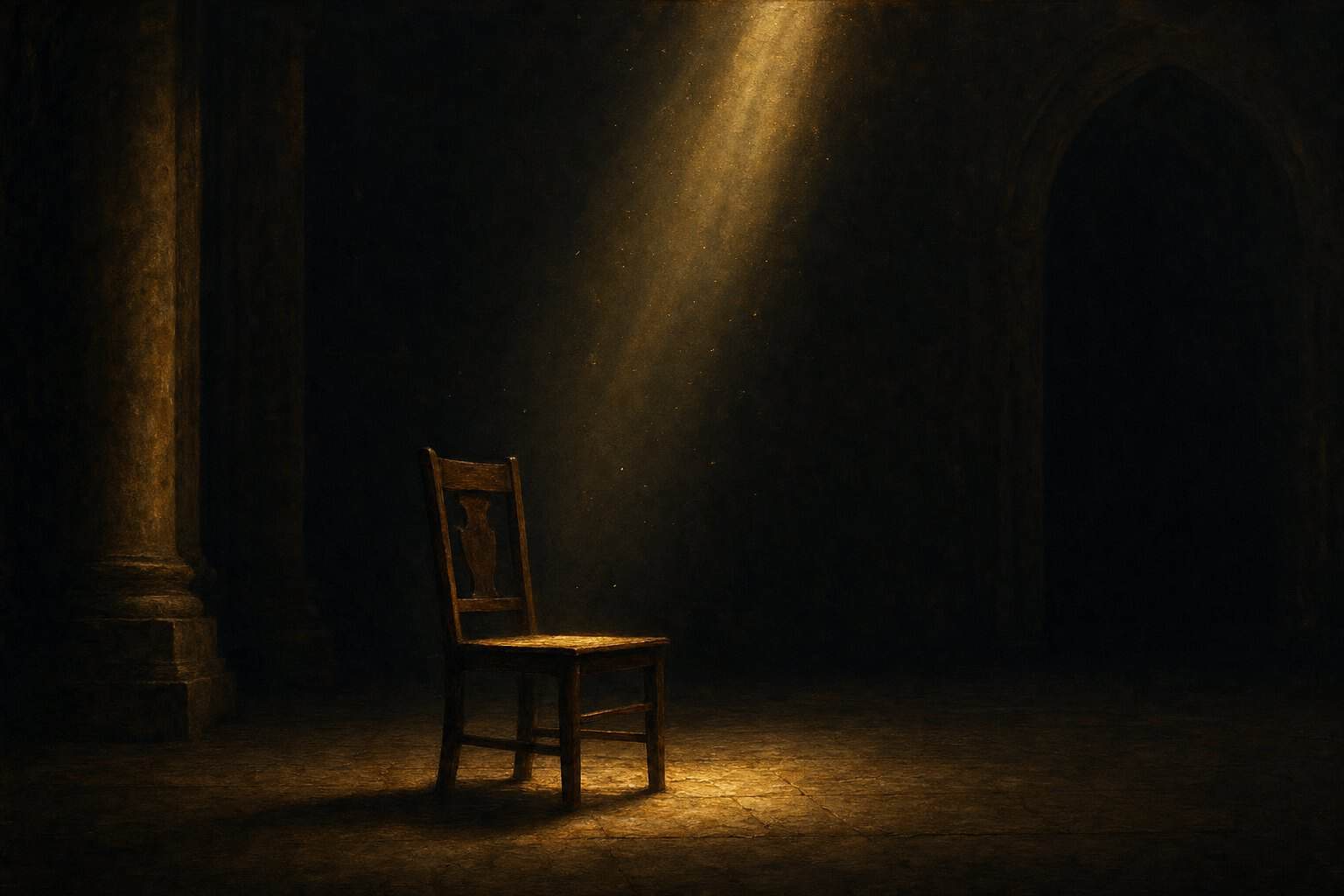
To speak the whole of a life toward silence is to face the one listener who cannot be flattered, deflected, or absorbed into the murmur of the crowd.
The Chair That Will Not Answer
Every confession requires a listener, and the peculiar genius of Confessions to the Empty Chair is that its listener refuses to occupy space. The chair sits there, upholstered in absence, and yet it is not nothing. Heidegger would recognize in it a clearing — a Lichtung, an opening where Being might show itself once the chatter of everyday self-interpretation has been stilled. To confess to a person is already to begin managing the impression, to slide into what Heidegger names das Man, the anonymous They whose approval we crave and whose verdict we half-write in advance. But the empty chair grants no approval. It cannot be persuaded. Before it, the machinery of self-presentation loses its purchase, and what remains is the raw fact of a self delivered over to its own existence.
This is why the empty chair is not merely a literary device but an ontological instrument. It stages the possibility of authentic discourse by removing the human audience that makes inauthentic discourse so easy. You cannot charm silence. You cannot win an argument with a vacancy. And so the confessor is thrown back — the word is deliberate — upon the truth of his own thrownness, upon the facticity of finding himself already situated in a life he did not choose, burdened with a history he must nonetheless answer for.
Thrownness and the Facticity of Sin
Heidegger’s thrownness — Geworfenheit — names the strange condition of finding ourselves already in the midst of existence, having never been consulted about our arrival, our era, our wounds. We are delivered over to a world with its burdens and its possibilities before we can deliberate about any of it. Adoré’s confessional writings enact precisely this confrontation. The childhood is already there; the trauma is already there; the ache toward faith and the pull toward temptation are already inscribed in the flesh before the will can weigh them. To confess is not first to accuse oneself of freely chosen crimes but to acknowledge the deeper fact that one was thrown into a condition one did not author.
Here Heidegger’s fundamental ontology and Adoré’s post-edenic ontology meet without collapsing into one another. For Heidegger, thrownness is neutral, a structure of Dasein as such. For Adoré, it is inflected by the Fall: the self is always-already fallen, and thrownness is thrownness east of Eden, into a nature bent before it can bend itself. The empty chair receives this confession not as a ledger of misdeeds but as the acknowledgment of a condition. And in that acknowledgment something authentic begins to stir — not the fantasy of a self-made purity, but the honest owning of what one has been given to carry.
The Call of Conscience Without a Voice
Heidegger’s most haunting analysis is of the call of conscience — der Ruf des Gewissens — which summons Dasein out of its dispersal in the They and back toward its ownmost self. The strangeness of this call is that it says nothing. It has no content, no message, no moralizing catalogue. It calls silently, and it calls the self to itself. The one who calls is Dasein in its uncanniness, its not-being-at-home in the everyday world into which it has fallen. The call comes from me and yet over me; it is mine and yet it seizes me.
What, then, is the empty chair, if not the very form of this call made visible? It says nothing because the call of conscience says nothing. It summons by its silence, refusing to fill the space with the reassurance a human confessor might offer. And yet — and this is where Adoré’s Catholic inflection deepens the German ontology — the silence is not empty of presence. The chair is the seat of the unseen listener: God, or the absent confessor, or the self one has fled. The Heideggerian call from nowhere becomes, under the sign of faith, a call from Someone who withholds His face precisely so that the truth may be spoken without the corruption of an audience. You confess into silence, and the silence is not indifference but attention of an order too pure to interrupt.
Truth is spoken most purely toward the one listener who cannot be flattered — and only there does the fleeing self finally stand still and become itself.
Being-Toward-Death as the Ground of Honest Speech
There is no authentic confession that does not stand within the horizon of finitude. Heidegger insists that Dasein becomes wholly itself only in Being-toward-death — not in morbid preoccupation, but in the sober recognition that existence is finite, that its possibilities are numbered, that the crowd’s endless distractions are a flight from this ownmost, non-relational, uncircumventable end. Death is the one possibility no one can take over for me; I die alone, and in facing this I am individuated, torn loose from the anonymous averageness of the They.
The empty chair enforces this same individuation. Before it, no one can confess in your place. The silence will not accept a proxy. To speak the truth of a life toward that vacancy is to speak as one who knows the account will close, who knows that this speech is not idle talk to be forgotten by tomorrow but the gathering of a whole existence toward its finitude. This is why confession, rightly understood, is a rehearsal of death — a laying bare of the self as if before the last judgment, which for Adoré it quite literally intends to be. The empty chair is the deathbed brought forward into the present, so that one might die honestly before one dies in fact.
The Clearing Where a Self May Show Itself
Heidegger describes his method as a phenomenological seeing that lets hidden structures come to light — the way a hammer withdraws in use to reveal the whole referential world of equipment, the way idle talk covers over the primordial discourse it imitates. Adoré’s fractured soul-portraits, read this way, are attempts to catch the self in its very flight, to interrupt the fall into ready-made interpretations long enough for something concealed to appear. The empty chair is the apparatus of that interruption. It withdraws every consoling reply so that the self, deprived of its usual reflections in the eyes of others, must at last see itself.
And yet this seeing is not despair. To confess toward silence is to trust that the clearing is not a void but a lit space where Being — and, for Adoré, the God who is Being itself — may show itself once the noise has ceased. The chair is empty of the crowd precisely so that it may be full of the one Listener who does not need words to receive them. You sit; you speak into the vacancy; you discover that the vacancy was listening all along, and that in speaking honestly toward it you have, for the first time, become someone capable of being addressed. The authentic self is not the one who is heard by many, but the one who dares to speak the whole truth to the silence that will not lie back to him.