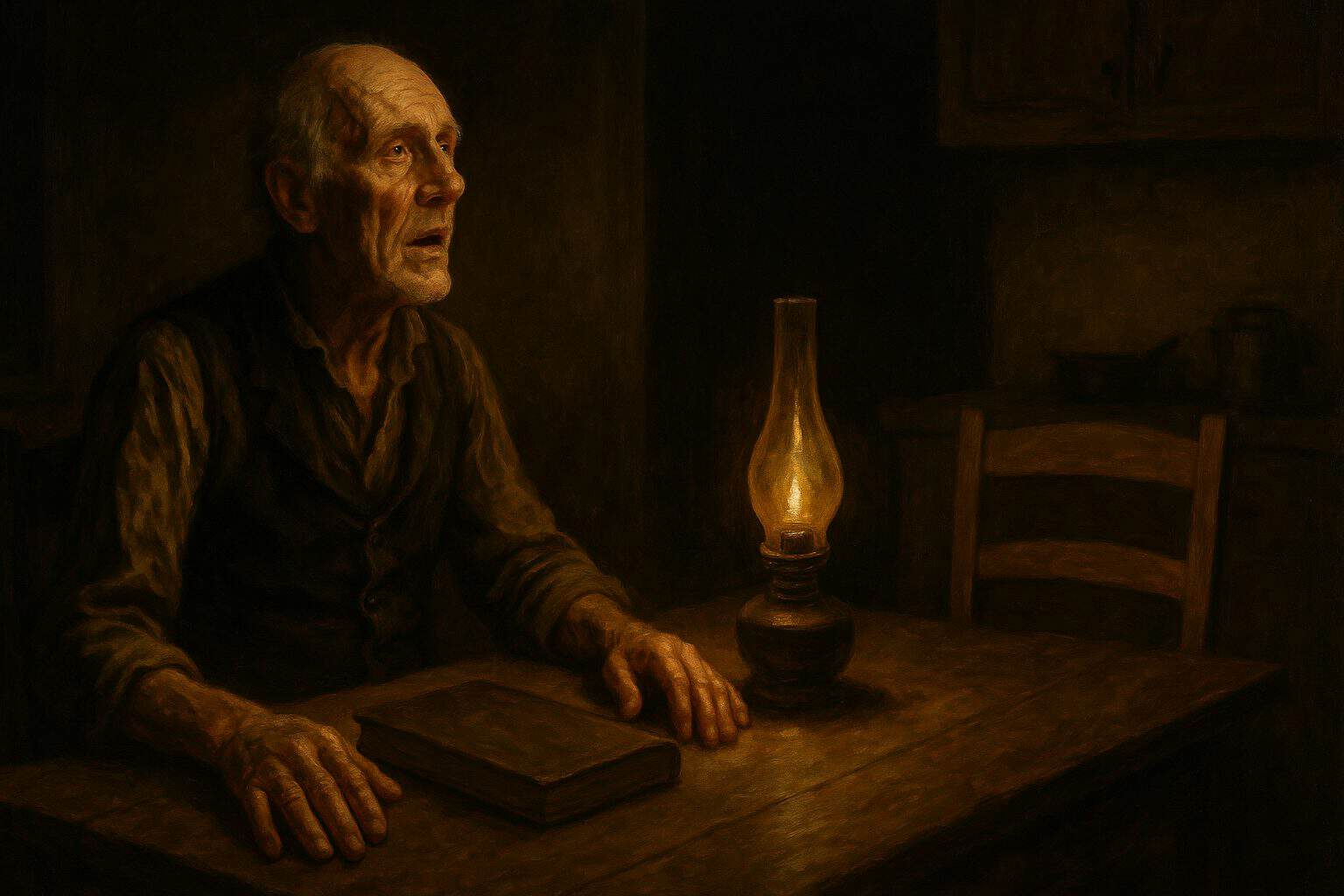
How reckoning and confession cross in the lived space between judgment and witness
The courtroom materializes first in the body—shoulders drawn back as if to receive sentence, breath held shallow in the chest, eyes that cannot quite meet the gaze across the kitchen table. “Though only feet away, she felt hundreds of miles distant.” The distance opens not through physical space but through a quality of presence that transforms proximity into exile. In that gap between bodies, a ledger unfolds: dates missed, calls ignored, the long silent hours tallied and weighed. The reckoning has already begun before words arrive to name it.
The Verdict Already Reached
There is a particular weight to discovering oneself on trial after the verdict has been rendered. The body knows it first—that peculiar sensation of being seen through rather than looked at, evaluated rather than encountered. “My disqualification as her husband remained a foregone conclusion, a verdict she reached long before I knew of the trial.” The temporal structure reveals itself: judgment precedes evidence, conclusion anticipates examination.
In the marketplace of worth that human relating sometimes becomes, value gets appraised quickly, traded often, lost easily. The eyes that scan become scales, measuring deficiency against an invisible standard. Silence transforms into both shield and sentence—protecting the judge from contamination while condemning the accused to a solitude more complete than physical absence could achieve.
Yet this same silence opens another register. What cannot defend itself before the court seeks another hearing, another chair.
The Empty Chair as Witness
“I now make public that which I once kept private, groaned in the solitude of a chapel, heard only by the moon and stars, my empty chair”
The empty chair receives what the courtroom cannot hold. Not argument or defense, but the raw fact of being as it gives itself before any accounting. In the chapel’s darkness, words pour out that have no currency in the marketplace of judgment—confessions that seek not absolution but articulation. The moon and stars become witnesses precisely through their indifference, their inability to return the evaluating gaze.
This is not metaphor but phenomenological structure: confession requires an addressee who cannot judge because judgment would transform confession into performance. The empty chair holds space for speech that moves beneath the level of justification. What emerges is not explanation but exposure—the self given over to its own seeing.
The Ledger’s Double Entry
Fractions of the Soul taught the eyes to see structure beneath surface—the careful accounting of parts that refuse to sum to a whole. Each fraction carries its own weight, irreducible to the others. The ledger mentality knows this intimately: every entry stands alone even as it contributes to a balance that perpetually shifts. Dates and calls become data points, but data points that pulse with absence, each one a small death tallied against an impossible total.
Confessions to the Empty Chair gives voice to what the ledger cannot capture—the cost of living that exceeds any accounting. “Neither I nor any other human being could render the description with proper justice.” The admission does not excuse but acknowledges: some debts cannot be paid because they cannot be properly named. They can only be confessed into a space that holds without calculating.
The Divine Audit
Between human judgment and empty witness, another seeing emerges. “He sees the hidden motivations of the heart animating behavior. He values sincerity—appreciating two copper coins as being greater than thirty pieces of silver!” The divine gaze inverts every earthly accounting. What appears as wealth becomes poverty; what seems like nothing reveals itself as everything.
“Faith is something that cannot be proven; it is something that either one has or one does not have.”
This is not comfort but intensification. Before the divine audit, performance collapses into transparency. “Rather than perform a lie before God and ask for performative forgiveness, I accepted what I was and, out of a strange respect for the sanctity of the Eucharist, abandoned it completely.” The honesty is more painful than any penance could be—to stand before the absolute without pretense, without even the covering of ritual observance.
Witnesses and Seers
“Those with eyes to see, saw me. Those with ears to hear, heard me. Else, either God or Lilith removed their perception of me.” The phenomenology of being witnessed splits along a fault line: there are those who see and those whose seeing has been occluded. The difference cannot be bridged by explanation or argument. It exists as a fundamental divide in the structure of encounter itself.
Yet sometimes, rarely, the miracle occurs: “She processed my words and glimpsed who and what I am. And when she saw me, she did not flee.” The seeing that does not flee is neither judgment nor blindness but recognition—the self given and received in its fractured wholeness. This is not the courtroom’s verdict but something more terrible and beautiful: acceptance without acquittal.
The Continuing Process
The ledger remains open. The chair stays empty. “So, I leave these confessions in the chair, not as a closed account, but as witness to a process that continues.” The crossing between reckoning and confession never resolves into a final balance. Each mode of accounting reveals what the other conceals—the ledger exposing confession’s evasions, confession revealing the ledger’s inadequacy.
“Most of the time, my prediction of not being understood comes true. The evidence rests in your absence, dear observer.” The absence is not failure but structure. Understanding would close what must remain open. The empty chair preserves the space where words can continue to fall without landing, where the self can appear without being fixed in place.
The Dead Who Speak
“Even though the dead cannot speak for themselves, our voice can unite with theirs and they can speak through our interpretations.” The ledger includes entries that precede our own accounting—debts inherited, judgments passed down through generations. The empty chair receives confessions that began before we learned to speak.
In the cemetery, the truth stands naked: “behaving as if their flesh will never return to dust. Neither a cemetery nor the dead rising to warn them of their doom would convert their hubris.” The ultimate reckoning mocks all provisional tallies. Every ledger ends in dust. Every confession falls finally into silence.
Yet between now and that silence, the crossing continues. “The ascent moves forward by consent.” Not by judgment overcome or confession completed, but by the daily choice to remain in the tension between them. To keep both the ledger and the chair, the courtroom and the chapel, the human gaze that weighs and the divine seeing that treasures two copper coins above silver’s gleam.
Fractions gave me the eyes to see the structure beneath the surface. Confessions gave me a voice to name the cost of living. Between structure and cost, between seeing and naming, the self discovers itself as both defendant and witness, accountant and penitent. The crossing is the dwelling place—neither verdict nor absolution but the lived space where reckoning and confession perpetually intersect, generating the light by which we see ourselves as we are: neither innocent nor condemned but terribly, beautifully responsible for the weight we carry and the words we speak into emptiness, trusting that somewhere, somehow, they are heard.