You want to heal a relationship after betrayal. This is why trust is hard to rebuild, and how the eyes you were raised on shaped it.
The Body That Insists on Being Watched
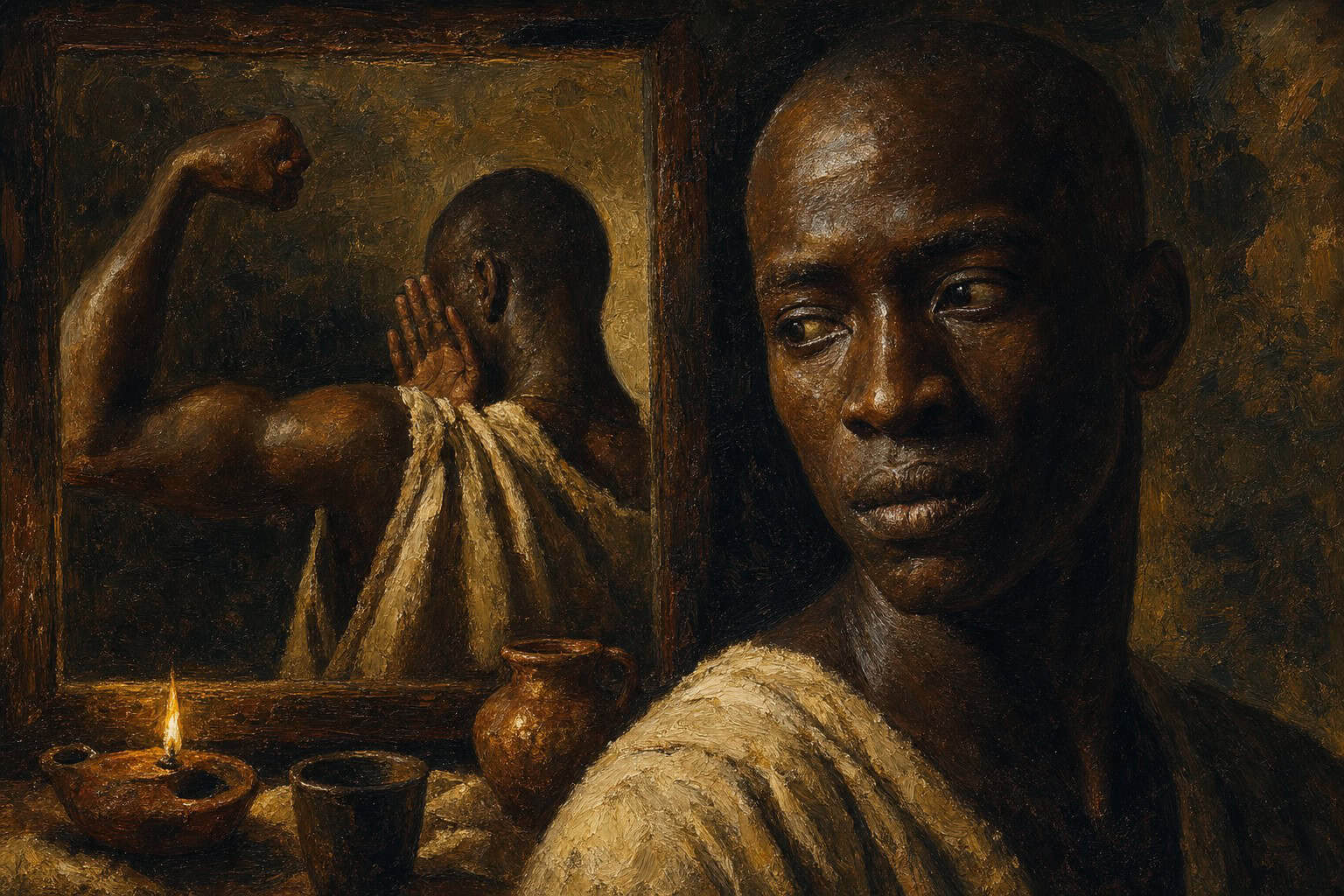
You want the relationship to mend, and you cannot find the hinge on which it turns. In the sixth chapter of Fractions of the Soul, the narrator sets down a plain observation about how people give themselves away without meaning to. A messy heart spills into fights with the people closest to it. A disordered mind makes bad choices and dresses them up as reasons. A closed-off spirit bolts itself against anything larger than itself and calls the smallness safety. And here is the part that stays with me: when one part of a person goes hungry, another part swells to cover the lack. The unfinished mind trains the body and shows it off in the mirror, in the doorway, in the way it fills a room. The starved heart reaches for the flesh, hoping that comfort will pass for love long enough to fool them both. The narrator names this without cruelty, but without softness either. He is describing the very machinery of betrayal before betrayal has a name. He is describing how a person can perform wholeness while rotting underneath, and how the performance is itself the confession. When you sit across from someone who broke faith with you, your eyes are not only on the lie. They are on everything the lie was built to hide. The gym-hard body that must be seen to feel real. The clever talk that swerves away the moment a conversation turns difficult. The devotion that curdles quietly into worship of the self. These are not random flaws scattered across a person. They are compensations, and the older narrator now reads them as a map of deficiency wearing the costume of strength. Healing does not begin with forgiveness, not yet. It begins with sight. You have to see what the display was covering before you can decide whether anything real still lives beneath it. That is the hardest looking there is, because it means you saw a person clearly once and stayed anyway. You watched the flexing. You heard the deflection. You felt the bolted door of the spirit against your knuckles, and you told yourself another story because the true one frightened you. The narrator knows this dishonesty from the inside. He is not standing above it with clean hands. He is confessing that he, too, learned to read others while refusing to read himself, that he became fluent in everyone’s evasions but his own. And the reading came late, long after the damage was done, when there was nothing left to do with the clear sight but grieve how blind he had chosen to be. That late clarity is not a triumph. It is a bill that arrives after the meal.
Trained on Counterfeits Since the Beginning
Betrayal rarely arrives as a single event. It arrives as the last link in a chain forged years before you ever met the person who finally snapped it, in the house where you first learned what love was supposed to feel like. The chapter presses on a bruise the narrator names carefully: the one who has known only imposters cannot recognize the real thing when it finally stands close. Her eyes were spoiled at the source. She mistakes a lesser thing for greatness because a lesser thing is all she has ever been fed, spoonful by spoonful, since before she could name what she was swallowing. This is the wound beneath the wound. It is not only that someone hurt her. It is that the equipment she uses to tell the true from the false was corrupted before she could learn to defend it. Now turn that on yourself, honestly, and the floor begins to tilt. If you keep choosing people who wound you, the question is not why they are cruel. The question is why cruelty feels like coming home. What did your first teachers of love actually teach your body to expect? What predisposition did they press into you, so quietly that you never once saw the handing? The narrator does not spare himself this interrogation, and it is not a graceful sight. He turns the lens inward and asks whether his own hunger for a certain kind of gaze was shaped long before he ever chose a partner. He asks whether he sought out people who would let him remain exactly as he was, who admired the cracks instead of pressing on them, because the pressing frightened him more than the cracks ever did. This is the current running under the whole passage. We make ourselves by what we reach toward and what we push away, decision after decision, until the pattern hardens into a self that feels like fate. And when the pattern was set by counterfeits, the counterfeit feels like truth and the truth arrives feeling like an insult, like too much, like a stranger you want to send away. Healing after betrayal, then, is not simply the repair of one broken bond. It is the slow, humiliating work of learning that your very taste was formed wrong, that some of what you called love was hunger wearing love’s borrowed face. The narrator does not hand this over as an excuse for anyone, least of all himself. He offers it as the harder mercy of understanding. You cannot mend what you refuse to see. And you cannot see what your whole life has trained you to look straight past, mistaking the familiar ache for the shape of home.
The Fire the False Teacher Will Not Enter
Here is the turn, and it cuts both ways at once. The chapter draws a line between what shapes you and what only flatters you into standing still. Something true endures the friction of being changed, the grinding down that hurts and does not apologize for hurting. Something false refuses the fire entirely. It stays stuck in the familiar out of fear or willful blindness, and it offers the appearance of formation while carefully changing nothing at all. The narrator sees now what he could not see then: that he was drawn, again and again, toward the one who demanded nothing of him. He wanted the person who would promise him change and let him remain untouched. He wanted transformation without cost, absolution without confession, healing that skipped the burning and went straight to the calm. And so, he admits, did the one who betrayed him. This is the revelation that reorders everything behind it. Betrayal is not only a thing done to you from the outside. It is often a shared refusal, a quiet treaty between two frightened people to keep pretending, until the pretense buckles under its own weight and someone gets blamed for the collapse. The one who broke faith avoided the pain of becoming true. But so did the one who kept choosing them, who kept returning to the comfortable mediocrity because greatness would have required being ground down. The narrator holds this without flinching and without the relief of a villain. He does not make himself the clean party watching a dirty one from a safe distance. He asks whether his own wound was, in part, a wound he arranged for himself, by loving only what could not challenge him.
What we most eagerly show is what we are most desperate to hide, and the wound to trust begins long before the lie.
To heal a relationship after betrayal, both people must become the kind of thing that endures the fire, and this is precisely what the human heart most desperately avoids. It is easier to blame. It is easier to leave. It is easier to find a new person who will let you stay exactly the same shape you already are. Real repair asks you to be ground down until you spark. It asks you to let the other see the deficiency you spent years dressing up as strength, and to let them stay anyway, and to stay in return without turning your eyes from what you now see plainly in them. The narrator understood, too late for some of it, that he had asked to be loved without being known. And being loved without being known is only a slower betrayal, one you commit patiently against yourself, in the dark, where no one else can be blamed for it.
What we most eagerly show is what we are most desperate to hide, and the wound to trust begins long before the lie.
When the Painting Peels and You Are Just Standing There
After the turn comes the exposure, and there is no dignity waiting in it. When the compensations fall away, when the shown-off body and the clever deflections and the private idol all stop working at the same moment, you are left standing before another person as you actually are, with nothing raised to cover the view. This is the part the narrator dreads most in the remembering, the part his voice goes quiet around. To be seen and found wanting. To have someone look past the display and straight into the deficiency it was built to hide, and to have no more curtains left to pull across the window. The oldest instinct in the body is to vanish. To cover yourself. To run from your own eyes as hard as you run from theirs. Shame does not want repair; repair means staying. Shame wants disappearance. It wants the floor to open and take you down before the other can finish looking. And here the chapter’s cool observation catches fire in the living, because to be read by another is not a neutral exchange between two people who happen to love each other. It is terrifying. When the one who betrayed you finally stands stripped of their performance, and when you stand stripped of yours in the same bare light, the impulse in both of you is to bolt straight back into the familiar counterfeit rather than endure the nakedness of being truly known. The narrator sits down inside this and does not rescue himself from it. He asks the unbearable question and lets it hang: did he even want to be healed, or did he only want the shame to stop hurting? Because those are not the same wish, and confusing them has wrecked more relationships than the original betrayal ever managed. The peeling away of the painted self is not the reward at the end. It is the crisis at the middle. And this is where, in the narrator’s telling, something quiet happens that he refuses to inflate into a rescue. God does not lift him up out of the shame. God does not erase the exposure or wave away the wreckage of what was done to him and what he did to others. Instead there is a presence within it, a nearness settling into the very place he most wanted to hide from. Not a fix. Not a repair of the ruined trust. Only the sense of being accompanied in the dark, seen by the single gaze that does not condemn even as it declines to look away from any of it. That accompaniment does not make the shame one degree less true. It makes it survivable. And survival, here, is not escape wearing a nicer name. It is learning to stand in the open place without running, because you have finally understood that you are not standing there alone.
Telling the Living Face from the Painted One
So where does this leave you, wanting to heal a relationship after betrayal and reading these hard pages hoping for a map? Not with a method. Not with steps to number and check off in the evening. The narrator refuses to hand you a clean procedure, because he knows the wish for one is usually the wish to skip the fire and keep the shape. What the chapter offers instead is a way of seeing that goes all the way to the floor of a person. You begin gathering the small evidence, the breadcrumbs, the manifestations that leak out of the hidden interior into daylight without permission. You learn to ask what a heart and mind must be arranged to make this behavior make sense and not some other. You learn to ask it of the one who hurt you. And you learn, far more painfully, to ask it of the face in the mirror before you point it anywhere else. This is slow work, and it does not flatter you at any point along the way. Some relationships, read this honestly, cannot be healed, because one party refuses the fire and would rather keep the painting of a self than risk the living one that might change. The narrator does not pretend otherwise to spare your hope. Repair is not owed to anyone and never guaranteed. But where it is possible at all, it arrives only through this narrow gate: two people willing to be ground down, to have their compensations named aloud, to let the deficiency stand uncovered and to remain anyway, without the display, without the idol, without the tireless flexing performance of wholeness. It asks you to move close enough to feel the true pitch of another person and to let your own be felt in return, which is the most exposed act a human being can commit while still breathing. Fractions of the Soul does not promise you the ending you came here searching for. It gives you something harder and, in the end, more useful. It gives you the sight to tell the living person from the painted one, including and especially the one wearing your own face. And it leaves you holding the narrator’s own unhealed, still-open question, the one he carries forward into everything that comes after: whether he can love without demanding to stay unknown, and whether he can bear to be loved once the covering finally comes down for good. That question is the entrance into the rest of his confession. If you have ever stood before someone you wounded, or someone who wounded you, wanting the trust to come back and not understanding why it will not, the pages ahead were written from inside the exact hunger you are carrying now.