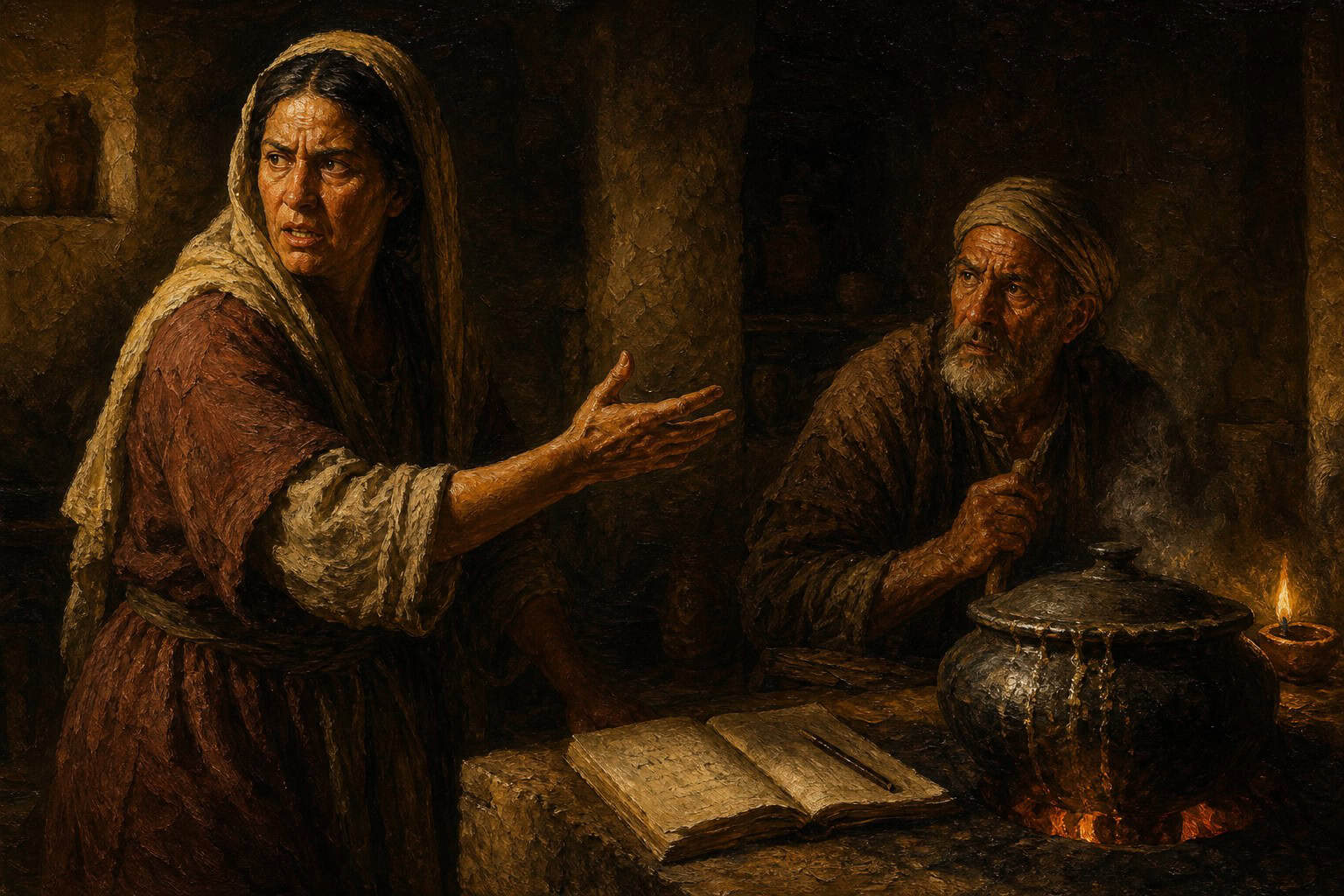
Caught up in emotion and afraid you’ll lose control? A raw reflection on how feeling floods reason – and what to do when the lid blows.
The Lid Trembling on the Pot
I remember the exact hour I decided I would out-think my own heart. I sat with a pen and a page and told myself that if I could name a feeling, cut it into parts, and weigh those parts against each other, I could keep it from ever ambushing me again. The picture I reached for was plain and true: a pot on the fire, the lid rattling, the pressure climbing underneath until something has to give. I believed then that the trick was to press the lid down harder, to lean my whole reasoning weight on it, and that the pressing itself was strength. It was not strength. It was fear wearing the face of discipline, and I did not see the face for years. What I wrote in those early pages of Fractions of the Soul was an attempt to give the steam a voice so it would not blow the lid to the ceiling and scatter chaos across a life I could not afford to lose. I called that honesty. I now suspect it was mostly management. A man who intellectualizes his terror still trembles; he has only learned to tremble quietly, in complete sentences. There is a whole language of self-command that is really just a longer way of flinching. I built that language carefully. I filled notebooks with the anatomy of my own reactions, as if understanding a wound were the same as tending it, as if disciplining a feeling with reason were the same as letting it be real. The older self reading this now understands something the younger man refused: the pressing hand and the boiling water were never two separate enemies. They were the same divided creature, half animal and half meaning-maker, trying to survive an ordinary evening. I wanted the feeling gone. What I actually needed was to sit down at the fire and admit the heat was real, that it was mine, that no amount of naming would cool it. There is a difference between disciplining an emotion and disowning it, and for a long time I confused the two the way a frightened boy confuses holding still with being safe. The pot did not care what I called my method. It went on heating through every clever page. And somewhere under the rattle of that lid was a question I was too proud to ask out loud: what am I so afraid this feeling will do to me if I let it stand up to its full height? I did not answer it then. I only pressed harder, and told myself I was thinking my way toward peace.
A Needle Aimed at the Whole Mountain
The confession I could not make in those years was simple, and its smallness shames me now. I preferred cold reason because I found emotion frothy, slobbering, undignified, a thing that dripped down other people’s faces and embarrassed the whole room. I watched those who wept easily and felt a fastidious contempt I dressed up as clarity. Reason, I told myself, was clean. Reason was a needle – fine, disciplined, able to pierce through the mess and find the one true thing sitting at the center. And yet even then, in some honest corner I kept locking, I knew the arithmetic did not add up. A needle is thin. Emotion is not a boil to be lanced and drained; it is a mountain, vast and old and made of rock, and my little needle of reasoning stood at its base pretending it could push clear through to the far side. That is the truth I hid from myself while I sharpened my instruments and admired their edges. My contempt for feeling was never mastery over it. It was a wall thrown up against a force so much larger than my thinking that I could not bear to measure it head-on. I mocked the slobbering because I dreaded becoming it. The men and women I judged for their undisciplined convictions were only showing me, out in the open, the flood I was damming in secret. What did I refuse to see in them? That they were more honest than I was. They let the water run down their faces where anyone could watch. I made mine run inward, where it quietly rusted the very reason I was so proud of keeping bright. Facing my own limits means admitting the needle was always going to bend against the mountain, that no amount of precision was going to make the heat stop being heat or the grief stop being grief. In that same book I built careful structures to map the pain between men and women, thinking the map would spare me the walking of the land. But a map does not lower a fever. The mountain does not shrink because you have learned to name its slopes and shade its cliffs. And the harder I insisted on the needle, the more plainly I proved how much the mountain frightened me. That fear was the real subject of everything I wrote, though I signed my name to arguments instead of confessions. I searched for a mate who would satisfy both flesh and spirit and called it wisdom, when it was really the hope that another person could reconcile the war I would not face inside myself. I was accounting for feelings on paper while refusing to be held accountable to them in my chest.
The Flood Was Never the Enemy
Here is what finally broke the spell, and it broke late, well past the age when a man expects to be undone. There came a rupture I had not scheduled and could not analyze my way around – a presence that erupted into my ordered life and shattered the law by which I had been living. My needle was useless against it. My categories for people, my careful ledger of who excited the flesh and who fed the spirit, my whole quiet marketplace of pricing another soul’s combined value against my own – all of it crumbled in a single hour of being overwhelmed. The clever structures did not so much fail as vanish, the way a drawn breath vanishes when someone strikes you in the stomach. And in that collapse I understood, at last, what I had gotten backward my entire life. I had believed the goal was to keep from being caught up, to stay above the flood, to hold onto control as though control were the same thing as virtue. But losing control was not the disaster. The disaster was the years I spent so guarded that nothing true could get through – not another person, not sorrow, not God. When the feeling finally rose to its full mountain height and swept the needle clean out of my hand, I did not drown as I had always assumed I would. I was met. Something waited for me inside the very loss of footing I had spent decades avoiding, and it was not the chaos I had been bracing against. It was closer to God than any of my clean reasoning had ever carried me. He was not there to lift the flood away or hand me back my dry footing. He was in the water with me, in the shaking, in the sob I could no longer talk myself out of. That was the revelation, and it did not feel like rescue. It felt like being found in the one place I had sworn I would never be seen. I had spent so long anatomizing my own life that I forgot life is not an anatomy. It is a body, warm and breathing and mortal, pulled toward its own ending, and I had been refusing to feel my own pulse for fear of what it might make me do.
What you fear will destroy you is often the only thing honest enough to reach you.
Standing Wet in a Kitchen That Went Quiet
Afterward there is no triumph to report, and I distrust anyone who reports one. The needle was gone. The mountain was still a mountain; it had not moved an inch for all my weeping. What changed was smaller and stranger than victory: I could stand at the base of the thing without pretending I was about to conquer it. I remember the odd stillness of a kitchen after a pot has finally boiled over, that hiss and then the quiet, the wet ring on the stove, the smell of what spilled. My careful pages did not save me from any of it. They only delayed the hour when I would have to stand there, undignified, with the evidence of my own overflowing running down the side of everything I had tried to keep contained. And the ache did not resolve into a lesson. I did not wake the next morning healed, reasonable, at peace with my own heat. I woke still divided – still the animal pulled toward its ending, still the maker of meaning building something against that pull, and now, for the first time, unable to lie to myself that the two were strangers. That is the honest accounting I owe the record. I hurt people while I was busy pressing the lid down; I called my coldness clarity and let it wound the ones who came to me warm. I refused the flood in them because I could not bear it in me. What did I leave undone in all those guarded years? I left love half-received. I took what fed my hunger and turned away from what asked me to feel. The reckoning is not that I finally learned to master emotion. It is that I finally admitted I never could, and that the mastering was itself the sin dressed as a discipline. There is a grief a man must pass through – the death of a certain dream he carried, the one where he stays untouched and safe and always the one holding the ledger – before anything real can meet him. I passed through it late. I would not call it comfortable. I would only call it true, and truth, I have come to think, is the thing God gives instead of the safety we keep begging Him for.
The Warm Ring Left on the Stove
So I set this down for whoever is sitting where I sat, leaning their whole weight on a lid that will not hold. You already know the pressure is climbing. You feel it in the tightness under your ribs, in the jaw you keep clenched through conversations, in the way your breath goes shallow when the feeling starts to rise and you order it back down. I want to tell you plainly what I could not tell myself for years: the flood is not your enemy, and losing control of it is not the ruin you have been rehearsing in the dark. The ruin is the guardedness itself, the slow rust of a heart that never lets the water run. I am not offering you a technique. I have no needle to hand you, no clean method to keep the pot from boiling over, because the method was always the trouble. What I have is the memory of standing wet in a quiet room, emptied of my arguments, and discovering that the emptying was where I was finally reachable – by another soul, and by God, who did not wait for me to compose myself before drawing near. He came into the mess, not after it. That is the whole of what I know. Fractions of the Soul is, in the end, the record of a man who spent half his life proving how much he feared his own heat, and only near the close began to warm his hands at it instead. If you have read this far with a lump in your throat you keep swallowing, I think you already understand more than the man who wrote all those confident pages ever did. The feeling you are afraid will overwhelm you is not the flood that drowns. It is the fire that was keeping you alive the whole time you were trying to put it out. Let the ring cool on the stove. Sit down at the table. Something waits for you in the letting-go, and it has been patient far longer than you have been afraid.