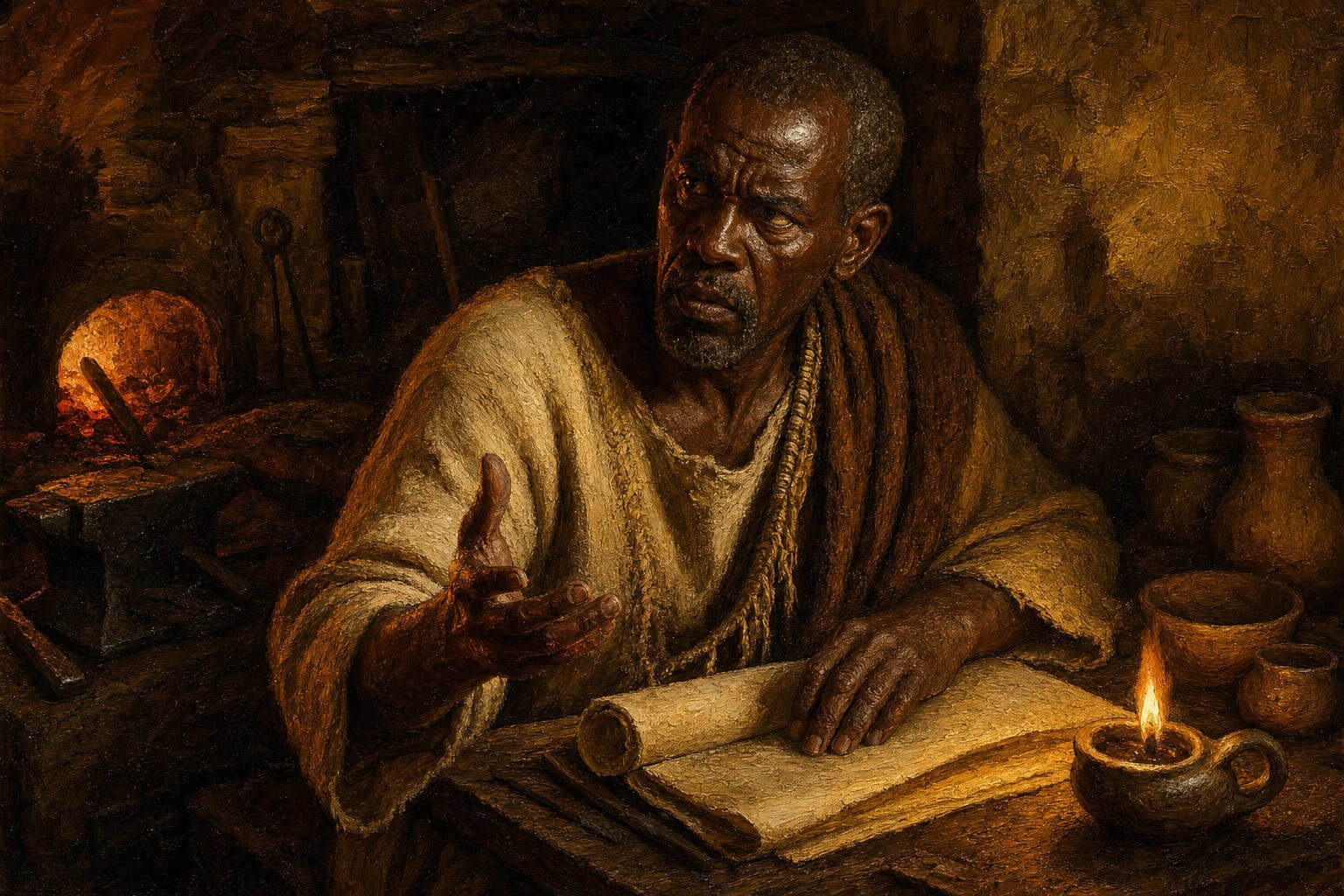
How to write pain without cheapening it, faking it, or performing a wound you have not lived. A reflection on the forge, the scar, and honest suffering.
The Sharp Intake Before The Cold Tile
You sit down to write the thing that hurt you, and your hand stops. There is a breath you take before you set it down, the same breath a body takes before a blow lands. I know this breath in my own chest. It is the sharp intake before surrender, the half-second where your hand hovers over the keys and picks the softer word, reaches for the wound and grabs a clean metaphor instead, because the metaphor does not still smell of blood. Most writing about pain fails right here, in that first strange politeness, because the writer describes the ache from a safe distance instead of stepping down inside it. You remember the night the pain actually arrived — the kitchen light left on past midnight, the phone face-down on the counter, your own breathing too loud in the empty room. That night you did not think in beautiful lines. You thought in short flat facts: this happened, then this, then I could not stand up, and your knees found the cold tile and stayed there. In the fifteenth chapter of Confessions to the Empty Chair I write about a rhythm I could not escape, lifted into consolation and then driven back down into loneliness and disappointment, the ordinary weathers of a soul that thought it had arrived and found it had not begun. When you try to write such a night later, you want to dress it. You want the reader to admire how you suffered rather than to feel the suffering itself, and those two hungers cannot be fed at the same table. Real pain on the page has a temperature you can feel with your hand. It is warm because it is fresh in you, or it is cold, and the reader knows within a line that you are handling a memory with gloves on. So the first thing pain demands is not skill. It is a decision about honesty made before craft enters the room: will you tell it as it felt, or as you wish it had felt so you come out looking better than you were? That question sits on the blank page like a small stone laid on your sternum. You can lift it or dodge it, and the page is patient and does not scold. But the reader always knows whether the words came from inside the room or from the bus parked outside with the engine running.
Feeding On The Miracle, Selling Tickets To The Mourning
Once you decide to be honest, a subtler danger sits down beside you. You notice which sentences make people lean forward, which phrasing makes a friend’s face go still, and you begin writing toward that lean. Your grief becomes a small stage, and you are both the mourner kneeling in the spotlight and the man at the door selling tickets to the mourning. It goes rotten quietly, because it still looks brave from outside. You describe the tears and then count them for effect. You linger on the worst moment not because it is true but because it photographs well. Watch your own hands when you write the hardest scene. If you feel a warm flush of pride at how devastating the paragraph turned out, set the pen down; that flush is the sound of the lie starting its engine, low and pleasant. In this chapter I confess a hard line I did not invent and cannot soften: some souls feed on the miracle itself rather than on the One who performed it. They come for the sensation and skip the transformation. Carry that into the writing room and it becomes a warning. You can manufacture the effect of pain the way a musician learns a mournful chord and reaches for it whenever the mood needs lowering. But if nothing in you was changed by the writing, you have made a spectacle and called it a confession. Good writing about pain and bad writing about pain can look identical from outside; both make the reader ache. The difference is invisible, and it is moral, and it lives in your motive alone. Did you write to be pitied, or to see? Did you offer your darkness, or sell tickets to it and pocket the coins? That is the whole difference between two copper coins clutched in a fist and two dropped freely into the box. The reader is not moved by your competence at seeming wounded. They are moved by recognition — the shock of finding their private ache described so exactly they wonder how a stranger read the numbers off their own heart. That comes only from the unlovely detail you did not choose for its beauty: the socks you still wore when the news came, the stupid cheerful song you could not turn off, the fact that you were hungry an hour after the worst hour of your life and hated yourself for it. There is a further trap, quieter still: you can love your pain because it makes you interesting, build a whole self on the wound, and refuse to heal because healing would leave you ordinary.
Only The Scar Holds Still Enough To Trace
Here is the turn that changes everything, and you feel it as relief and sentence handed down at once. You cannot write a pain you have not lived, and you cannot write a pain you have not yet survived. Both fail, in opposite directions. The pain you have not lived comes out as guesswork in borrowed clothes; the reader smells the research, the invented tears, the window you never stood behind. But the pain you are still drowning in comes out as a scream with no shape. A scream is honest. It is not yet writing. Writing requires that you have crawled far enough past the pain to walk its edges, to know where it began and how it moved room by room through your life like water finding the low places. The scar can be described — it has an edge you can trace with a fingernail. The open wound only bleeds on the page and blinds the reader who bends close. The oldest pain is the hardest, because it arrived before language did. Some wounds crossed thresholds we were too small to guard; they marked us as children, and live in the body as a bruise the mind cannot explain. When I finally tried to write these earliest violations, my usual tools failed in my hands. There was no clean cause and effect, only the after-feeling, the way a room could go cold for no reason I could name and my whole body knew before my thoughts caught up. What changed everything is this: I stopped trying to explain the wound and started staying faithful to how it feels in the body, today. That is not a technique you practice; it is a surrender. The hard-won clarity I chased came not from mastering the pain but from offering it up — refusing to hide the darkness from the One who went down into the lowest place to find exactly that darkness and sit with it. The unforgivable thing is never the wound itself; it is the refusal to bring it into the light. Darkness does not damn a page; hidden darkness does. You do not get to sharpen anyone on a blade you have not forged in your own fire and cooled in your own hands. When I finally offered the earliest bruise instead of managing it, the writing turned raw and, strangely, clean — not resolved, not healed into a tidy lesson, but clean the way a fever breaks: still shaking under the wet sheet, but no longer lying to itself.
You can only sharpen the reader on the edge of what has already cut you, and only after you have stopped hiding it from the One who bore it first.
What You Owe The Stranger At Three In The Morning
So you have survived enough to write it, and a new weight settles across your shoulders, heavier because you did not see it coming. The words are not only yours anymore. Someone will read them in a room you will never see, at three in the morning, when their own pain has them pinned flat to the mattress and the ceiling will not stop being the ceiling. What you write will either meet them there or leave them more alone than before. Nobody drew up this contract. You did not sign anything agreeing to keep a stranger company in the dark, yet the moment you write truly, that is the office you have taken up. There is real exhaustion in it. Half of you wants to withdraw, keep the wound private, spare yourself the labor of walking back into the worst rooms of your own life. That reluctance is honest and deserves naming rather than scolding, because each time you go back you pay something at the door, and the price does not drop with practice. Honest writing also keeps forcing you to see your own hand in what happened — my self-deceptions, the way I sometimes chose the descent by refusing to look inward. The people in the scene stop being simple. The ones who misunderstood me, who withheld the affection I was starving for, could no longer stay flat antagonists on a shelf; I had to ask what weight they carried that I never once considered. So you lose the version of the story that flattered you and let you sleep. The comforting explanations go first, the tidy blame next, then the role of pure victim I had leaned my whole weight on for years. Job says it in a handful of words that undo a lifetime of grasping — the Lord gave, and the Lord took away, and still His name is blessed. I did not want that verse near me. But the writing kept taking my comforts, page after page, until I stood inside the text as bare as I came from my mother’s womb. And yet the pain you shape into true words becomes a strange gift: a suffering described exactly tells the reader they are not insane, not alone, not permanently broken. Shaping it quietly changes the pain in your own chest. It stops being a private catastrophe locked in one skull and becomes a shared human fact, and shared facts weigh less than secret ones. The pain rarely leaves — do not let anyone sell you that — but it stops being poured into nothing.
The Fire That Keeps Someone In The Coals
Where this settles is not a solution, and I want to be plain, because the market for pain is crowded with writers who promise the wound will close if you just phrase it correctly. It will not. The rift that divides good from evil runs straight through every one of us, down into the lowest depths, and no sentence I have written closes it. What I found in place of resolution was company. Grace, for me, has rarely been a rescue lifting me out of the dark. It has been a nearness within it — quiet, walking beside me in my very sin, present in every tear I could not stop, a warmth against my side when I expected to be alone. So the truest pain-writing feels both raw and steady in the same breath: raw because it rises from a real wound, steady because the hand holding the pen has finally stopped shaking. You feel the grief fully, but the grief is no longer driving the car with its eyes closed. That quiet strength must not be mistaken for coldness, because coldness is what performance produces, not what survival does. It is the strength of a body that has healed enough to be touched again without flinching away. Everything comes down to a single test you feel in your chest when you read the sentence aloud to the empty room: did it cost you something, and does it give the reader something back? If it cost nothing to set down, it will give nothing; the ledger is that plain. The forge returns here, softened, the fire lower. The metal set in the coals is not abandoned to the coals. The One who laid it there stays in the fire with it, hand near the heat. So write from the scar and not the open wound. Write the small humiliating detail and leave the grand gesture on the floor. Do not lie about the heat, and do not lie about the presence either — do not pretend you were utterly alone if you were not, for the tenderness found in the dark is the most honest thing of all, and the hardest to earn without cheapening. Write toward the self you were taught to despise and offer him some plain care at last; he survived the thing you are describing, and deserves a gentler hand than the one that first wounded him. If you want to know how this labor feels from the inside, Fractions of the Soul was written straight out of this fire — not a manual, a witness left behind. The tears shaped into true sentences are not water poured into an abyss. They are received.