Where the horizon of choice meets the vertigo of freedom
The moment arrives without announcement. You stand at the kitchen counter, knife poised above the cutting board, and suddenly the automatic gesture suspends itself. The tomato before you—red, firm, waiting—becomes strangely alien. Not the tomato itself, but the about to cut that has always carried you forward without question. Your hand hovers. In this suspension, something vast opens: you could set down the knife, walk out the door, never return. You could continue cutting, but now the continuation itself becomes a choice rather than a momentum. The kitchen hasn’t changed, yet everything has become possible and therefore terrible.
This is the ledge—not a physical precipice but that moment when consciousness catches sight of its own freedom and recoils. Kierkegaard knew this place intimately, called it Angst, that dizziness before the abyss of possibility. Not fear of something specific, but the vertigo that comes when we glimpse that we are, at every moment, choosing ourselves into being.
The Weight of Wings
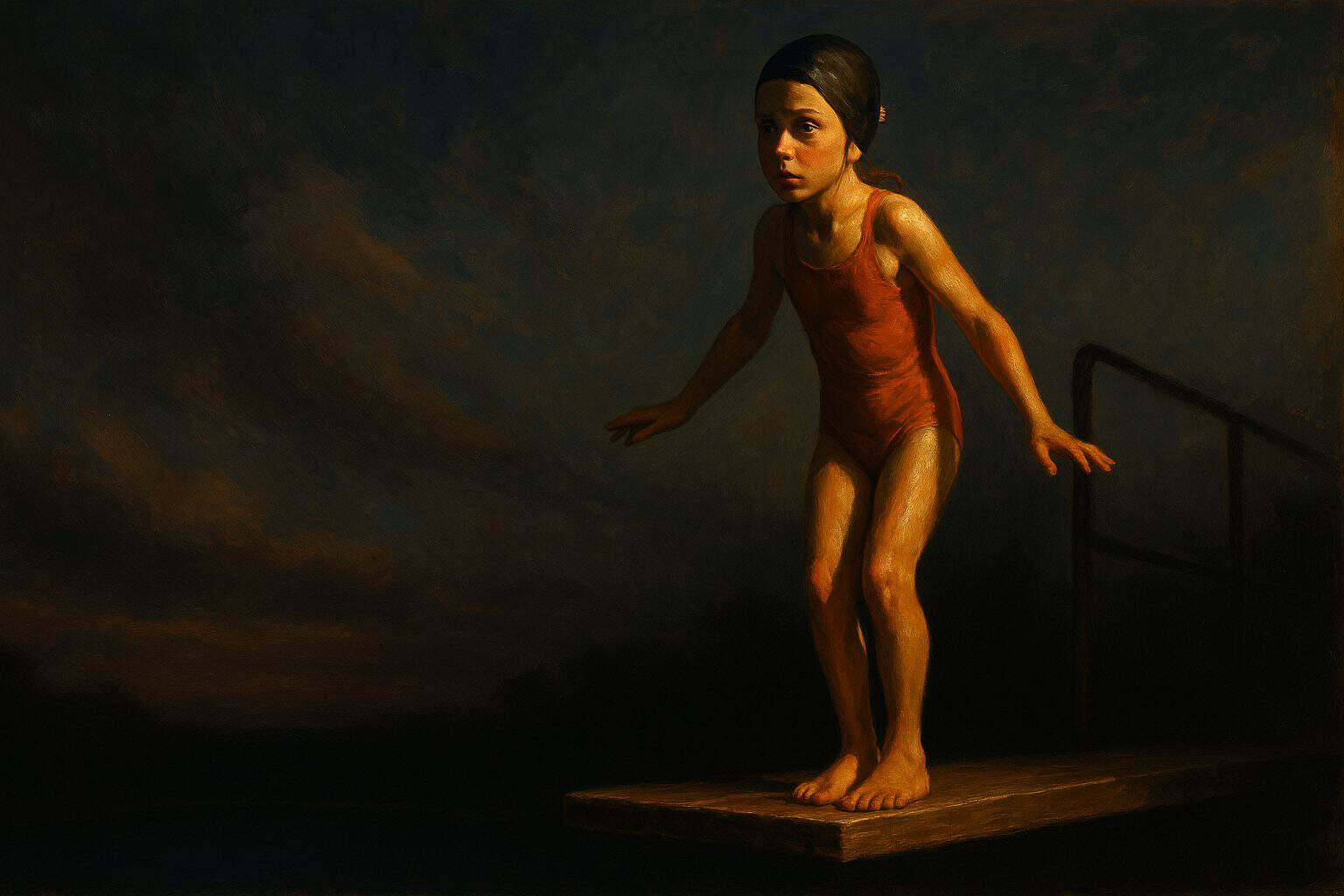
A child stands at the edge of the high dive for the first time. Below, the pool’s blue surface seems impossibly distant. Behind, the ladder presses with the weight of those waiting. But these external pressures fade before the internal recognition: I must choose this. No one can jump for her. The act cannot be delegated, deferred, or accomplished through compliance. As the manuscript observes: love and authentic action arrive “as a gift, or it does not arrive. This principle governs the divine economy—He seeks willing hearts, not automatons.”
The trembling in her legs is not merely fear of falling. It is the body’s registration of what consciousness apprehends: in this moment, she holds the terrible dignity of self-determination. She could climb down. She could stand here forever. She could leap. Each possibility is real, genuinely available, and this availability itself induces the shaking.
Watch how the child’s whole being reorganizes around this moment. Her hands grip the rails tighter, as if the physical holding could substitute for the existential suspension. Her breath becomes shallow, caught between the inhale of preparation and the exhale of release. Time dilates—seconds stretch into small eternities where everything remains potential, nothing yet actual.
The Familiar Prison
Most days, we flee this ledge. We construct elaborate architectures of habit, routine, obligation that obscure the terrible fact of our freedom. The alarm rings at 6:30, therefore we rise. The job expects us, therefore we go. The relationship has momentum, therefore we continue. We live, as Kierkegaard observed, in the aesthetic sphere—carried along by immediacy, by the flow of the given.
“Perceptual reality, from our point of view, reflects our intentions and to a large degree, desires and limits upon our perceptions are self-imposed.”
Consider the morning commute. The same route, the same turns, the same parking space if possible. We arrive at work unable to recall the drive itself—consciousness has retreated into automaticity. This is not mere absent-mindedness but a profound existential strategy. To truly experience each turn as a choice, each continuation as a decision, would be unbearable. We would arrive at work—if we arrived at all—exhausted by freedom.
Yet sometimes the automatic breaks. A detour forces a new route, and suddenly we’re awake to the city we’ve driven through unseeing for years. Buildings reveal themselves that were always there. Alternative paths suggest themselves. In this disruption, we catch a glimpse of how thoroughly we’ve chosen our blindness, how deliberately we’ve narrowed our perception to make life bearable.
The manuscript speaks to this self-imposed limitation: “Choosing one also means not choosing others. Choices made or not made all carry consequences.” But we rarely feel the weight of these unchosen possibilities. We tell ourselves the path we’re on is the only path, that circumstances dictate our direction. We become what Sartre called practitioners of mauvaise foi—bad faith—denying our freedom even as we exercise it.
The Boundary of Flesh
But here emerges a paradox that Kierkegaard understood and that contemporary existentialism sometimes forgets: our freedom is not infinite. “We cannot choose to transcend the threshold of human limitations… We cannot choose to become something other than ourselves.” The freedom that induces vertigo is always freedom within finitude.
Stand before the mirror in illness. The fever has taken hold, the body rebels against your will. You cannot choose to be well, cannot will the temperature down, cannot decide your way out of the biological facticity that holds you. Yet even here, especially here, freedom persists—not as the power to alter facts but as the capacity to relate to them. You can rage against the illness or accept it. You can see it as meaningless suffering or as a teacher. You can isolate in bitterness or reach out in vulnerability.
The manuscript illuminates this bounded freedom: “All human beings perceive through their limits, with their limits, and because of their limits.” The limits are not obstacles to freedom but its very condition. Without the resistance of facticity, choice would be meaningless—a phantom gesture in a void. It is precisely because we cannot be everything that we must choose to be something.
Watch a pianist at the keyboard. Eighty-eight keys create the boundary. She cannot play notes that don’t exist, cannot reach octaves her hands won’t span. Yet within these limits, infinite expression remains possible. The limitation creates the freedom, gives it shape and significance. Each note played is a note chosen, and in that choosing, a musical self emerges that could not exist without the constraint.
The Tunnel and the Wall
“Tunnels and permeability exist, by definition, outside the perceptual awareness of the one bound to the familiar.” This phenomenological insight reveals another dimension of our situated freedom. We choose not in a vacuum but within horizons we cannot fully see, toward possibilities we only dimly apprehend.
A woman sits in her office, successful by every measure she’s been taught to value. The promotion is within reach, the trajectory clear. Yet something unnamed stirs—a restlessness that has no object, a longing without clear direction. She attributes it to stress, to need for vacation, to anything but what it might be: the pressure of an unchosen life against the walls of a chosen one.
One evening, walking past a community center, she hears music—a guitar class in session, beginners struggling with chords. She stops. Not because the music is beautiful but because something in the struggle speaks to her. A tunnel has revealed itself, a permeability in what seemed solid. She could walk on, return to the known life. She could enter, pick up an instrument she abandoned in childhood. The choice terrifies precisely because it’s real.
“How you look shapes what you see.”
This is not about positive thinking or manifestation. It’s about the fundamental structure of perception itself, always selective, always oriented. The woman who sees only career sees truly—but partially. The tunnel toward music was always there, but her way of looking couldn’t reveal it until something in her shifted, some readiness emerged.
The Anguish of the Between
Kierkegaard located human existence in the tension between finite and infinite, temporal and eternal. We are, he insisted, a synthesis that must be achieved, not a given unity. This achievement happens in time, through choice, in the face of anxiety. We are always becoming what we are.
A father stands in his teenager’s doorway. The child has lied—about where they were, who they were with, what they were doing. The father holds knowledge the child doesn’t know he holds. He could confront immediately, could pretend ignorance, could wait for confession. Each response will shape not just this moment but the trajectory of trust between them.
Feel the weight of this pause. The father experiences what the manuscript calls the “gap” where “it becomes easier and easier to inject one’s own intentions into the original stimulus.” His anger wants immediate expression. His hurt counsels withdrawal. His love suggests patience. He stands in the between, where nothing is determined, where the next moment depends entirely on what he chooses to become in this moment.
This is the ethical sphere Kierkegaard described—where we must choose not from impulse but from principle, not from immediacy but from a conception of the good. Yet even principles don’t remove the anguish. The father must still decide how to apply them, must still risk being wrong, must still act without guarantee.
The Leap
At the heart of Kierkegaard’s vision lies the leap—not a single dramatic moment but the recurring structure of authentic existence. We cannot think our way across the gap between possibility and actuality. We cannot reason ourselves into commitment. At some point, we must jump.
“We can either risk being alone, surrounded within our own familiar existence in safety… or we can risk being wrong in our deductions and exposed.” The safety is illusory—we’re already exposed, already at risk, already leaping whether we acknowledge it or not. The only question is whether we leap with awareness or in denial.
A woman receives a job offer in another country. The spreadsheets are complete—salary comparisons, cost of living analyses, career projections. Friends have been consulted, pros and cons listed. Yet the decision refuses to make itself. No amount of data bridges the gap between analysis and action. She must choose not because she knows but despite not knowing.
The night before her answer is due, she sits with the uncertainty. Not trying to resolve it but letting it be fully present. The familiar life here—known, comfortable, limiting. The possible life there—unknown, challenging, expansive. Neither guaranteed to bring happiness. Both involving loss. The choice cannot be outsourced to logic or chance. She must author it, own it, become it.
This is what Kierkegaard meant by “the leap of faith”—not necessarily religious faith but the faith required by any genuine decision. The faith that we can choose without certainty, commit without guarantee, leap without seeing the landing.
The Return
Yet here’s what Kierkegaard also knew: we don’t leap once and remain airborne. We land, and in landing, face the ledge again. The commitment made must be renewed. The choice chosen must be chosen again. Freedom is not a problem to be solved but a condition to be lived.
A couple, married fifteen years, sits across from each other at dinner. The conversation has worn smooth grooves—work, children, schedules. Beneath the familiar exchange, each carries the knowledge that they could leave. Not that they want to, not that they will, but that they could. This possibility doesn’t threaten their bond but constitutes it. They are together not because they must be but because they choose to be, and this choosing happens not once but continuously, mostly below the threshold of conscious thought but sometimes breaking through into awareness.
One evening, perhaps tonight, one of them will look up and see the other as if for the first time—not through the haze of habit but in their stark particularity. In that moment, the relationship becomes new again, chosen again, fragile and therefore precious. The ledge reappears, the vertigo returns, but now it’s not only terror but also gratitude for this terrible, beautiful burden of freedom.
The Horizon’s Edge
“Biological reality and material causality are accepted as facticity and set the horizon within which meaning, openness, consciousness, and perception appear.” We live always at the edge of our own horizons, able to see the boundary but not beyond it, aware of limits without knowing what they exclude.
An elderly man tends his garden. His movements have slowed, his strength diminished. He cannot choose to be young again, cannot will his body back to its former power. Yet watch how he works—not with resignation but with a kind of graceful negotiation. He kneels differently now, rises more carefully, takes breaks he once didn’t need. The garden itself has changed in response—raised beds replace ground-level plots, perennials replace annuals, design accommodates reality.
Is he less free than when he was young? Or has his freedom simply changed shape, become more subtle, more aware of itself? He knows now what he couldn’t know then: that freedom was never about infinite possibility but about creative response to the given. The limitations of age have revealed what the powers of youth concealed—that we are always choosing within constraints, always free within bounds.
The manuscript reminds us: “consciousness itself has limits. Instead, the individual lens, flawed as it is, enables people to understand and interpret a phenomenon.” The flaw is not a defect but a feature. It’s precisely because we can’t see everything that we must choose what to see. Because we can’t be everything, we must decide what to be.
The Courage to Be
In the end, what Kierkegaard offers—what the phenomenon of freedom demands—is not escape from the human condition but the courage to inhabit it fully. We stand always on the ledge of the possible, always at the horizon of choice, always suspended between what is and what might be.
The vertigo doesn’t go away. The woman who took the job abroad still feels it, just in a new landscape. The father who chose patience still questions his choice. The couple who renewed their commitment will face the question again tomorrow. This is not failure but the very structure of human existence—to be free is to be anxious, to choose is to risk, to live is to leap.
Yet in accepting this condition, something shifts. The ledge remains but becomes familiar. The vertigo persists but becomes bearable, even at times exhilarating. We learn to live suspended, to choose without certainty, to leap with something approaching grace.
The manuscript observes that God “endowed the angels and humanity with intelligence, awareness, decision-making, and freedom—not for His benefit, but for our own, so that we might come to discover Him in our own way on our own terms.” Whether one accepts this theological frame or not, the phenomenological truth remains: our freedom is not a burden imposed but a gift offered, not a problem to solve but a capacity to develop.
We cannot choose to be other than human, cannot transcend the threshold of our limitations. But within these bounds, on this ledge, at this horizon, we can choose what kind of human to become. The possibility terrifies. The possibility liberates. Both, always, at once.
The ledge of the possible is where we live.