How the vertigo of freedom lives as both wound and arrival in the memoirs of Anthony Adoré
The moment arrives without warning—a sudden loosening in the chest, as if the ground beneath one’s feet has become transparent glass revealing depths below. Anthony Adoré knows this sensation intimately: “I felt a strange, terrifying relief wash over me. I did not have to calculate. I did not have to strategize. I simply had to be.” The terror and the relief arrive together, inseparable, like two faces of a single coin spinning in midair. This is how freedom announces itself in lived experience—not as abstract principle but as visceral undoing, a dissolution of the familiar coordinates by which we navigate our days.
The Vertigo
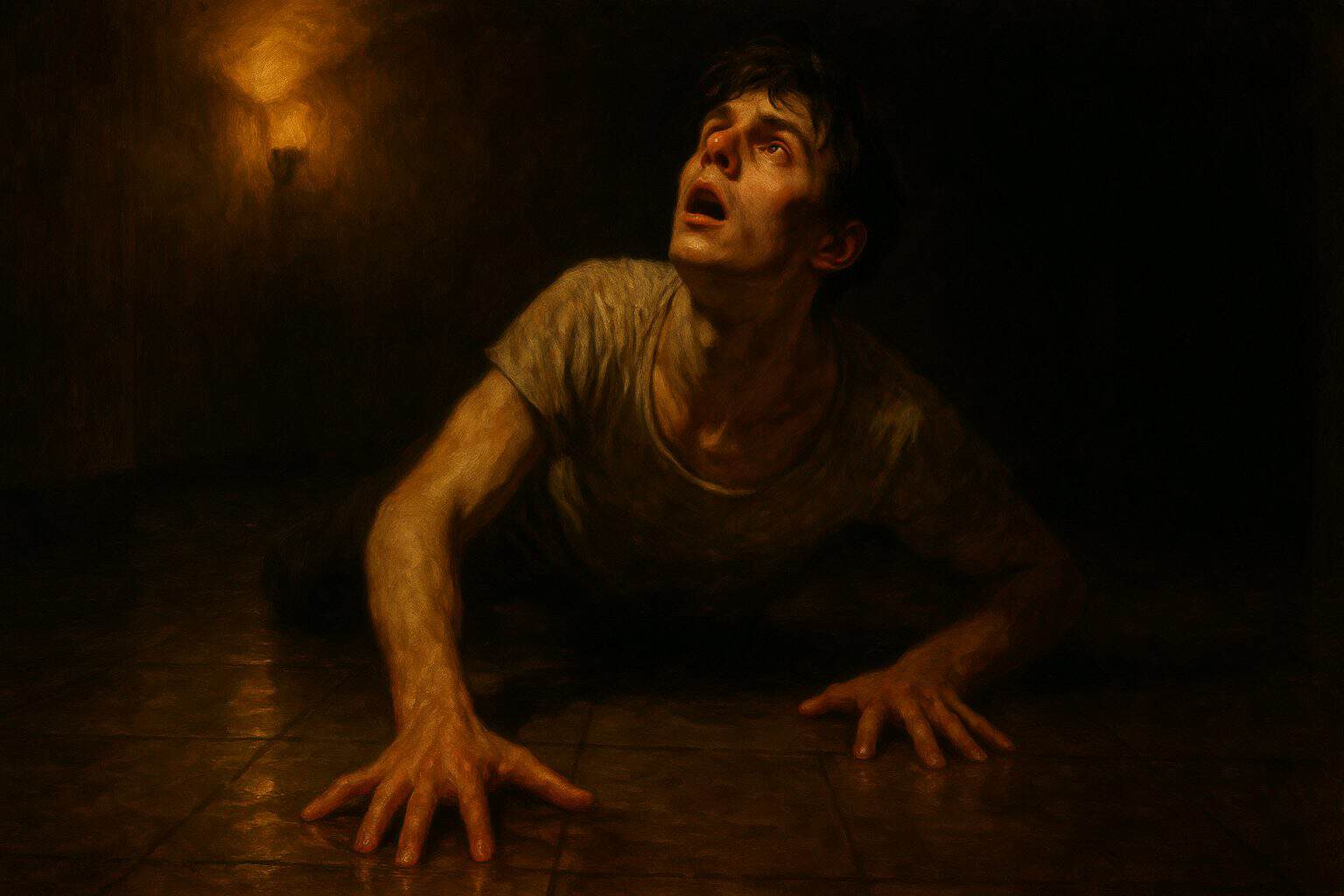
In Fractions of the Soul, Adoré describes crawling to a communal shower, “unable to walk… world spinning, figuring cold water might help sober me up.” But the spinning world he names is more than physical disorientation. It is the Stimmung of a consciousness discovering its own groundlessness, the dizzying recognition that beneath every choice lies another choice, and beneath that another, with no bedrock anywhere. The body crawling across institutional tile becomes the perfect image for how we move when the usual supports—habit, expectation, the comfortable prison of routine—suddenly give way.
This vertigo appears again in those moments of moral rupture: “‘Oh no. What did we just do?’ I thought—disoriented after being thrown back into reality, pleasure and guilt intertwined.” The disorientation he names is not confusion about facts but something more fundamental—the sudden visibility of oneself as the author of one’s actions, with no excuse, no alibi, no refuge in “it just happened.” The pleasure and guilt intertwine because they emerge from the same source: the terrible dignity of having chosen.
The Arrest
Yet freedom in Adoré’s lived world is never pure spontaneity. It arrives always in relation to limit, to boundary, to what Merleau-Ponty might call the resistant texture of the world. Consider how he describes a moment with Ms. D’Angelo: “she arrested my momentum with a gentle hand movement—a restraint like a sea wall holding a wave before its crash.” The image is precise—not a wall that blocks but one that holds, creating a space where the wave gathers its own force, becomes aware of itself as force.
This arrest is not the opposite of freedom but its necessary companion. “With Ms. D’Angelo, I experienced a freedom and an acceptance I had not known before… I felt seen without being exposed—a new arrangement I could tolerate.” The freedom emerges precisely through the boundary, through being held in a gaze that neither possesses nor abandons. It is freedom discovered not in limitless possibility but in the particular shape of this encounter, this restraint that paradoxically releases.
The Wound of the Possible
“My spirit writhed in futile protest before collapsing, succumbing to a new desolate sorrow… the disorientation of being thrown back into the world…”
The abyss of possibility opens as wound. Adoré’s memoirs return obsessively to moments of spiritual rupture—”I could not feel Him anymore; was it all a dream?”—where the loss is not of something possessed but of a presence that had made the world coherent. The wound is precisely the discovery that this coherence was contingent, that it could be otherwise, that even the most profound spiritual experience exists in the realm of the possible rather than the necessary.
Yet he refuses the temptation to flee this wound through false necessity. “I chose the ache I knew over the grace I did not, held in place not by virtue, but by that very ghost of hope.” The choosing continues even in desolation. Even clinging to familiar pain rather than unknown grace remains a choice, remains an exercise of that terrible freedom that will not release us even when we beg for release.
The Divine Economy of Freedom
In Confessions to the Empty Chair, Adoré develops a theology of freedom that illuminates its lived structure. “Love is free—free to accept or reject. It cannot be coerced, manipulated, purchased through compliance, or sustained by obligation.” But this is not abstract doctrine. It emerges from the lived experience of discovering oneself as neither automaton nor sovereign, but as this strange being suspended between determination and possibility.
“God did not create automatons,” he insists, “beings incapable of self-determination who mechanistically follow orders without a second thought to the contrary.” The divine economy itself operates according to this principle: “He seeks willing hearts, not automatons.” Even God, in Adoré’s phenomenology, respects the boundary of human freedom, approaching always as invitation rather than compulsion.
This theological insight illuminates why freedom arrives as both gift and burden. “The moment something has freedom is the same moment that it can”—the manuscript breaks off, but the completion is clear: the moment it can refuse, can turn away, can choose its own destruction. Freedom and fallibility are not accidentally but essentially connected.
The Territory of Mind
“My mind constituted the only territory I truly controlled, and I refused to let it be infected by secondhand haze.” Here Adoré names a particular refuge—not from freedom but for it. The mind becomes the space where freedom can be exercised even when external circumstances constrain. Yet even this territory is not simple possession. “The belief any woman could ensnare my heart with her body is and was ludicrous. The notion that my mind and spirit were weak enough… was an insult.” The insult is precisely the suggestion that this inner territory could be taken without consent, that freedom could be simply overwhelmed by force or seduction.
But maintaining this territory requires constant vigilance, constant choosing. It is not a fortress but a practice, a repeated assertion of sovereignty over one’s own consciousness even as that consciousness discovers its own contingency.
The Horizon of Limitation
“We cannot choose to transcend the threshold of human limitations… We cannot choose to become something other than ourselves.” This recognition does not diminish freedom but specifies its domain. Freedom operates within what Heidegger calls Geworfenheit—thrownness—the irreducible fact of finding ourselves already in a world, already with a history, already limited by body, time, circumstance.
“For the first time, my hunger made sense. I was not lost; I was arriving.”
The hunger that makes sense is not satisfied but understood—recognized as the very structure of human existence, the perpetual reaching beyond what is given toward what might be. To be lost and to be arriving become the same movement seen from different angles. Freedom is not the absence of hunger but its conscious embrace, the choice to be this hungry being rather than to “resign ownership over personal freedom, choice, and responsibility to others, ignoring death and finitude.”
The Strange Relief
Return to that initial moment: “I felt a strange, terrifying relief wash over me. I did not have to calculate. I did not have to strategize. I simply had to be.” The relief is strange because it arrives through surrender—not the surrender of freedom but surrender to freedom, to the simple terrible fact of existing as this choosing being. The calculations and strategies were attempts to manage freedom, to make it bearable by reducing it to technique. Their dissolution reveals freedom in its raw form: not as power but as exposure, not as mastery but as the acceptance of one’s own groundlessness.
This is what Sartre means by angoisse—not fear of something specific but the dizziness of recognizing oneself as the source of values in a world that provides no ultimate justification for any choice. Yet in Adoré’s lived experience, this anguish carries within it a strange peace. To “simply be” is not to escape choice but to cease fighting against the chooser one is.
The Arrival
“For the first time, my hunger made sense. I was not lost; I was arriving.” The arrival is not at a destination but at an understanding—the recognition that the hunger itself is the human condition, that the sense of being lost is inseparable from the movement toward finding. Freedom lives in this tension, this perpetual approach that never quite reaches, this hunger that defines us more essentially than any satisfaction could.
In Adoré’s phenomenology, freedom and dread are not opposites but intimates. They arise together in those moments when the usual world loosens its grip and we glimpse the abyss of possibility beneath every solid-seeming surface. The dread is real—who would not tremble before such responsibility? But so is the strange exhilaration of discovering oneself as more than mechanism, more than the sum of one’s conditioning.
The abyss of the possible yawns beneath every moment, visible only when we dare to look. Adoré’s memoirs become a record of such looking—neither celebrating nor lamenting but simply describing how it feels to live as this kind of being, suspended between the given and the chosen, forever arriving at what we already are.